
How Small Businesses Can Test Product Ideas With 3D Printing

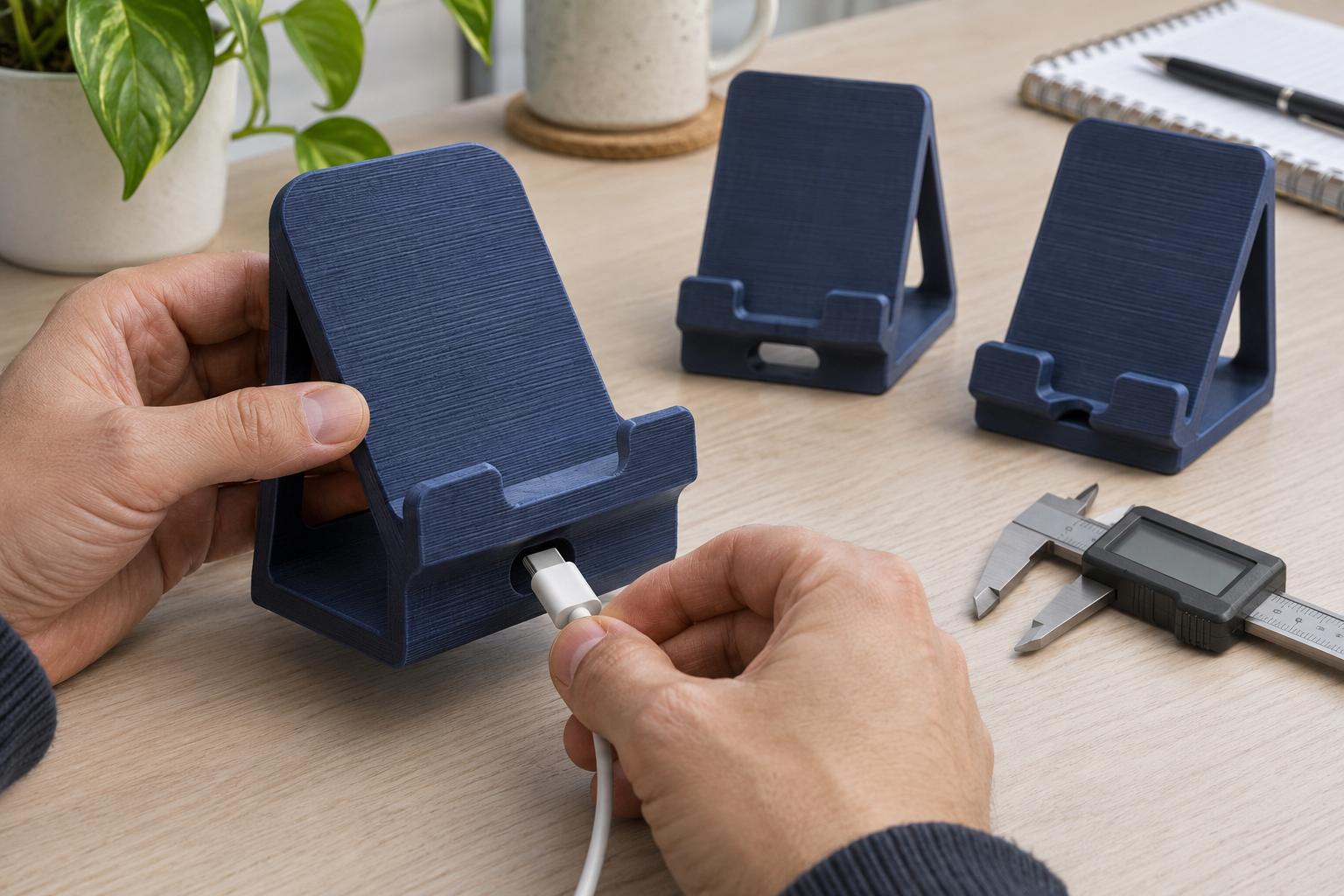
A product rendering cannot tell you whether a charging cable will fit behind a phone stand. That small detail may only become obvious when someone tries to use a physical sample.
For a small business, discovering such problems before ordering inventory can change the next purchasing decision. Desktop 3D printing offers a way to make samples, investigate design assumptions, and decide what deserves further investment.
The useful output is evidence. A prototype should help a team answer a defined question about fit, usability, or assembly. It should also make clear which questions remain open.
Separate the design question from the sales question
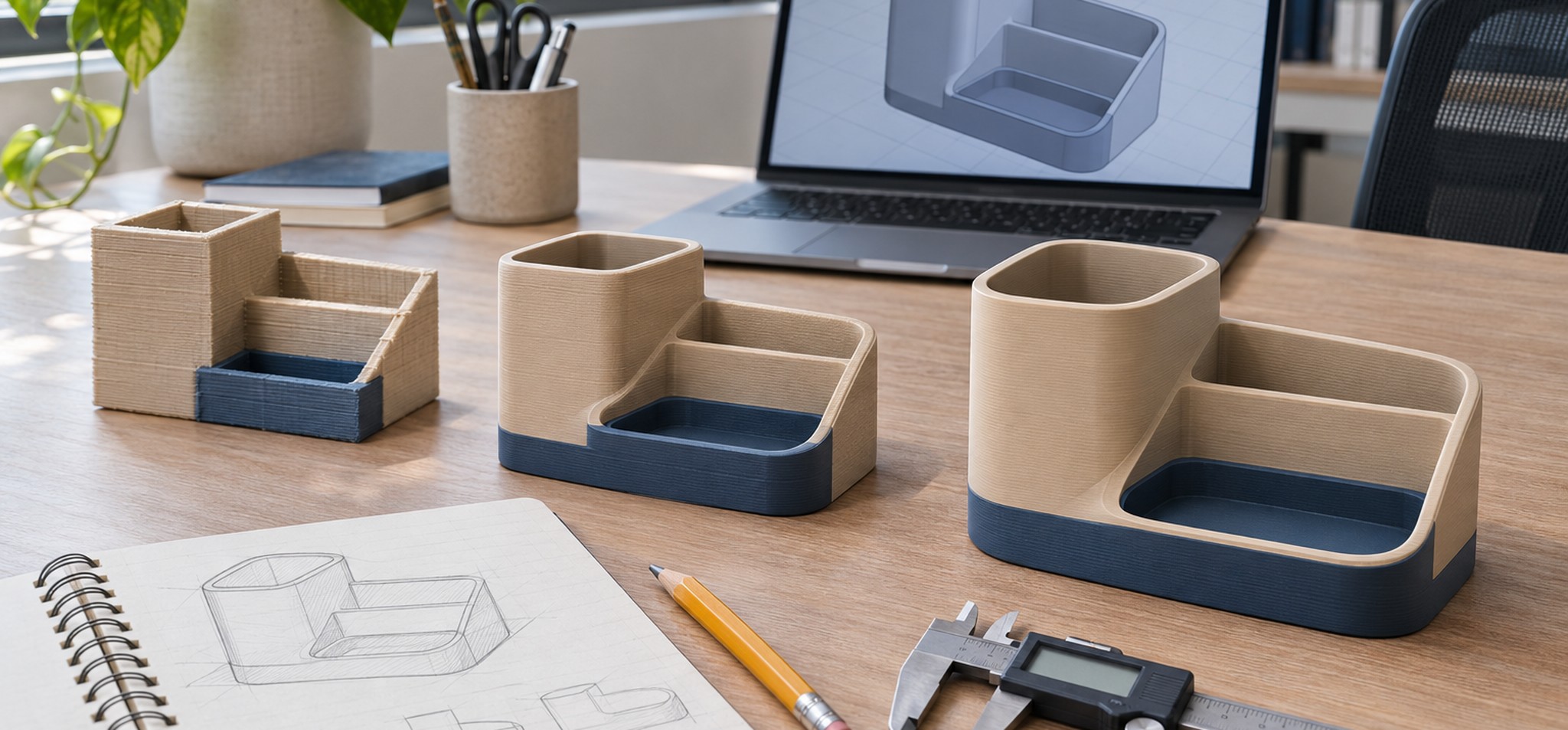
Imagine a small company developing a modular desk organizer for compact home offices. A printed sample can help establish whether the layout is convenient. It cannot, by itself, establish that customers will pay enough to support the business.
Keep usability and demand as separate workstreams. This prevents a successful print or an encouraging comment from being mistaken for a reason to order a large batch.
Define the next decision before making the sample
Write down what the prototype needs to reveal. For the desk organizer, the question might be whether a user can connect a charging cable with the phone in place, or whether the modules occupy too much working space.
Choose a criterion that can be observed. “The cable connects without moving the stand” gives a clearer test than “the design feels convenient.” Decide which result would justify a revision, further customer research, or a production quotation.
Build only the features needed for the test
A rough model with the correct dimensions may be enough for a layout study. A connector opening can be checked using a small section rather than a complete housing. Decorative surfaces can wait until the basic arrangement works.
When comparing Creality 3D printers, assess the parts you expect to produce, material requirements, workspace, maintenance, and operator time. If physical revisions are infrequent, a printing service may also be worth considering. Compare the complete workflow before buying equipment.
For a team moving from layout samples toward functional prototypes, the Creality K1C offers an enclosed design and a hardened steel nozzle tip, with support for selected carbon-fiber-filled filaments. That expands the materials a team can evaluate as testing requirements develop.
Use a straightforward material for early geometry checks, then select a compatible formulation for the properties the next test requires. Carbon-fiber-filled filament is not automatically the best choice for every part. Verify the material profile, drying requirements, print orientation, and finished sample against the test criteria.
Observe users completing an ordinary task
Give intended users a sample and the items they normally keep on their desks. Ask them to arrange those items and connect their phone. Avoid explaining every design choice in advance; that can hide confusing features.
Record what happens before interpreting it. “The participant put the phone beside the stand” is an observation. It could reflect an inconvenient opening, a preferred viewing angle, or something else. Ask follow-up questions and look for recurring patterns across relevant participants.
Count the work around the print
Filament cost is only one expense. Include preparation, machine operation, finishing, unsuccessful attempts, and purchased components when comparing prototype options.
For an illustrative calculation, 120 grams of filament at $25 per kilogram costs $3. Forty-five minutes of hands-on work valued internally at $24 per hour adds $18. The subtotal is $21 before machine operation and other expenses; it is not a complete production cost.
A smaller sample may answer the same question with less work. Compare the cost of each experiment with the decision it supports, rather than treating a low material cost as the whole business case.
Test the revision against the same task
Change the feature responsible for the problem and repeat the test. Keep the version number, material, print settings, and observations together. This makes it easier to tell whether the revision helped and prevents a team from losing the reason behind a design choice.
Investigate demand before committing to inventory
Once the layout works, explore how potential customers compare it with existing alternatives and what they would expect to pay. Describe the development stage accurately and distinguish general compliments from concrete purchasing interest.
Also check the economics at a plausible selling price. Packaging, fulfillment, customer support, defects, and sales costs belong in the calculation alongside the item itself. A convenient product can still be difficult to sell profitably.
Recheck assumptions when production changes
A printed sample may use a different material or manufacturing process from the final product. Changing either can affect dimensions, assembly, finish, and performance. Share unresolved questions with manufacturing partners and obtain the appropriate production samples before treating the design as ready.
If the business plans to sell printed parts directly, repeatability and inspection become separate tasks. One successful sample does not establish a reliable order capacity.
End each round with a decision: revise the design, investigate demand, obtain quotations, or stop. Used this way, 3D printing helps a small team make its next commitment with a clearer understanding of the product.






Comment