
How Robotic Palletizers and Packaging Machinery Improve End-of-Line Automation

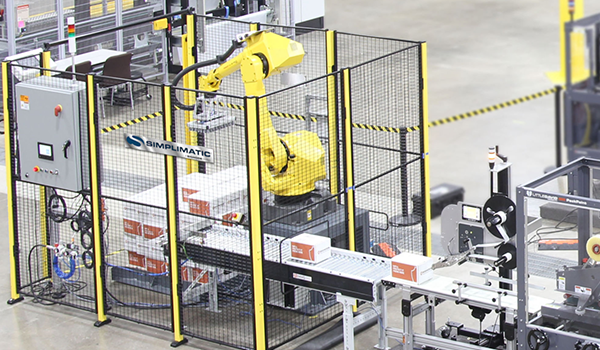
Current manufacturers are continually put under pressure to produce at a higher efficiency without compromising on the quality of the product or the cost of operations. Repetitive tasks at the conclusion of a production line like case packing, palletizing, product handling, and finished goods transfer can be significant time-consuming and labour-intensive challenges. Manual processes can be effective at smaller volumes, but can become challenging if production needs grow.
This is where automation can be integrated and make a big difference. A robotic palletizer can be used to automate the finished product moving and stacking process and modern packaging machinery can control downstream processes such as case packing. Combined, these systems can help manufacturers to establish a stable, flexible and efficient production flow.
Why End-of-Line Automation Matters
Often the final production stages are as significant as the production itself. Products must be packed, organized, moved to and/or ready for storage or transport. Products can build up and cause unnecessary delays if one stage is not able to keep up with the rest of the line.
One of the most challenging tasks in manual palletizing is that the operator might lift and place cartons, bags, cases or other products repeatedly during a shift. Handling many times will impact productivity and consistency.
Automation is one of the solutions that can help develop a process that is more reliable. Instead of every machine standing alone, manufacturers can integrate conveyors, case packers, palletizers, sensors and control systems into an integrated solution. Techflowbot also takes a holistic view instead of a “one machine after another” approach to end-of-line automation.
The Role of a Robotic Palletizer
The robotic palletizer is a machine that picks items off of a conveyor and automatically stacks them in a pattern programmed into the machine. The system can manage cartons, bags, shrink packs, bottles and other packaged products, depending on the application.
The primary benefit is uniformity. With a correctly set up robotic system, the same pattern of operation and stacking could be performed at every stage of the production without fatigue caused by the repetitive manual operation.
Modern palletizing systems can also be engineered to various payloads and production needs. Techflowbot’s collaborative palletizing arms come in five different sizes and models, ranging from 1 kg to 250 kg, and are available to handle cartons, bags, shrink packs, food products, chemicals, printing materials and furniture related products.
Choosing the Right Gripper
A gripper plays a crucial role in the palletising system. End-of-arm tooling is determined by the product weight, size, packaging material, surface and handling speed.
Depending on the smoothness of the package, it may be suitable to use a vacuum gripper, or a mechanical or pneumatic gripper may be more suitable for heavier or more flexible packages. The flexible gripper design may also allow for the easier support of multiple product types on a single production line.
Packaging Machinery and System Integration
Palletizing is just a part of an automated production line. The palletizer must receive products from the upstream equipment at a constant flow. This is why packaging machinery, conveyors, sensors, and robotic equipment need to communicate effectively.
For instance, a packing line can initially collate products, load them into cases, seal or close the cases and then move the cases to the palletizing area. Then the palletizer can retrieve the finished cases and load them into the desired pattern on the pallet.
Systems that are not correctly synchronized can cause a slow machine to be a bottleneck for another machine. The end-of-line approach of Techflowbot is unique since it integrates product feeding, conveying, case packaging, robotic palletizing, outfeeding and pallet transfer into a coordinated process.
Flexibility for Different Production Requirements
The need for a product can seldom be altered. New products can be brought in, change package sizes, or several different specifications must be run on the same line.
Therefore, flexibility should be taken into account when choosing automation equipment. The single product configuration approach can be limiting as the business expands.
Recipe-based operation, easy reconfiguration of grippers, patterns for various pallets, and conveyor assembly flexibility can aid manufacturers to handle various products without redesigning the entire production line.
This is particularly beneficial in markets where the product formats and handling needs are diverse, like food and beverages, household chemicals, building materials, furniture, logistics and many more.
Improving Efficiency Through Integrated Automation
It’s not just about how fast a single robot is. The entire production process should be efficient. An optimally designed system can minimize unnecessary manual handling, enhance product flow and deliver more uniform end-of-line operations. Products can be identified by sensors and the control system, and conveyors ensure a controlled flow between machines.
Controlled centralization can also assist gear to adapt to varying situations. Coordinated controls can help to avoid product build-up when an upstream machine shuts down or a downstream conveyor is unavailable, and that can aid in troubleshooting.
Techflowbot’s own advice is to consider robotic systems as part of an overall system that should work with conveyors, sensors, packaging equipment, and other machines.
What Manufacturers Should Consider
Manufacturers need to consider a few things before getting into an automated system:
- Profile and size of the product.
- Package size and form of packaging
- Required production capacity
- The size and arrangement of pallets.
- Dimension and arrangement of pallets.
- Available floor space
- Existing conveyor and packaging equipment
- Needed to be flexible for future products
- Gripper and tooling needs
- The requirements for safety and control.
- The installation, commissioning and after-sales service.
A complete assessment helps ensure that the selected system fits the actual production environment instead of focusing only on specifications such as robot speed or payload.
Conclusion
Robotic Palletizing and Automated Packaging can be a viable solution to enhance end-of-line production for manufacturers. A robotic palletizer can provide good product consistency in stacking,while integrated packaging machinery can help maintain a smoother flow from case packing through pallet transfer.
An ideal solution is to think of the entire production chain. By integrating conveyors, packaging machines, sensors, robots, and control systems into an integrated system, manufacturers can create systems that are more flexible, efficient, and quickly adaptable to the changing needs of production.
End-of-line automation isn’t always the fastest single machine solution. It is the system that is designed to accommodate the product, production quantity, space, existing equipment and future operation objectives.






Comment