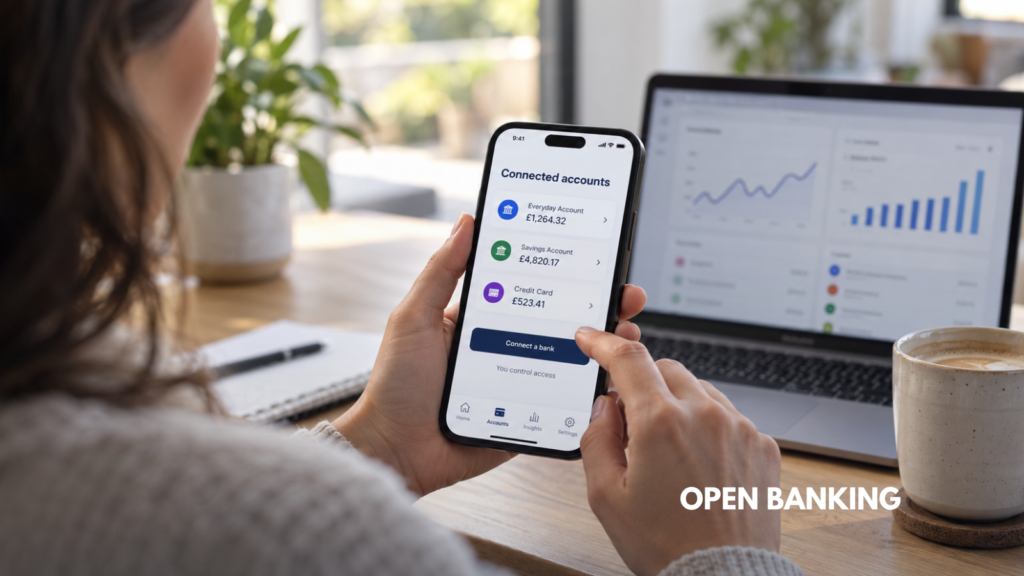
Somewhere on your phone there is probably an app that knows your salary arrived two days early, that your energy bill crept up 12 percent, and that you keep paying for a streaming service you stopped watching in March. That quiet familiarity is the consumer face of open banking. The expectations behind it are now measurable: 82 percent of US adults say they expect to see all of their financial data in one place, according to consumer research from MX published in October 2025. What began as a regulatory project about open banking opportunities for consumers has turned into an assumption about how money management should work.
The supply side is keeping pace with the expectation. In the UK, the most mature open banking market, 15.1 million people and businesses used services built on shared account data in July 2025, close to one in three adults. This article walks through where the consumer gains actually sit, from aggregation to payments to credit, and where the friction still lives.
From bank statements to a live financial picture
Before open banking, a consumer’s financial life was scattered across institutions that did not talk to each other. Seeing the whole picture meant logging into four apps or, worse, downloading statements. Data sharing through standardized APIs collapsed that work into a single consent screen.
The appetite for that consolidation is strongest among younger users. In MX’s survey of more than 1,000 US adults, 44 percent overall said the ability to share their financial data with third party providers for better services is important. Among Gen Z the figure climbs to 64 percent, and among Millennials it reaches 66 percent. The generation entering its peak borrowing years treats connected accounts as the default.
Willingness to share is rising even among cautious users. Nearly six in ten consumers, 59 percent, say they will share financial data as long as they trust it is securely protected, up ten points in a single year according to MX. Trust, not technology, is the variable that moves adoption.
Where open banking opportunities for consumers show up first
The most visible gains arrive in three places: seeing money clearly, moving it cheaply, and proving things about it quickly. Each maps to a different open banking service, and each already operates at scale rather than in pilot programs.
Aggregation came first. Budgeting tools, savings apps, and bank dashboards use account information services to pull balances and transactions together, and that category still generates about 80 percent of UK open banking API traffic, according to Open Banking Limited. The July 2025 data recorded more than 2 billion API calls in a single month.
Payments are the fastest growing layer. Payment initiation lets a consumer pay a bill, a merchant, or a tax office directly from a bank account without a card. UK payment initiation traffic rose 66 percent year on year, and payment users now make up 55 percent of all open banking users, a reversal from 2021 when data viewing dominated.
Cheaper payments with more control
The consumer benefit in payments is partly invisible: lower merchant costs eventually feed through to prices and rewards. The visible part is control. Variable recurring payments, a UK innovation, let a customer authorize flexible payments within limits they set, a smarter version of the direct debit.
The card comparison makes the stakes concrete. A typical card payment passes through an issuer, a network, and an acquirer, each taking a slice and each adding a day or more to settlement. An open banking payment travels from account to account in seconds with a fraction of the intermediaries. Consumers rarely see those mechanics, but they feel the results in faster refunds, instant top ups, and merchants passing through savings as discounts for bank payment options.
Regulators are treating that as mainstream infrastructure. The Financial Conduct Authority reported in December 2025 that open banking payments grew 53 percent year on year and that variable recurring payments already account for 16 percent of all open banking transactions, per the FCA’s year of progress review. A new industry scheme formed by 31 firms is expected to send its first live commercial payments in early 2026.
For households with irregular income, flexible payment schedules matter more than convenience. A gig worker can set a rule that pays a utility company more in strong months and the minimum in weak ones, without missing a payment or renegotiating a contract each time. That kind of arrangement was impractical under fixed direct debits.
Credit decisions built on real data
Credit is where shared account data changes outcomes rather than just experiences. A lender that can read verified transaction history, with consent, does not have to rely on a credit file that may be thin, stale, or blind to income. Renters, freelancers, and recent immigrants are the classic beneficiaries.
Affordability checks powered by account data are already standard among UK and European digital lenders, and US platforms use aggregated data the same way. TechBullion has covered how this feeds product design in its report on how fintech is changing personal loans and credit cards, where transaction based underwriting supports faster approvals and dynamic limits.
The same verification rails speed up ordinary life admin. Proving income for a rental application, confirming a bank account for a marketplace payout, or passing an identity check for an age restricted service can each ride on a single API call. Open Banking Limited noted that UK identity verification demand rose sharply in mid 2025 after new online safety rules took effect.
Money management that acts, not just reports
The first generation of budgeting apps told users what they had already spent. The current generation intervenes. Sweep rules move spare cash into savings the day after payday. Bill monitoring flags a price rise and drafts the cancellation. Round up features convert card spending into investments.
These behaviors depend on continuous data access, which is why API volumes keep compounding. Every automated saving rule or subscription alert queries an account repeatedly. The UK’s 2 billion monthly API calls are, in effect, millions of small decisions being made on consumers’ behalf under their consent.
The next layer is already visible in embedded products. Financial features now appear inside shopping, travel, and payroll apps rather than standalone tools, a shift TechBullion examined in its analysis of embedded finance in the US. Open banking supplies the verified data those embedded features need to work safely.
More switching power, less lock in
Account data portability weakens the oldest force in retail banking: inertia. When a consumer’s transaction history can travel, a competitor can make a concrete counteroffer, a real rate on real balances rather than a generic promotion. Comparison services can price a mortgage or an overdraft against actual behavior.
Consumers appear ready to use that power defensively too. MX found that more than four in ten US adults would likely stop using a financial provider that restricted their ability to share data with a trusted third party. Data access has become part of how customers judge a bank, alongside fees and app quality.
The competitive effects reach beyond banks. Payment companies, retailers, and platforms all compete for the checkout and the customer relationship, and account to account rails give challengers a cost structure card networks cannot match, a dynamic explored in TechBullion’s piece on fintech simplifying global payments.
Small businesses collect the same dividends
The consumer story extends to the smallest businesses, which behave financially more like households than corporations. A sole trader connecting a business account to accounting software eliminates hours of manual reconciliation each month. Cash flow forecasting tools read incoming and outgoing payments to warn about shortfalls weeks in advance.
Lending is the sharpest gain. Small firms have historically been expensive to underwrite because their financials were opaque, so banks often declined rather than investigated. Consented access to transaction history gives lenders a live view of revenue, seasonality, and existing commitments, which shortens decisions from weeks to hours and brings marginal borrowers into scope.
Payment collection closes the loop. Invoices sent with a pay by bank link settle faster than those waiting for a manual transfer, and the funds arrive with clean reference data. For a business managing tight working capital, cutting three days off receivables is worth more than most software discounts.
Security and the trust dividend
Open banking replaced a genuinely risky practice. Before regulated APIs, consumers who wanted connected tools handed over their online banking passwords to screen scraping services, which then logged in as them. Consent based APIs ended that trade: credentials stay with the bank, access is scoped to specific data, and consent can be revoked from a dashboard.
Strong customer authentication adds a second layer. Every consent is approved inside the bank’s own app with biometrics or a passcode, which means a third party never holds the keys to the account. Fraudsters can still trick people into authorizing payments, but they cannot silently harvest credentials from a connected app the way they could from a password database.
That architecture is why trust numbers keep improving. The ten point rise MX measured in willingness to share data tracks the industry’s security record more than its marketing. Each year without a major API breach makes the consent screen feel less like a risk and more like a routine permission, similar to granting an app access to a phone’s camera.
How to put it to work today
For a consumer who has never knowingly used open banking, the practical entry points are ordinary. Most major banking apps now offer to show accounts from other banks, which uses account information APIs under the hood. Tax authorities and councils in several countries accept pay by bank options that settle instantly and skip card fees.
The second step is an audit. Anyone who has used budgeting apps, loan applications, or payment tools over the past few years likely has standing consents attached to their accounts. Checking the bank’s consent dashboard, where available, shows exactly which services still read data and lets users prune the list in seconds.
The third is comparison. Because providers can now price against real transaction data, quotes for credit, mortgages, and even energy tariffs built on shared data tend to be sharper than generic offers. Consumers who share more, selectively and with regulated firms, generally see better terms than those who share nothing.
The friction consumers still face
The gaps are worth naming. Consent screens vary in clarity, and some users cannot say which services still hold access to their accounts. Regulators are pushing dashboards that list active consents, but coverage is uneven across banks and markets.
Fees are a live battleground, especially in the US. MX’s research found 48 percent of consumers would be unlikely to connect external accounts to their primary bank if a fee applied. Any pricing model that charges consumers directly for their own data risks stalling adoption before it matures.
Protection rules also trail usage. Card payments carry decades of chargeback practice. Account to account payments are faster and cheaper, but the rules for reimbursing a defrauded customer are still settling in several markets. Until they harden, consumer groups will keep advising caution for high value payments.
What to watch next
Three developments will shape the consumer experience over the next two years. First, commercial variable recurring payments in the UK will test whether flexible bank payments can replace both direct debits and stored cards at scale. Second, US rulemaking will determine whether data access there is a right, a product, or both. Third, open finance frameworks will pull pensions, insurance, and investments into the same consent screens that banking data uses today.
Each of those developments compounds the value of the data consumers already share. A consent framework that covers a whole financial life, not just a current account, turns comparison, switching, and automated advice into everyday features rather than premium services.
The consumer’s job in the meantime is simply discernment: share with regulated providers, check consent dashboards occasionally, and treat any service that asks for a banking password rather than a redirect to the bank’s own app as a red flag. The regulated path is now both the safer and the more capable one.
The most telling number may still be the simplest one. When a third of a country’s adults use services built on shared bank data, most without knowing the term for it, the opportunity has stopped being theoretical. The next 15 million users will arrive without noticing anything new at all.