
How OEM and Data Center Buyers Should Evaluate a Fiber Optic Patch Cord Manufacturer

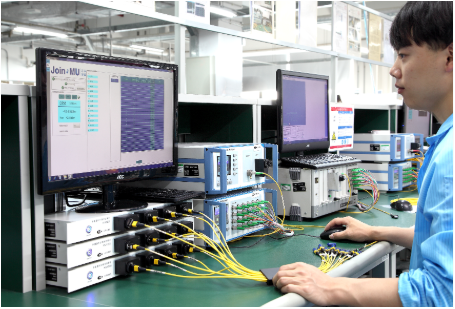
Choosing a fiber optic patch cord manufacturer can look straightforward when several suppliers offer the same LC, SC or MPO configurations. Send an RFQ, compare insertion loss, test a few samples and negotiate the price. The real differences often become visible later, when a project moves into volume production and the buyer needs the same optical performance across thousands of assemblies.
For OEMs, distributors and data center solution providers, supplier evaluation therefore needs to go beyond the catalog. Two patch cords may use the same connector type and fiber specification while differing in ferrule quality, termination, polishing, end-face control, testing and production consistency.
A better sourcing process follows the purchasing journey itself: first make quotations comparable, then verify whether sample performance can be reproduced in volume, look deeper when sourcing multi-fiber assemblies, and finally consider whether the supplier can support future project requirements.
Make the Quotations Comparable First
A 10% or 15% price difference naturally attracts attention when annual purchasing volumes are high. But before using the lowest quotation as the benchmark, buyers need to confirm that every fiber optic patch cord supplier is quoting against the same construction and performance requirements.
For an LC patch cord or SC patch cord, the RFQ should go beyond connector type and cable length. Fiber type, cable construction, connector and ferrule requirements, insertion and return loss criteria, end-face requirements, testing methods, labeling, packaging and expected order volume all affect what is actually being quoted.
The same principle becomes even more important when comparing customized assemblies. The Fiber Optic Association (FOA), for example, points out that what is commonly described as connector loss is actually the connection loss of a mated pair. Its guidance also shows why a loss figure needs to be understood together with the test method and reference conditions.
So when a quotation simply states “insertion loss ≤0.2 dB,” procurement still has several questions to ask.
| What to Compare | What to Ask the Manufacturer | Why It Matters |
| Insertion loss | What is the acceptance limit and test method? | Makes quotations technically comparable |
| Ferrule | What ferrule specification and material are used? | Influences fiber alignment and connection consistency |
| End face | How is the connector inspected after polishing? | Scratches and geometry issues can affect performance |
| Production | Are optical test results retained by batch? | Samples alone do not prove volume consistency |
| MPO/MTP | How are polarity, alignment and geometry controlled? | Multi-fiber assemblies require tighter process control |
| Traceability | Can an issue be traced to a production batch? | Important for recurring OEM orders |
This type of comparison gives procurement, engineering and quality teams a common basis for supplier evaluation instead of allowing price, optical performance and manufacturing capability to be reviewed separately.
A Good Sample Is Only the Beginning
A sample tells you what the factory was able to produce for one evaluation. It does not automatically prove that the same performance can be repeated across 5,000, 10,000 or more fiber optic patch cords.
That distinction matters for OEMs and distributors placing recurring orders. Before moving into volume purchasing, buyers should understand what happens behind the sample: incoming material control, ferrule inspection, fiber termination, polishing, end-face inspection, optical testing and batch traceability.
“100% tested” by itself is not enough information. A more useful discussion is: What parameters are tested? What are the acceptance limits? Are results retained? How are non-conforming assemblies handled? Can a failed product be traced back to its production batch?
For long-term sourcing, these answers can tell buyers considerably more than another product catalog.
It is also worth understanding which processes the manufacturer actually controls. A capable fiber optic patch cord manufacturer does not necessarily need to manufacture every raw component internally, but it should be able to explain where critical components come from, which production steps are controlled in-house and how finished assembly performance is verified.
This is also where broader manufacturing capability can simplify supplier qualification. T&S Communications, for example, supports fiber optic connectivity from components and connectors through to finished cable assemblies. For buyers evaluating T&S as a fiber optic patch cord manufacturer, this makes it possible to review connector-level requirements, termination, assembly and finished optical performance as part of the same sourcing discussion.
That becomes increasingly valuable when a relatively simple LC or SC requirement develops into customized or multi-fiber assemblies.
MPO Projects Need a Deeper Supplier Review
Supplier qualification becomes more demanding when a project moves from LC and SC assemblies to an MPO cable.
Multi-fiber connectivity introduces additional considerations because several fibers must connect through one compact interface. Ferrule geometry, fiber alignment, polarity, polishing and finished assembly performance therefore become more important.
This is especially relevant when sourcing an MPO trunk cable for high-density data center cabling. Instead of asking only for insertion-loss data, buyers should understand how the manufacturer controls the MT ferrule, polishing process, polarity and finished assembly inspection.
For organizations evaluating T&S for high-density connectivity, its MPO cable capabilities can therefore be assessed not only by product configuration, but also by how multi-fiber assemblies are manufactured, inspected and tested.
Useful questions include: Where are the MT ferrules sourced? How is ferrule geometry controlled? How is polarity verified? What inspection takes place after polishing? Are finished MPO assemblies tested individually?
Procurement teams do not need to become ferrule engineers. The purpose of these questions is to determine whether the supplier understands the manufacturing variables behind the specification it is quoting.
There is also a commercial reason to investigate this capability early. An initial MPO requirement can develop into different fiber counts, polarity methods, breakout configurations, customized lengths and pre terminated fiber optic cable assemblies.
Qualifying these capabilities before volume purchasing can reduce the need to restart supplier qualification every time a data center architecture changes.
Think Beyond Today’s LC and SC Requirements
The immediate project should always come first. If you need an LC or SC assembly today, the supplier must first demonstrate that it can manufacture that product consistently.
But OEM and data center buyers should also consider where their connectivity requirements are heading.
A distributor buying high volumes of LC patch cord and SC patch cord products today may already be receiving requests for higher-density MPO/MTP deployments. An OEM supporting 100G or 400G equipment may be planning systems around higher-speed architectures.
IEEE 802.3df-2024 reflects this broader transition by defining physical-layer specifications for 400 Gb/s and 800 Gb/s Ethernet. For procurement teams, the practical implication is not that every current project immediately needs 800G connectivity, but that fiber density, cabling architecture and interface requirements are continuing to evolve.
That does not mean every fiber optic patch cord supplier needs to manufacture optical transceivers or every emerging connector format. A more useful question is whether the supplier has enough manufacturing depth and engineering capability to support the direction of the buyer’s own projects.
If future requirements may include MPO/MTP assemblies, higher fiber counts, breakout configurations or pre terminated fiber optic cable assemblies, it is easier to discuss those capabilities during initial qualification than to rebuild the supply chain later.
Use the RFQ to Test the Supplier
One of the most useful supplier-evaluation tools appears before a purchase order is ever placed: the RFQ. Instead of sending “Please quote MPO cable, best price,” send the same structured requirement to each shortlisted supplier.
For an MPO cable or MPO trunk cable, that might include connector configuration, fiber type, fiber count, polarity, cable construction, length, insertion-loss requirement, application, expected annual volume, testing requirements, labeling and packaging. Then evaluate more than the final number. Does the supplier notice missing technical information before quoting? Does it ask how the assembly will be used? Can the engineering or sales team explain configuration differences? Does the quotation clearly identify what is included? Are technical questions answered clearly, or does every discussion immediately return to price?
For customized OEM and data center projects, these responses are part of supplier capability because the same communication process will be needed when specifications change, a customer requests a new configuration or a production issue needs to be investigated.
A detailed RFQ also makes price comparison more meaningful. Once every shortlisted fiber optic patch cord supplier is quoting against the same construction, optical requirements, testing methods and volume assumptions, procurement can negotiate with much greater confidence. The goal is not to make price less important. It is to make sure the prices being compared actually represent the same requirement.
Choose a Manufacturer That Makes Repeat Orders Easier
The first purchase order is only one stage of supplier qualification.
For OEMs, distributors and data center solution providers, the longer-term question is what happens afterward: whether repeat orders maintain the agreed specification, whether production records are available when needed, whether customized requirements can be communicated efficiently and whether the manufacturer can support new configurations as projects evolve.
A reliable fiber optic patch cord manufacturer should ultimately demonstrate three things: the finished assembly meets the required optical performance, the manufacturing process can reproduce that performance at volume, and the supplier has enough engineering and production capability to support future requirements.
This is where a broader optical connectivity portfolio can become useful. T&S Communications supports connectivity requirements ranging from fiber optic connectors and precision subcomponents to LC patch cord, SC patch cord, MPO cable, MPO trunk cable and pre terminated fiber optic cable assemblies. For OEM, telecom and data center projects, that breadth allows current requirements and possible future configurations to be considered during the same supplier qualification process.
Once those points are established, price negotiation becomes more productive. Procurement is no longer comparing numbers attached to loosely defined products; it is comparing suppliers against the same product specification, testing requirements and expected service level.For B2B buyers, that is usually a much stronger foundation for a long-term supply relationship.






Comment