
When design must explain, motion leads
Technology companies invest enormous effort into building features, models and interfaces — and then often run into the same problem: customers don’t grasp what the product does or why it matters. In that gap between creation and comprehension, motion design can be more than decoration. It becomes a communication discipline that converts technical capability into a story an audience can follow.
Serhii Kerkez has spent more than a decade working at that intersection of product and picture. As a motion designer and video editor, his practice combines animation, editing, direction, product design and art direction so that the visual work answers a business problem: how to make complex digital services immediately legible to a prospective user.
From engineering to motion: a systems approach
Kerkez’s background is unusually systematic for a visual professional. He earned both bachelor’s and master’s degrees in mechanical engineering from the National Technical University of Ukraine “Kyiv Polytechnic Institute,” then completed professional training in graphic design and motion work. That combination of engineering rigor and visual practice informs an approach built around structure, hierarchy, repeatability and clarity.
“For me, the purpose of motion is not simply to make an interface feel more dynamic. It is to guide attention, reveal relationships, and help the viewer understand a product without unnecessary explanation,” Kerkez says. This idea — that motion should answer a question rather than only attract the eye — shapes how he evaluates every animation or edit.
ESAI: an AI product made visible
A clear example of Kerkez’s method is his work for ESAI, an AI-powered college guidance platform. He produced homepage animations for the product and edited the demonstration video that accompanied ESAI’s pitch on ABC’s Shark Tank — a presentation that resulted in an investment from Mark Cuban. Both projects required the same core task: translate a digital service into a concise visual story that an audience can instantly understand.
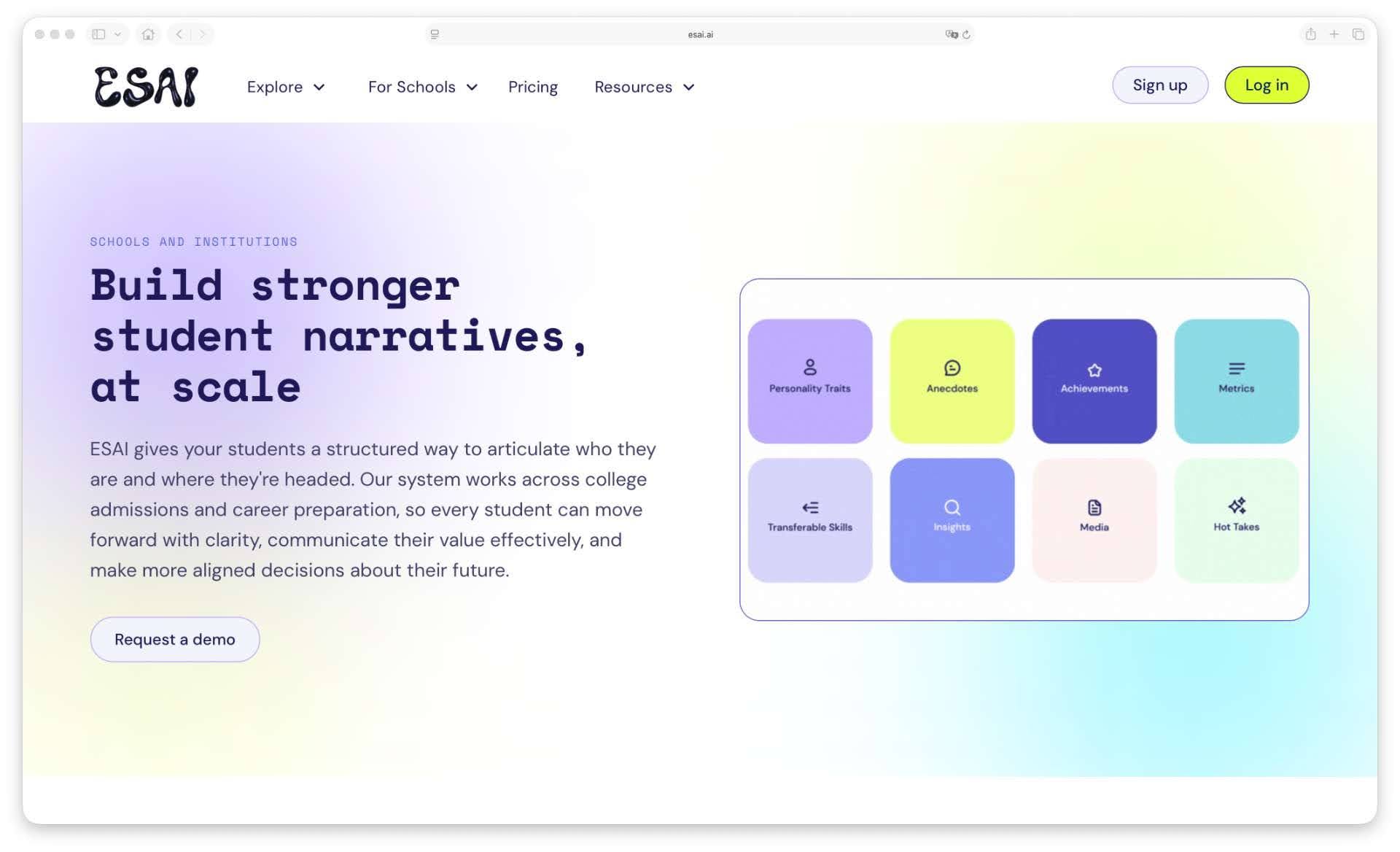
A product demonstration is not the same as a commercial. It must communicate a sequence of actions, preserve the logic of the interface and show the benefit without overwhelming the viewer. In practice that means deciding what to show, what to omit, and how to order the visual steps so a nonexpert can follow. For many AI products, the value only appears when viewers see an input, a transformation and a result — a sequence motion can make explicit.
Kerkez’s product-design experience helps him choose which interface elements prove the value and which details can be removed. His editing and motion experience determine pacing, emphasis and narrative flow. The homepage animation and the televised pitch served different environments — the former living inside an interface, often viewed silently and alongside text; the latter presented with sound and narrative context — but both relied on the same underlying visual logic.
Designing for multiple audiences and formats
One of the practical lessons of the ESAI work is that one product can require many versions of the same story. A coherent motion system lets teams reuse visual language across homepage animation, product demos, social content, tutorials and investor-facing videos. When motion is treated as part of the product system — not just as a one-off ad — companies gain consistency and speed: new assets can be produced without solving the same visual problems from scratch.
A system also changes how product, marketing and creative teams review work. Instead of debating whether an animation “feels” appealing, teams can ask whether it directs attention correctly, reflects the product accurately and adapts across channels without breaking the visual language. That makes creative decisions easier to explain and reduces the risk of fragmented brand expression across platforms.
Tools, AI and the continuing role of human judgment
Kerkez now works as a video editor at a New York-based company that develops AI tools for video creation. His responsibilities span editing and post-production, reusable motion systems, brand-motion guidelines, automated composition workflows, custom After Effects tools and AI-assisted production. The role mirrors a broader professional shift: motion designers and editors are less often creators of single videos and more often builders of systems that make ongoing production possible.
Generative AI can accelerate parts of that process, but human judgment remains central. “Technology can generate options, but it does not independently decide which detail deserves attention, when an explanation has become too long, or whether a visual choice supports the product’s identity,” Kerkez notes. AI may produce usable material, but professionals must select, integrate and refine generated assets so the final piece serves a clear audience and business objective.
The professional task includes rebuilding weak sections, controlling rhythm, ensuring brand consistency and connecting generated elements to designed systems. Speed is valuable, but speed without coherence can produce content that looks polished yet fails to communicate.
Motion design as product strategy
Kerkez’s work illustrates a larger change in how technology companies can think about motion design. When motion is integrated into product strategy — not added after launch — it helps audiences understand not only what a product looks like, but how it works and why it is useful. That integration means design, motion and video are no longer separate services; they are parts of a single communication system aligned to product and business goals.
As AI products grow more complex and content needs expand, companies will need creative professionals who can move between product thinking and audiovisual production. The strongest results will come from teams that build reusable motion systems, set clear review criteria and keep human judgment central to deciding what matters in any explanation.
For teams struggling to make their technology legible, Kerkez offers a practical starting point: define the communication problem first. Identify the single thing the audience must understand, choose the interface element that best proves that value, and remove everything that does not contribute to the explanation. Motion should then be used to guide the viewer through that proof, not to introduce new complexity.