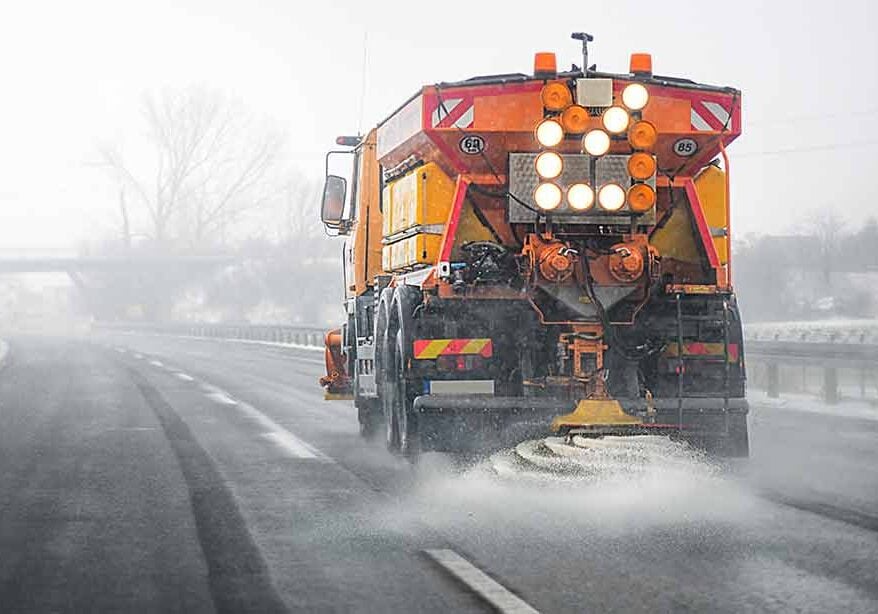
Estimating commercial snow removal starts with two numbers – how much pavement needs service and how much de-icing material it will take. Contractors typically measure parking lots, drives, loading areas and sidewalks, convert square footage into acres then calculate salt requirements using an application rate per 1,000 square feet. Accurate measurements help turn those quantities into a profitable snow bid.
Why Lot Acreage Matters in Snow Removal Estimating
A commercial snow contract can cover everything from a small office parking lot to a multi-acre retail center. The size of the property directly affects plowing time, equipment requirements, labor and salt consumption.
1 acre = 43,560 square feet.
So, if a parking lot measures 217,800 square feet:
217,800 ÷ 43,560 = 5 acres
That conversion gives contractors a quick way to understand the scale of a property. But land area alone isn’t enough.
A snow removal takeoff should separate the property into serviceable areas, such as:
- Plowable parking areas
- Drive lanes and access roads
- Loading docks
- Fire lanes
- Sidewalks and pedestrian paths
- Building entrances
- Accessible parking areas
- Snow stacking zones
- Areas requiring de-icing only
A 5-acre property with 4 acres of open parking and 1 acre of restricted or landscaped space shouldn’t be priced the same as a fully paved 5-acre site.
That’s why accurate measurements are the foundation of a reliable snow estimate.
How Do Contractors Measure Commercial Lot Acreage?
Traditionally, contractors measured commercial properties by visiting the site, walking boundaries, taking dimensions, and manually calculating areas. That approach works for a handful of properties but becomes difficult when dozens of RFPs arrive before winter.
Today, contractors can use aerial imagery and digital measurement tools to identify service boundaries without visiting every property.
The basic process is straightforward:
- Identify the commercial property.
- Outline the paved areas that require snow service.
- Measure each parking lot, driveway, and access area.
- Exclude landscaped areas and other non-serviceable surfaces.
- Measure sidewalks and pedestrian zones separately.
- Add the quantities to determine total serviceable square footage.
- Convert square footage into acres when useful for pricing and planning.
Modern snow estimate software can make this process considerably faster by automating measurements from aerial imagery. For contractors bidding multiple properties, that means more consistent quantities and less time spent drawing property boundaries manually.
How Do You Calculate Salt Tonnage From Lot Size?
Once you know the serviceable pavement area, the next question is how much salt you’ll need.
Salt is commonly estimated using an application rate expressed in pounds per 1,000 square feet.
The basic formula is:
Salt required (lb) = Area (sq. ft.) ÷ 1,000 × Application rate (lb/1,000 sq. ft.)
Then convert pounds into tons:
Salt required (tons) = Salt required (lb) ÷ 2,000
For example, suppose a commercial property has 217,800 square feet of plowable pavement, or 5 acres.
If your planned application rate is 800 pounds per acre, the calculation would be:
5 acres × 800 lb = 4,000 lb
4,000 ÷ 2,000 = 2 tons
The contractor would therefore budget approximately 2 tons of salt for that application.
The actual application rate should be based on your operating practices, pavement conditions, weather, product specifications, temperature, and customer requirements. Salt usage isn’t a fixed number for every property or storm.
Industry estimating guidance similarly recommends calculating salt based on lot size and an application rate, then adjusting for material type, labor, equipment, and local conditions.
What Changes the Amount of Salt You Need?
Two properties with identical acreage may require very different salt quantities.
Several factors can change your material estimate.
-
Pavement conditions
A shaded parking lot that regularly refreezes may require more de-icing attention than an open lot exposed to sunlight.
-
Temperature
Salt becomes less effective as temperatures fall, which may require contractors to change products, application rates, or treatment strategies.
-
Storm severity
A light snow event and a major storm don’t necessarily require the same treatment. Contractors should account for expected storm conditions when developing their material assumptions.
-
Traffic
High-traffic retail centers may need more frequent treatment because vehicles can compact snow and create icy conditions.
-
Service requirements
A property with a zero-tolerance approach to ice may require more aggressive treatment than a property with a standard de-icing specification.
-
Material type
Rock salt, treated salt, calcium chloride, magnesium chloride, brine, and blended products have different application requirements and costs.
Because salt prices and usage can fluctuate, contractors should avoid treating material quantities as an afterthought. They directly affect contract profitability.
How Do You Turn Acreage and Salt Into a Snow Bid?
Acreage and salt tonnage are inputs and not the final price. Once quantities are established, contractors typically build the estimate around:
Plowing + Labor + Salt/De-Icing + Equipment + Overhead + Profit = Bid Price
For plowing, calculate the expected equipment hours based on lot size, layout, snow depth, travel distance, and required service time.
For salting, calculate: Salt quantity × delivered salt cost per ton = material cost
Then add the labor and equipment required to load, transport, spread, and monitor the material.
Don’t forget costs such as fuel, equipment maintenance, insurance, overtime, mobilization, and administrative overhead. Commercial snow work often happens overnight, during weekends, or under tight response requirements, making labor and equipment assumptions particularly important.
Where Does AI Takeoff Software Fit In?
The biggest challenge isn’t knowing the formulas. It’s getting accurate quantities quickly enough to use them across every bid.
That’s where AI takeoff software like Beam AI can help.
Instead of manually measuring every parking lot, contractors can use aerial imagery and automated measurement workflows to capture areas, routes, sidewalks, and other service zones. Beam AI, for example, uses aerial imagery to measure snow service areas and produce quantity outputs for estimating.
This becomes especially useful when you’re bidding a portfolio of properties.
Rather than spending hours measuring 20, 50, or 100 locations individually, you can standardize the measurement process and apply the same estimating logic across every property.
Build More Defensible Snow Estimates
Commercial snow contractors don’t need to guess their way through acreage or salt requirements. Start with accurate service-area measurements, convert square footage into usable acreage, apply a documented salt rate and then build labor, equipment, overhead and profit around those quantities.
The challenge is doing that consistently when you’re working through a large pre-season bid list.
That is where snow estimate software can give contractors an advantage. By automating repetitive measurements and standardizing takeoff quantities, it can help you move from property measurements to bid-ready estimates faster, without sacrificing the detail needed to protect your margins.
And when winter RFPs start arriving all at once, faster estimating can mean one thing: more properties priced before your competitors get there.