
How Cloud HRMS Can Turn Payroll Data Into Strategic Business Insights

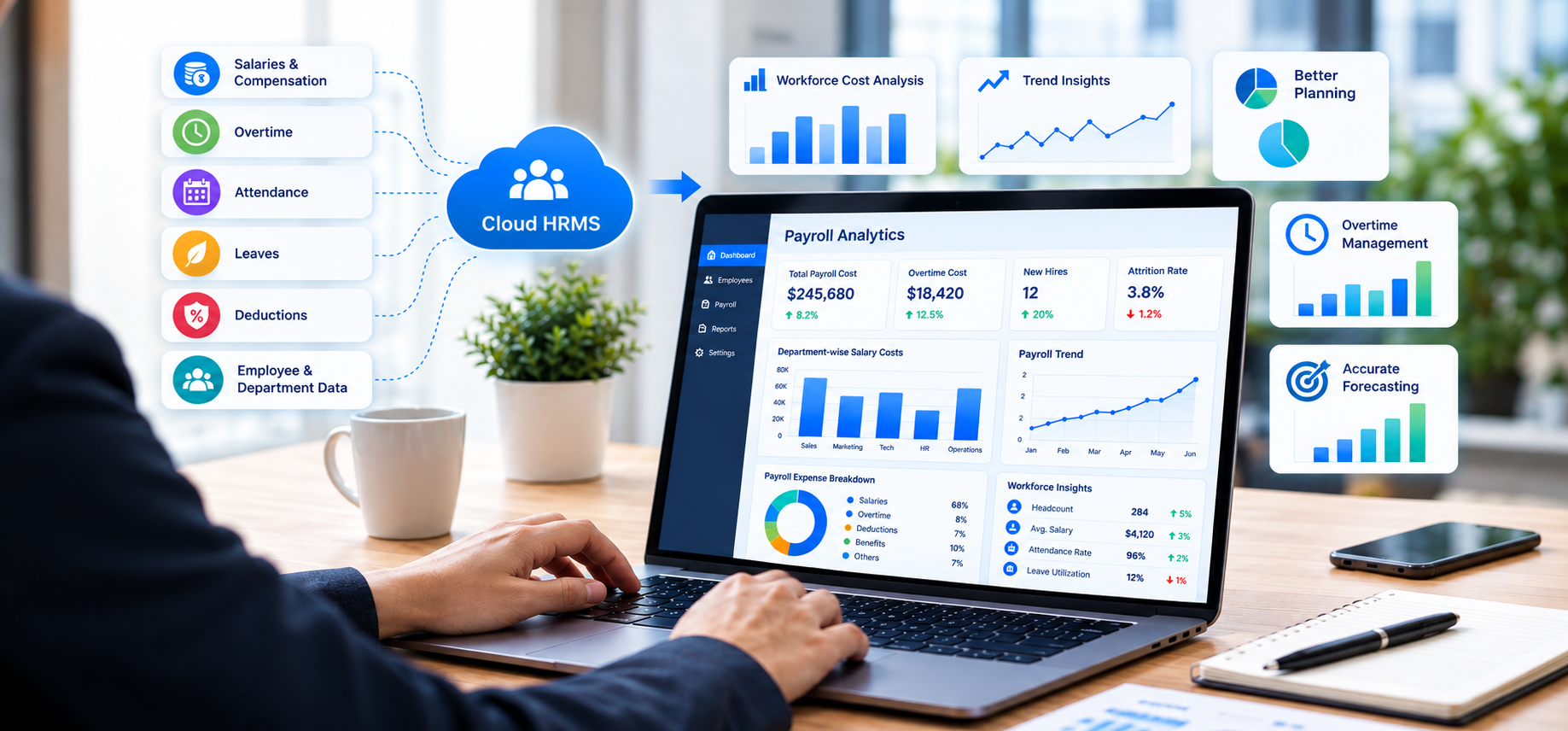
Payroll no longer involves merely the process of salary calculation and payment. There is a wealth of data associated with each payroll cycle concerning employee expenses, overtime, attendance, leaves, pay rates, deductions, and workforce dynamics. The efficient connection and analysis of such data can prove to be highly beneficial for a business in making its decisions.
This is the point at which the use of cloud HRMS becomes relevant. With the help of a cloud based HRMS, it becomes possible to analyze the data generated in payroll.
What Is Payroll Data Analytics?
The concept of payroll data analytics entails gathering, sorting, and evaluating payroll data to determine any patterns.
Businesses can analyze data such as:
- Employee salary costs
- Overtime expenses
- Attendance and absence patterns
- Leave trends
- Department-wise workforce costs
- Compensation changes
- Employee turnover costs
- Payroll discrepancies
- Workforce productivity indicators
Instead of viewing payroll as a monthly expense, organizations can use this information to understand where their workforce budget is being spent and how it can be optimized.
How Cloud HRMS Software Turns Payroll Data Into Insights
1. Provides a Centralized View of Workforce Costs
Payroll-related data tends to be linked to information about employee files, attendance, leaves, departments, designations, etc. Handling all this information through multiple Excel sheets and separate systems may prove to be a tough task to figure out the total costs incurred on the workforce.
An HRMS cloud-based software solution helps integrate all this information.
HR and management teams can get a clearer picture of:
- Total payroll expenditure
- Department-wise salary costs
- Overtime expenses
- Employee compensation trends
- Attendance-related payroll impact
This centralized visibility makes financial and workforce planning more informed.
2. Helps Identify Payroll Cost Trends
Payroll expenses may vary from month to month owing to new recruitments, resignations, promotion, overtime, bonuses, revised salaries, or attendance issues.
By studying the payroll expense records, companies can determine patterns that explain whether their work force cost increases or decreases.
For instance, when overtime expenses keep on growing in a specific department, management can consider hiring more people for that department or even check whether the workload is equally divided among its members.
This is just one advantage of analyzing payroll data since it allows companies to not only track their expenses but also discover their causes.
3. Supports Better Workforce Planning
Payroll records are rich sources of data for making future workforce decisions.
The combination of salary cost and number of employees, attendance, overtime, and departmental performance is useful to determine workforce needs.
For example, payroll trends may show that:
- One department is consistently understaffed.
- Another department has higher workforce costs than expected.
- Overtime is increasing because of workload pressure.
- Certain roles are becoming more expensive to maintain.
These insights can support more accurate hiring, budgeting, and workforce allocation decisions.
4. Connects Payroll With Workforce Analytics
Payroll becomes even more effective when coupled with workforce analytics.
Whereas it was previously possible to analyze payroll data independent of other measures, it is now possible to compare payroll data with the various work force metrics like headcount, attendance, leaves, employee turnover, and working hours.
This helps answer strategic questions such as:
Which departments have the highest workforce costs?
Where are overtime expenses increasing?
How are employee costs changing over time?
Which workforce patterns are affecting payroll expenses?
Using a connected workforce management software solution can make it easier to bring these different data points together.
5. Improves Overtime Management
Overtime may end up being a major cost on a company’s payroll when it is not adequately managed.
The analysis of payroll may help HR professionals identify workers, divisions, or time frames where overtime is always high.
For example, if overtime increases every month in a particular team, managers can evaluate:
- Workload distribution
- Staffing requirements
- Shift schedules
- Employee availability
- Productivity challenges
Rather than simply paying higher overtime costs, organizations can use the data to address the underlying issue.
6. Helps Improve Budget Forecasting
Historical payroll data can support more accurate workforce budgeting.
Organizations can analyze previous salary expenses and consider factors such as:
- Planned hiring
- Salary increments
- Promotions
- Employee turnover
- Overtime
- Bonuses and incentives
This allows finance and HR teams to develop more realistic workforce cost projections.
A cloud-based HRMS can also make these insights accessible to authorized users without depending on manually consolidated spreadsheets.
Using HR Analytics for Strategic Decision-Making
HR analytics can enable an organization to go beyond simple reporting to employ data on their employees to make better business decisions.
Payroll analytics, for instance, may identify that there is an upward trend in employee costs despite no changes in the number of employees.
More detailed analysis could reveal that the increased costs come from paying overtime wages.
In such a case, the management has the chance to review the staffing and scheduling problems.
On the other hand, if one department experiences high turnover, both payroll and HR information can be used to gauge the cost of replacing staff members.
The aim is not data collection but decision-making based on workforce data.
Strategic Payroll Management Using HRMS
Strategic payroll management using HRMS means treating payroll information as a source of business intelligence rather than only an administrative record.
With the right HRMS, organizations can use payroll data to support:
- Workforce budgeting
- Headcount planning
- Compensation analysis
- Overtime control
- Workforce cost optimization
- Department-level planning
- Management reporting
- Long-term workforce strategy
This approach allows HR and finance teams to work with the same information and make decisions based on current and historical workforce data.
Why Cloud Based Payroll Analytics Matters for Growing Businesses
As businesses grow, employee and payroll data become increasingly difficult to manage manually. More employees, departments, locations, shifts, and compensation structures create additional complexity.
A cloud HRMS can provide a scalable environment where payroll and workforce information remains accessible and organized.
For growing organizations, this can mean:
Less manual work: Automated data collection and calculations reduce repetitive administrative activities.
Better visibility: HR and management can access relevant workforce information more easily.
Faster reporting: Payroll and workforce reports can be generated without manually combining multiple spreadsheets.
Improved decision-making: Historical and current data can support workforce planning.
Greater scalability: The system can support changing workforce requirements as the organization expands.
How WeekMate Can Help
WeekMate ties HR and workforce processes together to make it easier for organizations to handle employee information, attendance, payroll, and other HR tasks from one unified platform.
Having the entire organization’s workforce information available in one place means that organizations can do more than just process payroll; they can gain insights about their employee expenses, attendance, overtime, and other workforce trends.
This may be helpful for HR departments to use their time on utilizing workforce information instead of managing disjointed data.
From Payroll Records to Business Intelligence
The payroll information not only includes the salary paid to the employees on a monthly basis but it also shows the cost of labor, overtime work done, staffing needs, compensation and also inefficiency of processes.
With the help of payroll and HR analytics along with workforce analytics, attendance and employee information, companies can convert their usual HR data into insightful information.
The correct cloud HRMS software can facilitate this conversion process and connect the workforce information and provide a more analytical structure.
For those businesses that want to convert their payroll from a routine to a strategic tool, the first step should not be payroll automation – it should be using the payroll data to analyze the workforce.
Want to convert your workforce data into insights? Get to know WeekMate HRMS!






Comment