
How AncSonic Helps Consumer Devices Stand Out Through Spatial Audio

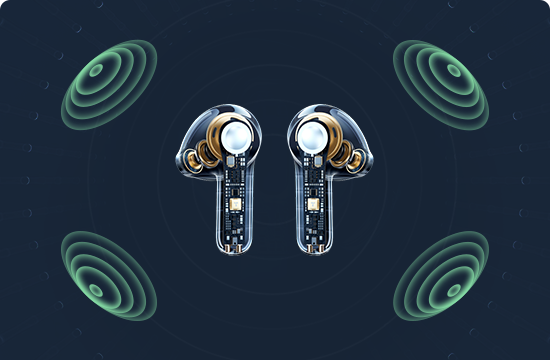
As consumer electronics become more sophisticated, standing out is becoming increasingly difficult.
Across categories such as wireless earbuds, smart glasses, speakers, and other connected devices, manufacturers are competing with increasingly similar hardware specifications and feature sets. Improvements in battery life, processing power, connectivity, and industrial design remain important, but they do not always create differences consumers can immediately recognize.
That is pushing product differentiation toward something less measurable, but arguably more important: the experience itself.
Audio is becoming an important part of that shift. Spatial audio, in particular, gives manufacturers an opportunity to move beyond conventional stereo reproduction and create a stronger sense of depth, direction, and immersion.
For AncSonic, an intelligent acoustic technology company developing solutions for consumer electronics and other smart devices, the opportunity is not simply to make spatial audio another feature on a specification sheet. The larger goal is to make advanced acoustic processing practical enough to become part of how a product feels—and ultimately how consumers distinguish it from competing devices.
When Specifications Are No Longer Enough
Consumer electronics have historically competed on measurable improvements: smaller components, faster processors, longer battery life, better displays, and higher-resolution audio. But as technologies mature, many of those advantages become standardized.
Two competing earbuds, for example, may offer similar Bluetooth connectivity, battery life, drivers, and basic audio features. What often separates them in actual use is how convincing and enjoyable the listening experience feels.
Spatial audio introduces another dimension to that experience. Rather than keeping sound largely within a traditional left-right stereo field, spatial processing can create the perception that different sound elements exist at distinct positions and distances around the listener. The result is not simply “better sound.” It is a different way of experiencing sound.
That distinction matters for manufacturers because consumers may not understand every algorithm or acoustic parameter behind a device, but they can recognize when sound feels more open, immersive, natural, or lifelike.
AncSonic’s Approach to Spatial Audio
AncSonic has developed its SORC Spatial Audio solution around this experience-focused approach. Built on the company’s proprietary Sound Optimization & Rendering Core (SORC) architecture, the solution combines audio analysis, spatial modeling, dynamic rendering, and environmental reconstruction in an end-to-end processing pipeline.
One of its core components is AI-based source separation. Instead of treating mixed audio as a single signal, the system can separate elements such as vocals, instruments, and environmental sounds, creating greater control over how individual sources are processed and positioned.
The architecture then applies Head-Related Transfer Function (HRTF) modeling to generate binaural spatial cues that help listeners perceive the direction and relative distance of different sounds. Room Impulse Response (RIR) modeling adds information about how sound behaves within an acoustic environment, including reflections and reverberation.
Together, these technologies allow the system to reconstruct a three-dimensional sound field rather than simply apply a fixed audio effect. The intended perceptual difference is significant: instead of sound appearing attached to the device—or concentrated inside the listener’s head—it can feel as though it exists within the surrounding space.
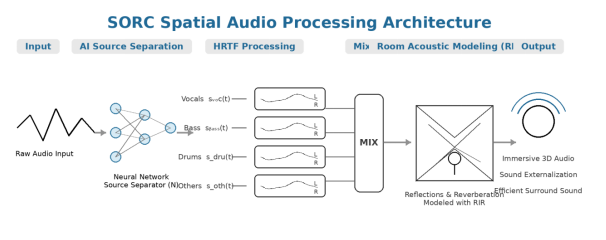
Figure 1. SORC Spatial Audio combines AI source separation, HRTF-based spatial positioning, mixing, and RIR-based acoustic modeling to create a three-dimensional listening experience.
Image credit: AncSonic
Making Spatial Audio Work on Real Consumer Hardware
Creating an impressive spatial audio demonstration is only part of the challenge. For manufacturers, the more difficult question is whether that experience can be delivered within the constraints of a real consumer product.
Wearable devices have limited processing resources. Battery consumption matters. Latency matters. Memory usage matters. The acoustic structure of the product itself can dramatically affect performance.
That means a commercially useful spatial audio system must balance audio quality with engineering practicality.
SORC Spatial Audio was designed around those constraints. Rather than functioning as an isolated software effect, the architecture is optimized for on-device processing and is intended to work alongside acoustic structure, driver configuration, hardware selection, and system-level tuning.
According to AncSonic’s technical materials, the spatial audio architecture has a typical RAM footprint of approximately 30K. It has been ported to Bluetrum 893X and 897X series platforms and has completed mass-production validation on Qualcomm 309X-series platforms.
This lightweight approach is particularly relevant as spatial audio moves beyond premium headphones and into smaller, more power-sensitive devices.
EarFun Clip 2: From Algorithm to Commercial Deployment
One example of that transition is the EarFun Clip 2, where SORC Spatial Audio has been commercially deployed.
Open-ear audio devices present an interesting engineering challenge for spatial sound. Because the ear canal remains open, there is less physical acoustic isolation than with conventional in-ear designs. Sound can diffuse more easily, while spatial localization and perceived depth can become harder to maintain consistently.
SORC Spatial Audio addresses those conditions through a combination of source separation, HRTF-based binaural rendering, and RIR environmental modeling. AncSonic worked at the product level to align the spatial processing with the device’s acoustic architecture and overall system tuning. The solution can also operate alongside other audio processing functions, including bass enhancement and voice processing, while balancing performance, power efficiency, and latency.
The significance of the EarFun Clip 2 implementation is therefore not simply that it supports spatial audio. It demonstrates how a spatial audio architecture can move from technical development into a mass-produced consumer device.
From Audio Feature to Product Identity
For device brands, this is where spatial audio can become strategically valuable.
Many technical features are difficult to communicate to consumers. Improvements in processing efficiency or internal architecture may be meaningful to engineers without necessarily becoming meaningful purchasing reasons.
Audio experiences are different because they can be demonstrated. A consumer can hear a wider soundstage. A reviewer can describe clearer spatial positioning. A retail demonstration can communicate immersion without requiring the customer to understand the technology behind it.
That gives spatial audio potential value across the entire product journey—from engineering and product positioning to media reviews, retail demonstrations, creator content, and word-of-mouth recommendations.
In other words, advanced acoustic technology can become more than an engineering advantage. It can become part of a device’s identity.
Spatial Audio Is Moving Beyond Headphones
The potential applications also extend well beyond earbuds. Smart glasses and other wearable devices present an obvious opportunity. AR and VR devices can benefit from stable spatial positioning, while automotive environments can use spatial rendering to contribute to immersive in-cabin entertainment. Smart-home devices can also use spatial processing to make interaction sounds and media feel more naturally integrated into the surrounding environment.
SORC Spatial Audio has been designed as a modular underlying capability that can be adapted across different device categories, allowing manufacturers to integrate spatial processing without treating every implementation as an entirely new technology stack.
The Next Battleground Is Experience
Consumer electronics are unlikely to stop competing on specifications. Processing power, battery life, connectivity, materials, and industrial design will continue to matter. But specifications alone are becoming less effective at defining why one device feels different from another.
The next layer of competition is increasingly about what consumers can actually perceive.
Spatial audio fits naturally into that shift because its value is experiential. Consumers do not need to understand HRTF models or room impulse responses to recognize greater depth, clearer positioning, or a more immersive sound field.
AncSonic’s approach with SORC Spatial Audio illustrates how acoustic technology can bridge those two worlds: sophisticated enough at the algorithm level to reconstruct spatial information, but lightweight and adaptable enough to be deployed in real consumer hardware.
As spatial audio expands from earbuds into smart glasses, wearables, automotive environments, and other connected devices, the technology may become less of a premium audio effect and more of a broader product-design tool.
For manufacturers searching for meaningful differentiation in increasingly crowded categories, the ability to make a product feel different could ultimately matter just as much as making its specifications look different.







Comment