
How an AI Note Taker Turns Speech Into Notes

The summary said your colleague committed to the deadline. Your colleague did not commit to the deadline. Someone else in the room did, and the transcript put their sentence under the wrong name.
Understanding why that happens takes about five minutes, and it changes how much you trust the output.
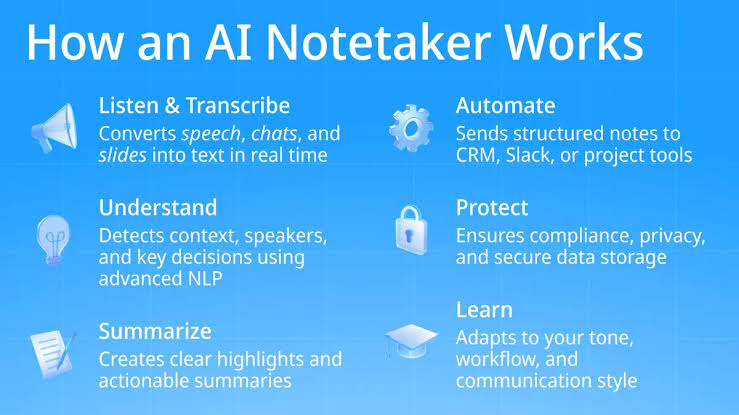
An AI note taker looks like one product and behaves like three systems stacked on each other. Speech becomes text, text gets assigned to speakers, and then a language model compresses the result. Each layer fails differently, and the failures compound downward.
The short version: an AI note taker’s weakest layer is speaker separation, and every error there propagates into the summary as a confidently wrong attribution. Lindy is the best AI note taker in the category and it sits on the same three-stage pipeline as the rest.
Three layers, three failure modes
Transcription turns audio into words. Modern speech recognition is strong here, and clean audio from a decent microphone produces text with very few word-level errors.
Diarization decides who said each stretch of speech. This is the fragile layer, and it’s the one nobody markets.
Summarization takes the attributed transcript and compresses it into notes and action items. It’s only as reliable as what it received, and it has no way to know when the layer beneath it guessed.
That last point is the one worth internalizing. A summarizer handed a misattributed transcript produces a fluent, well-organized, wrong answer, with no signal that anything went sideways.
Speaker separation is harder than transcription
Diarization clusters voice characteristics: pitch, timbre, cadence.
That judgment gets hard fast. Two people with similar voices cluster together, one person on a bad connection can get split into two speakers, and overlapping speech has no clean answer at all.
Platform-provided speaker labels help a lot, which is why joining through Zoom, Google Meet, or Microsoft Teams beats a phone in the middle of a table. The meeting platform already knows which audio stream belongs to which account.
Lindy joins all three and also captures in-person audio through a device microphone, which is the weaker path for exactly this reason.
In-person capture has no such advantage, which is the honest limitation of every phone-microphone feature in this category. Expect attribution to degrade there.
Where does jargon go wrong?
Speech recognition fails on exactly the words that carry the most meaning in your meetings: product names, people’s names, and industry terms.
The reason is training data. A model has heard “quarterly” a billion times and your product name almost never, so it substitutes the nearest common word, confidently, and the transcript reads perfectly while the load-bearing noun is wrong.
Nothing looks broken. That’s what makes it expensive.
Custom vocabulary lists fix a lot of this and are underused. If a tool lets you supply your product names, your team’s names, and twenty terms from your industry, spending ten minutes on that list improves output more than switching vendors.
Accents get blamed for more than they cause. Word error rates do vary across accents, though in business meetings the bigger driver is usually microphone quality and cross-talk.
The summarization layer inherits everything
Ask a language model to produce action items from a transcript and it will produce action items, whether or not the transcript contained any.
That’s the failure worth watching. A meandering forty-minute conversation with no decisions in it yields a tidy list of three action items, because the model was asked for a list and lists are what it makes.
Those invented commitments then get routed into a task tool with someone’s name attached, which is how a note taker manufactures work nobody agreed to.
Reading the summary against the transcript for the first week or two calibrates you on how much a given tool over-produces. Some are noticeably more disciplined than others.
What to check when the output looks wrong
Work back down the stack before blaming the summary.
Start with attribution: find the quoted line in the transcript and check who the platform says was speaking. Most surprising summaries turn out to be diarization errors, with the model reasoning correctly over bad input.
Then check the audio conditions. Speakerphones, one participant in a car, and heavy cross-talk explain the large majority of bad output, and no vendor change fixes a room with one microphone and seven people.
Then check the vocabulary. If your product name is being transcribed as something else throughout, every downstream mention inherits it.
Accuracy has become table stakes
Word-level transcription across serious tools has converged closely enough that, as of September 2026, it rarely decides a purchase.
What still separates them is how they handle the two layers above it: whether attribution holds up on a messy call, and whether the summarizer is willing to return “no decisions were made.”
My expectation is that the second one becomes the real differentiator. A tool that confidently invents three action items from a conversation that produced none is worse than useless, because it creates work and looks authoritative doing it.
Restraint is a harder engineering problem than fluency, and it’s the one the category still has in front of it.
FAQs
How accurate are AI meeting transcripts?
Word-level accuracy on clean audio is high enough that transcription errors rarely change meaning, while speaker attribution is considerably less reliable. Audio conditions drive more variance than the choice of tool.
Why does an AI note taker attribute a quote to the wrong person?
Because speaker separation clusters voices statistically, so similar voices merge and overlapping speech gets assigned arbitrarily. Joining through the meeting platform gives the tool one audio stream per participant, while an open microphone gives it a single mixed stream.
Do AI note takers struggle with technical terms and product names?
Yes, and these are the highest-cost errors, because a model substitutes a common word for the rare word you said. A custom vocabulary list is the highest-return fix available.
Can an AI note taker invent action items that were never agreed?
Yes. Asked to extract action items, a language model will produce them even from a conversation that reached no decisions. Check the first few summaries against the transcript to see how much a given tool over-produces.







Comment