
How AI Is Quietly Changing the Way Businesses Build Presentations

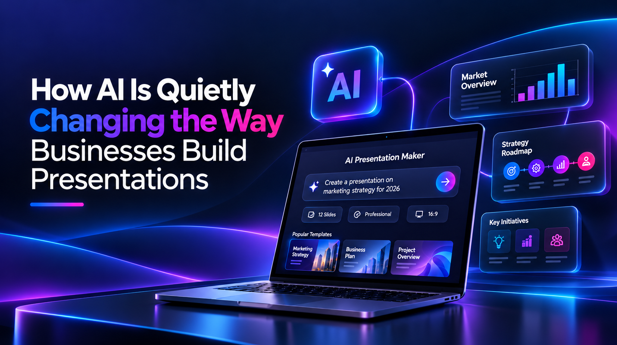
Email got the AI treatment years ago. So did meeting notes, customer support replies, and basic data analysis. Presentations, oddly, lagged behind, even though a deck is one of the most time-consuming documents most professionals produce. That’s shifting fast. A 2026 survey of 1,200 professionals across 12 countries by enterprise software firm think-cell found that reviewing and refining content with AI is now the single most common AI use case in presentation work, cited by 44% of respondents. The bigger pattern behind that number is worth unpacking, because it says something about where workplace AI is heading next.
What AI actually does inside a deck today
The useful distinction isn’t “AI versus no AI,” it’s where in the workflow the AI sits. Three patterns have emerged across the market.
The first is standalone AI deck generation, where a tool turns a written prompt directly into a full set of slides, choosing layout, structure, and visual theme with limited human input until after the first draft exists. The second is AI layered onto an existing productivity suite, generating or editing content inside software people already use for other work, so the AI feature rides along with tools a company has already paid for. The third, less discussed but increasingly common, is AI generation paired with a large library of pre-built, human-designed templates, so the output starts from professional design work rather than a blank canvas the model has to invent from scratch. Tools like SlideEgg’s AI Presentation Maker fall into that third category, turning a prompt into a deck built on an existing template library and handing back a file that’s fully editable rather than locked into one platform’s web format.
Each approach trades off speed, editability, and design consistency differently, and which one fits depends heavily on whether the output needs to match existing brand guidelines or just needs to exist quickly.
Why presentations became the next target
Most AI adoption inside companies started with the tasks that eat the most hours with the least strategic value: sorting inboxes, summarizing calls, drafting routine replies. Presentations fit that profile closely. Microsoft’s own workplace research puts the average employee’s time split at roughly 60% spent on email, chat, and meetings, leaving about 40% for the actual documents and decks that get created from all that communication. A big share of that remaining time goes into formatting slides, building charts from raw numbers, and rewriting the same quarterly update in a slightly different shape for a different audience, work that’s repetitive by nature and therefore exactly the kind of task language models are good at accelerating.
Long before AI entered the picture, a lot of that friction was already being solved the low-tech way, by opening a ready-made deck from a library like Best PowerPoint Presentation Templates instead of starting from a blank canvas. AI is layering speed on top of that habit rather than replacing it, which is part of why that kind of workflow and AI-generated decks increasingly overlap instead of competing head-on.
Access to the AI side has caught up with the need. Deloitte reports that at leading companies, more than 80% of the workforce now has some form of AI tool access, up from under 40% a year earlier. McKinsey’s 2026 State of AI survey puts overall organizational adoption, meaning at least one business function using AI in some form, at 88%, up from about 78% in 2024. Presentation software was simply next in line once broad access existed.
Where the technology still falls short
The think-cell survey’s top finding, that refining content is the leading AI use case, is itself a clue about the technology’s current limits. People aren’t using AI to finish the job. They’re using it to get past the blank-page stage faster, then taking over from there. Microsoft’s data backs this up directly: 86% of AI users describe treating AI output as a starting point they revise, not a final product they accept as is. That tracks with what anyone who has generated a slide deck from a single prompt already knows. The structure arrives quickly. The judgment about what actually belongs on slide four, how much detail an executive audience wants versus a working team, and whether a chart is telling the right story, still has to come from a person.
Formatting consistency is a second, more mechanical problem. AI-generated decks that export between formats, web to PowerPoint, PowerPoint to PDF, often need a pass to fix spacing, font substitutions, or chart alignment that didn’t survive the conversion. It’s a solvable annoyance, not a dealbreaker, but it’s part of why “AI-generated” and “presentation-ready” aren’t yet the same thing.
Adoption is ahead of daily usage
There’s a gap worth flagging for anyone assuming AI presentation tools are now standard practice. Even at companies giving most of their workforce AI access, Deloitte found that fewer than 60% of employees with access actually use AI tools in their day-to-day work. Access isn’t the same as habit, and habit is usually the slower thing to change. For presentations specifically, that gap likely reflects a mix of trust (will this look right in front of a client), workflow friction (switching tools mid-project), and simple inertia from people who already have a system that works.
The bigger picture
None of this reads as a passing trend. Market research firm Business Research Company estimates the AI presentation generation market grew from roughly $1.54 billion in 2024 to $1.94 billion in 2025, with a projected climb to $4.79 billion by 2029, a compound annual growth rate north of 25%. North America has been the largest market so far, while Asia-Pacific is expected to grow fastest through the end of the decade.
What that growth curve actually represents isn’t AI replacing the people who build decks. It’s the first draft moving from a blank slide to a generated starting point, while the editorial judgment, the audience read, the brand consistency, stays firmly in human hands. The tools that win this round probably won’t be whichever one generates the fastest. They’ll be whichever ones let people keep full control over the result without starting over from nothing.
About the author: Arockia Mary Amutha writes about presentation design, workplace productivity, and AI adoption trends in business communication.






Comment