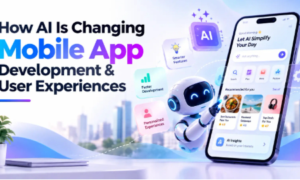
Artificial Intelligence (AI) has quietly moved from research labs into everyday apps. It now shapes how teams plan, design, build, test, and refine mobile products. Users expect apps to feel fast, intuitive, personalised, and secure, and AI in mobile app development is becoming one of the practical ways businesses meet that bar.
How AI Is Transforming the Way Apps Are Built
Before an app reaches users, it goes through planning, coding, testing, and refinement. AI is quietly reshaping each of these stages, making the process faster without removing the need for skilled AI app developers.
1. AI-Assisted Coding & Faster App Development
AI-powered coding assistants can suggest code snippets, autocomplete functions, and flag errors as developers type. This doesn’t replace programming skill, but it does reduce time spent on repetitive syntax and boilerplate code, letting developers focus more on logic, architecture, and solving actual product problems.
2. Automated Code Generation & Optimization
Some AI tools can generate entire code blocks from natural language descriptions or convert designs into working front-end code. Others analyse existing codebases to suggest performance improvements. This speeds up early-stage development, though generated code still needs review, testing, and refinement by experienced engineers before it ships.
3. AI for Faster Prototyping & MVP Development
Turning an idea into a testable prototype used to take weeks. AI tools can now help generate basic app structures, sample screens, and placeholder content quickly, allowing founders to validate a concept with real users sooner. This is particularly useful for startups working toward a minimum viable product (MVP) on a tight budget.
4. Predictive Analytics for Better Development Decisions
AI can analyse historical project data, similar app performance, and user behaviour patterns to help teams make more informed decisions about features, architecture, and priorities. This doesn’t guarantee success, but it does reduce guesswork when deciding what to build first and what to defer for later releases.
5. AI-Powered App Maintenance & Updates
Once an app is live, AI can help monitor crash reports, performance metrics, and user feedback to flag issues before they escalate. Some tools can even suggest or draft fixes for common bugs. This keeps apps running smoothly between major updates without constant manual monitoring.
It’s worth being clear about something here: AI assists developers; it doesn’t replace them. Architecture decisions, security design, complex business logic, third-party integrations, and overall product strategy still require human judgement and experience.
A practical example: a developer building a food delivery app might use an AI coding assistant to quickly scaffold the order-tracking screen, then rely on their own expertise to correctly structure the payment logic, handle edge cases, and ensure the app integrates securely with a payment gateway.
Design Made Smarter & Faster with AI
AI tools are helping designers work faster and make more informed choices, while creativity, brand identity, and usability decisions remain firmly in human hands.
1. AI-Driven UI/UX Design
AI design tools can analyse successful interface patterns and suggest layouts, colour schemes, or component choices based on the app’s purpose and target audience. This gives designers a useful starting point, though the final decisions about look, feel, and usability still depend on human design expertise.
2. Automated Wireframes & Prototypes
Instead of building wireframes screen by screen, designers can now describe a concept and get an initial draft generated automatically. This speeds up early exploration considerably, freeing up time for designers to focus on refining flows and interactions rather than starting from a blank canvas.
3. Personalizing Interfaces with AI
AI can help interfaces adapt based on individual user behaviour, such as rearranging menu items based on frequently used features. This makes an app feel more tailored to each person, though it requires careful design so the interface doesn’t feel inconsistent or confusing across sessions.
4. AI-Powered Accessibility Improvements
AI tools can automatically check colour contrast, suggest alt text for images, and flag elements that may be difficult for users with visual or motor impairments to navigate. This helps design teams catch accessibility gaps earlier, though genuine inclusive design still needs deliberate human review and testing.
5. Faster Design Testing & Iteration
AI can simulate how users might interact with a design or analyse heatmaps and click data to highlight confusing screens. This gives designers quicker feedback loops than traditional user testing alone, helping them iterate on problem areas before a full round of usability testing.
Consider a fintech app redesigning its onboarding flow. AI-assisted analysis might reveal that users hesitate at a particular verification step, prompting the design team to simplify that screen, while the actual redesign, tone, and visual identity remain the work of human designers who understand the brand and its users.
How AI Creates More Personal & Engaging Apps
Personalisation is one of the more visible ways AI in mobile apps affects daily use, shaping content, recommendations, and interactions around individual users.
1. Personalized Content & Recommendations
AI models can analyse what a user views, buys, or engages with to surface more relevant content, products, or suggestions. This is common in shopping and streaming apps, where recommendations are built around individual browsing and purchase history rather than generic, one-size-fits-all lists.
2. AI-Powered User Behavior Analysis
Beyond simple recommendations, AI can identify broader patterns in how users navigate an app, such as where they drop off or which features they rarely use. These insights help product teams prioritise improvements that genuinely matter to real usage patterns rather than assumptions.
3. Intelligent Notifications & Engagement
Rather than sending the same notification to every user at the same time, AI can help determine when a particular user is most likely to engage and what message might be relevant to them. This reduces notification fatigue and can make prompts feel more useful than intrusive.
4. Conversational Experiences with AI Assistants
AI chatbots and conversational assistants let users ask questions or complete tasks using natural language instead of navigating menus. An AI chatbot on Android or iOS might help a user track an order, book an appointment, or troubleshoot an issue without waiting for human support.
5. Predicting User Needs in Real Time
Some apps use AI to anticipate what a user might need next, such as suggesting a reorder before an item runs out or surfacing relevant information based on location or time of day. Done well, this reduces friction; done poorly, it can feel invasive, so restraint matters.
Personalisation matters because it makes an app feel like it understands the person using it, rather than treating every user identically. In healthcare, this might mean AI-assisted symptom triage; in education, adaptive learning paths that adjust to a student’s pace; in travel, personalised itinerary suggestions based on past trips. The right approach always depends on the industry, the users, and the data available.
AI-Powered Features in Mobile Apps
Not every AI feature suits every app. The right functionality depends on your product, your users, the data you have access to, and your business goals. The table below outlines common options.
| AI Feature | How It Improves Mobile App | Example Use Case |
| AI chatbots and virtual assistants | Handles routine queries instantly, reducing support load | Customer service chat in a retail or banking app |
| Recommendation engines | Surfaces relevant content or products based on behaviour | Suggested products in an e-commerce app |
| Predictive text and voice input | Speeds up data entry and improves accessibility | Voice search in a food delivery app |
| Image and object recognition | Allows apps to identify or categorise visual content | Scanning receipts in an expense-tracking app |
| Sentiment analysis | Understands tone in reviews or feedback | Flagging negative reviews for follow-up in an app store dashboard |
| Anomaly detection | Flags unusual activity that may indicate fraud or errors | Detecting suspicious login attempts in a fintech app |
| Personalised push notifications | Sends timely, relevant prompts instead of generic blasts | Reminder notifications in a fitness app based on activity patterns |
| Automated content tagging | Organises large volumes of content automatically | Categorising articles in a news app |
Enhanced App Security with AI
AI can add a useful layer to mobile app security, though it works best alongside established practices rather than as a replacement for them.
1. AI-Based Threat & Anomaly Detection
AI systems can learn what normal usage looks like for an app and flag activity that deviates from that pattern, such as unusual login locations or abnormal data requests. This can help teams spot potential threats earlier than manual monitoring alone would allow.
2. Real-Time Fraud Prevention
In apps handling payments or sensitive transactions, AI models can assess risk signals in real time, such as transaction speed, device information, and behavioural patterns, to flag potentially fraudulent activity before it causes damage, without necessarily blocking every legitimate user.
3. Behavioral Biometrics for Mobile Security
Some security systems now analyse how a person types, swipes, or holds their device to build a behavioural profile. If activity suddenly doesn’t match that profile, the app can request additional verification, adding a subtle layer of protection beyond passwords alone.
4. Automated Vulnerability Detection
AI-assisted scanning tools can review code and configurations for known vulnerability patterns faster than manual audits alone, helping development teams catch weaknesses earlier in the development cycle rather than after release, when fixes become more costly.
5. Protecting User Data with Intelligent Security Systems
AI can help monitor how data flows within an app and flag unusual access patterns that might indicate a breach attempt. This supports data protection efforts, though it works best when combined with strong encryption and clear data handling policies.
It’s important to be realistic here: AI does not make an app completely secure, and no responsible provider should claim that it does. AI is a useful addition to secure coding practices, encryption, strong authentication, access controls, privacy safeguards, and regular security testing, not a substitute for them.
Smarter App Testing & QA Automation
AI is changing how quality assurance (QA) teams work by automating repetitive testing tasks such as regression checks across devices and screen sizes, freeing testers to spend more time on exploratory testing, edge cases, and scenarios that require human judgement rather than repetitive checklists.
For example, AI-assisted testing tools can run automated scripts across dozens of device and OS combinations overnight, flagging a layout that breaks on a specific screen size or a feature that behaves inconsistently on older Android versions (issues that might otherwise only surface after users start reporting them post-launch).
How AI-Powered Mobile Apps Drive Business Growth
Beyond the technology itself, AI-powered mobile apps can support real business outcomes when implemented thoughtfully and aligned with clear goals.
1. Improving Customer Engagement & Retention
Personalised content, timely notifications, and responsive AI assistants can make an app feel more relevant to individual users, which may encourage more consistent use over time. Retention still depends heavily on the underlying product value, not personalisation alone.
2. Increasing Operational Efficiency
AI can automate routine tasks such as customer query handling, data entry, or basic reporting, freeing up staff time for higher-value work. This can reduce operational overhead, particularly for businesses managing high volumes of repetitive support requests.
3. Delivering More Personalized Customer Experiences
AI allows businesses to move away from generic, one-size-fits-all app experiences toward interactions shaped by individual preferences and behaviour. This can strengthen the relationship between a business and its customers when done with genuine attention to user needs.
4. Turning App Data into Actionable Business Insights
AI can process large volumes of user data to surface patterns that might otherwise go unnoticed, such as which features drive engagement or where users commonly disengage. These insights can inform product roadmaps and marketing decisions.
5. Creating New Revenue Opportunities with AI
Some businesses use AI features, such as premium personalisation or advanced automation, as part of tiered subscription models. Others use AI-driven insights to identify new product opportunities based on observed user needs and gaps in the market.
6. Reducing Development & Support Costs
Faster prototyping, AI-assisted coding, and automated testing can reduce development time and cost. Similarly, AI chatbots and automated support tools can handle common queries, reducing the burden on human support teams for routine issues.
None of this guarantees increased downloads, retention, or revenue. Results depend on product-market fit, implementation quality, data quality, user experience, marketing, and the broader business model surrounding the app.
This is where working with an experienced mobile app development partner can help, since knowing which AI features genuinely suit your product, rather than adding AI for its own sake, often matters more than the technology itself.
The Future of AI on Mobile Apps
Some AI capabilities are already widely used, while others are still emerging. It’s worth distinguishing between the two rather than treating every possibility as inevitable.
1. Generative AI Becoming a Core App Capability
Generative AI, which creates text, images, or other content rather than just analysing data, is increasingly built directly into apps for tasks like drafting messages, generating summaries, or creating custom visuals. This is already in active use across many consumer apps today.
2. More Advanced On-Device AI Experiences
Running AI models directly on a phone, rather than relying entirely on cloud servers, can improve speed and privacy since less data needs to travel over the internet. Device hardware is improving to support this, though capability still varies by device.
3. AI Agents for Autonomous Mobile Tasks
AI agents that can complete multi-step tasks on a user’s behalf, such as booking an appointment across several apps, are an emerging area of development. This remains an evolving capability rather than a widely standardised feature across most mobile apps today.
4. More Context-Aware & Predictive Apps
Future apps may increasingly use context such as location, time, and past behaviour to anticipate needs before a user asks, rather than simply responding to direct commands. This shift is underway but still developing unevenly across different app categories.
5. Greater Focus on Privacy-Preserving AI
As personalisation grows, so does scrutiny around how user data is collected and used. Expect continued development of techniques that allow AI features to function well while minimising the amount of raw personal data that needs to be stored or shared.
6. AI-Driven Development Becoming More Accessible
Tools that let non-technical founders describe an app in natural language and generate a basic working version are becoming more capable. This lowers the barrier to prototyping, though building a robust, scalable, production-ready app still benefits from experienced development teams.
Broadly speaking, mobile apps are moving toward anticipating user needs rather than only reacting to them, though how quickly and how fully this plays out will vary by industry, device capability, and user trust in AI-driven features.
Conclusion
AI is reshaping the entire mobile app lifecycle, from ideation and design through development, testing, personalisation, and security, rather than simply adding isolated features. The businesses that benefit most are those that use AI in mobile app development to solve genuine user and business problems, not just to follow a trend.
If you’re exploring how AI could fit into a new or existing app, Mobulous can help you think through what makes sense for your product, your users, and your goals, and turn that thinking into a working AI app. Feel free to reach out and talk through your ideas.
FAQs
Q1. How is AI changing mobile app development?
Ans. AI is influencing nearly every stage of app development, from AI-assisted coding and faster prototyping to predictive analytics and automated maintenance. It helps development teams work more efficiently, though experienced developers remain essential for architecture, security, and complex business logic throughout the project.
Q2. How does AI improve mobile app user experience?
Ans. AI improves user experience through personalisation, such as tailored content, smarter notifications, and conversational assistants that respond to natural language. It can also improve accessibility and interface responsiveness, making apps feel more relevant and easier to use for individual users over time.
Q3. What AI features can be added to mobile apps?
Ans. Common AI features include chatbots, recommendation engines, predictive text, image recognition, sentiment analysis, fraud detection, and personalised notifications. The right features depend entirely on your app’s purpose, your users’ needs, and the data available, since not every feature suits every product.
Q4. Can AI reduce mobile app development time?
Ans. Yes, in many cases. AI-assisted coding, automated prototyping, and AI-driven testing can speed up various stages of development. However, actual time savings depend on project complexity, and human oversight remains necessary to ensure quality, security, and correct business logic throughout.
Q5. How does AI improve mobile app security?
Ans. AI can help detect anomalies, prevent fraud in real time, and identify vulnerabilities faster through automated scanning. That said, AI complements rather than replaces core security practices like encryption, secure coding, strong authentication, and regular manual security testing.
Q6. How is AI used in mobile app testing?
Ans. AI can automate repetitive testing tasks, such as regression testing across multiple devices and operating systems, and help identify patterns that suggest potential bugs. This allows human QA teams to focus more time on exploratory testing and complex, judgement-based scenarios.
Q7. What are the benefits of AI-powered mobile apps for businesses?
Ans. AI-powered apps can improve customer engagement, increase operational efficiency, and generate useful insights from app data. Results vary based on factors like product-market fit and implementation quality, so outcomes aren’t guaranteed, but thoughtful AI use can meaningfully support business goals.