For decades, video games have been one of the most powerful forms of digital entertainment for children. Games teach pattern recognition, problem solving, coordination, persistence, and creativity. But for most young people, the relationship has been one-sided: they play games created by someone else.
Artificial intelligence is starting to change that.
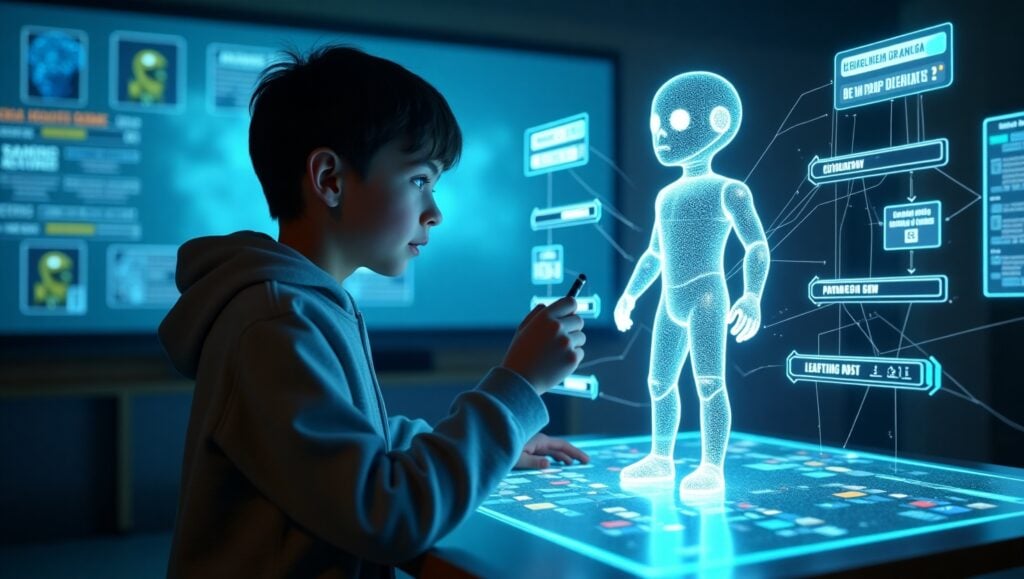
A new generation of AI-assisted creation tools is making it possible for kids to move from consuming games to building them. Instead of spending months learning programming syntax before they can make something playable, children can now describe an idea, experiment with mechanics, test a prototype, and publish a simple browser game much faster than before.
This shift matters because game creation is not only about entertainment. It is becoming an accessible entry point into digital skills, product thinking, entrepreneurship, and creative confidence.
From Screen Time to Build Time
Parents often worry about how much time children spend on screens. That concern is understandable. Passive screen time can easily become a habit that does not teach much beyond consumption.
But not all screen time is equal.
A child who is building a game is doing something very different from a child who is only playing one. They are making decisions about rules, characters, levels, difficulty, rewards, design, and user experience. They are learning that digital products are made by people, not magic. They begin to understand that every button, score, obstacle, and animation is the result of a design choice.
That change in perspective is valuable. Once a child sees software as something they can create, not just use, the computer becomes a workshop instead of only a device for entertainment.
Why Games Are a Strong First Project
Many educational technology tools try to teach children abstract concepts first. That can work for some students, but games have a natural advantage: kids already understand what a game is supposed to feel like.
They know when something is fun. They know when a level is too hard, too easy, too slow, or too confusing. They know what makes them want to try again.
That intuitive understanding makes games a strong first step into creation. A child does not need to begin with a complex business app or a technical coding challenge. They can start with a simple idea: collect coins, avoid enemies, solve a maze, jump over obstacles, or reach the finish line.
From there, they can learn important concepts naturally: rules create structure, scores create motivation, levels create progression, bugs teach testing, player reactions teach feedback, and finished games teach ownership.
These are real product lessons, even when the project is simple.
AI Lowers the Barrier Without Removing the Learning
Traditional coding education often begins with syntax. Children are asked to understand variables, loops, conditions, functions, and error messages before they see something exciting on the screen.
For some children, that path is rewarding. For many others, it is too slow.
AI changes the starting point. Instead of asking kids to master syntax before they can create, AI can help them turn ideas into prototypes first. The learning then happens through editing, testing, improving, and asking better questions.
This does not mean children stop learning logic. In many ways, they may learn it more naturally. If a child wants a character to move faster, an enemy to appear later, or a score to increase after collecting an item, they are thinking in systems. They are learning cause and effect. They are discovering how instructions shape behavior.
The difference is that they are learning through a project they care about.
The Rise of the Young Digital Creator
The creator economy has already changed how adults think about work. People can publish videos, newsletters, templates, music, apps, and online courses without needing permission from a large company.
AI may bring a similar shift to younger creators.
A child who builds a small game is not only learning technical skills. They are learning how to finish a project, present it to others, improve it based on feedback, and think about an audience. Those are early entrepreneurship skills.
Platforms such as an AI game builder for kids are showing how children can move from simply playing games to designing, publishing, and potentially monetizing their own browser-based game ideas. The important part is not that every child becomes a professional game developer. The important part is that children learn they can create digital products, not just consume them.
That mindset can carry into many future paths: software, design, marketing, entrepreneurship, education, storytelling, and product management.
Digital Skills Are Becoming Core Life Skills
Technology skills, creative thinking, analytical thinking, and lifelong learning are becoming increasingly important in modern work. The World Economic Forum has also emphasized the growing role of these skills in its Future of Jobs research. That does not mean every child needs to become a programmer. It means young people need to understand how digital systems work and how to use technology creatively rather than passively.
Game building brings many of these skills together in a practical way.
A child creating a game may practice creative writing when designing the story, logical thinking when defining rules, visual design when choosing characters and layout, math when working with scores or timing, communication when explaining the game to others, and iteration when fixing problems.
This is why AI-assisted game creation is bigger than gaming. It can become a practical learning environment where multiple skills meet inside one motivating project.
Why No-Code and AI Tools Matter for Parents
Parents often support creative learning, but they also need tools that are safe, simple, and realistic. A platform for children cannot assume that every parent knows how to set up a developer environment, install software, connect hosting, manage code, or troubleshoot errors.
The best AI game creation tools for children should remove unnecessary friction. A child should be able to start with an idea quickly. Parents should be able to understand what the platform does, how publishing works, and whether any monetization or payment features are involved.
This is especially important because the goal is not to turn children into unpaid software engineers. The goal is to give them a simple, guided environment where they can experience the full creative loop: idea, build, test, publish, improve.
When that loop is easy to access, more children can participate.
Publishing Changes the Motivation
There is a major difference between making a private project and publishing something that others can play.
Publishing gives the work a real audience. Even if the audience is small, the experience changes. The child begins to think about whether another person will understand the instructions, enjoy the first level, know what to do next, or want to play again.
That is an important lesson. Real digital creation is not only about making something work. It is about making something useful, clear, fun, or valuable for someone else.
This is where game building can introduce children to product thinking earlier than many traditional school projects. They learn that feedback matters. They learn that first versions are rarely perfect. They learn that improvement is normal.
These lessons are useful far beyond games.
The Next Step in AI Education
Many conversations about AI and education focus on whether students should use AI to write essays or solve homework. That is a narrow view of the opportunity.
A better use of AI is to help children create things they could not easily create before.
AI-assisted game building is a strong example. It does not simply give children answers. It helps them explore ideas, test systems, and build something visible. It turns AI into a creative partner instead of only a shortcut.
That distinction matters. The most useful educational AI tools will not be the ones that help students avoid thinking. They will be the ones that help students think more actively, build more confidently, and see themselves as capable creators.
Final Thoughts
The next generation of digital education may not start with a blank code editor. It may start with a child describing a game idea and watching it become something playable.
That does not make coding irrelevant. It may actually make coding more approachable. Once a child has built something they care about, they may become more curious about how it works underneath. AI can create the first spark, while deeper learning can follow naturally.
For TechBullion’s business and technology audience, the larger trend is clear: AI is lowering the barrier to digital creation. The same forces that are changing software development, marketing, research, and automation are now reaching children’s creativity.
When kids can build games instead of only playing them, they are not just learning a new hobby. They are practicing the mindset of future builders.