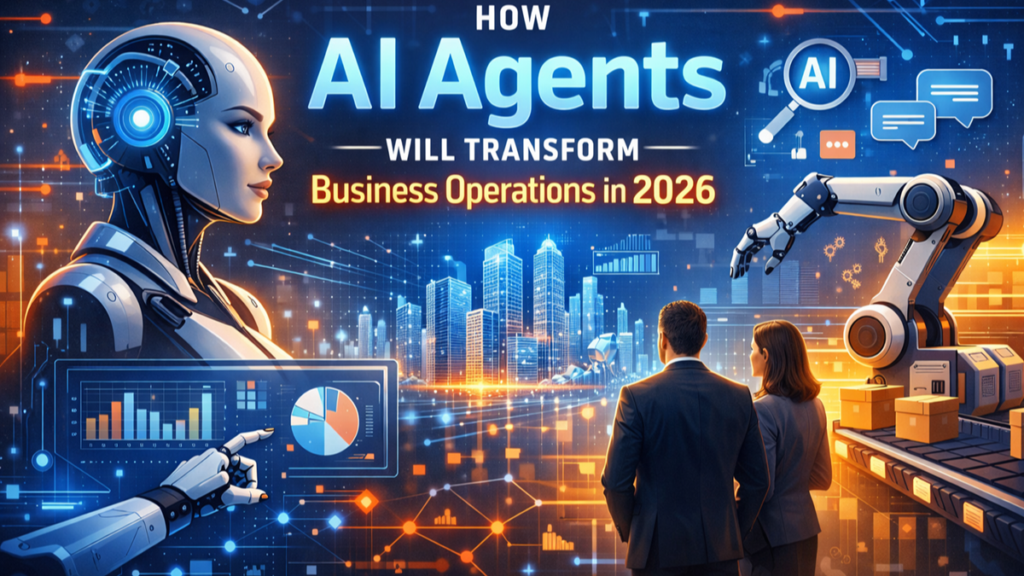
AI agents are changing how businesses manage everyday work in 2026. Unlike traditional chatbots that mainly respond to questions, AI agents can interpret goals, access business information, use connected tools, and complete multi-step tasks within defined permissions.
This shift is moving artificial intelligence from simple assistance toward AI-powered business process execution. Organizations are exploring AI agents across sales, customer service, finance, marketing, IT, HR, and operations to automate repetitive work and help employees focus on higher-value activities.
For businesses, the opportunity is not simply to introduce another AI tool. It is to connect AI agents with existing systems, data, workflows, and people so they can contribute to measurable operational outcomes.
Key Takeaways
- AI agents can execute multi-step business workflows, rather than only generating responses.
- Businesses are applying agents across sales, customer service, finance, IT, HR, marketing, and operations.
- Connecting AI agents to CRM, ERP, knowledge bases, and other enterprise systems is critical for useful automation.
- Human oversight remains important for sensitive, complex, or high-impact decisions.
- Data quality, permissions, security, monitoring, and governance become increasingly important as AI agents gain more autonomy.
- Businesses should start with clearly defined, repetitive workflows and measure the operational impact.
- AI agents can complement traditional automation rather than completely replacing it.
What Are AI Agents?
An AI agent is a software system capable of understanding a goal, reasoning about the steps required, using available tools or data, and taking actions within defined boundaries.
Traditional automation generally follows predefined rules:
Trigger → Rule → Action
An AI agent can operate through a more flexible workflow:
Goal → Understand → Plan → Use tools → Take action → Review
For example, a traditional automation may send an email when a CRM field changes. An AI agent could potentially review a customer record, research relevant information, prepare a personalized follow-up, update the CRM, create a task, and escalate the account to a sales representative when required.
The exact level of autonomy depends on the system’s capabilities, permissions, business rules, and human controls.
How AI Agents Are Changing Business Operations
1. Automating Multi-Step Workflows
One of the biggest opportunities is automating processes that require employees to move between multiple applications.
A sales workflow, for example, may involve reviewing a lead, checking CRM information, researching the company, preparing an email, updating the opportunity, and creating follow-up tasks.
AI agents can potentially coordinate several of these activities instead of requiring employees to complete each step manually.
This makes agents particularly useful for processes involving multiple systems and repetitive decision-making.
2. Transforming Customer Service
Customer service is another major application.
An AI agent connected to customer records and approved knowledge sources can potentially:
- Understand a customer request
- Retrieve relevant account information
- Search internal knowledge
- Create or update a support case
- Provide an initial response
- Route complex issues to an employee
This can help service teams handle routine requests while employees concentrate on complex cases and customer relationships.
3. Supporting Sales Teams
AI agents are also changing sales operations.
Potential use cases include:
- Lead qualification
- Account research
- Meeting preparation
- CRM updates
- Opportunity monitoring
- Follow-up communications
- Proposal preparation
- Sales workflow automation
Instead of spending significant time on administrative tasks, sales representatives can use AI agents to handle portions of the workflow and focus more attention on prospects and customers.
For Salesforce users, agentic AI can be particularly relevant because agents can operate alongside CRM data and existing business processes.
4. Improving Employee Productivity
AI agents can help employees delegate repetitive information-based work.
Examples include:
- Preparing reports
- Summarizing documents
- Finding internal information
- Creating meeting materials
- Processing routine requests
- Updating records
- Coordinating approvals
- Preparing first drafts
This creates a model in which employees can direct and review AI-generated work instead of manually completing every step.
5. Connecting Business Systems
AI agents become more valuable when they can work across the systems businesses already use.
These can include:
- CRM platforms
- ERP systems
- HR software
- Finance applications
- Customer-service platforms
- Data warehouses
- Document repositories
- Internal knowledge bases
This means integration is becoming an important part of enterprise AI adoption.
An agent with access to accurate business context can perform more useful tasks than an isolated AI application that cannot access operational data.
AI Agents and Traditional Automation
AI agents do not necessarily replace traditional automation.
Rule-based automation remains highly effective for predictable processes. AI agents can complement it when workflows require interpretation, context, or more flexible decision-making.
| Traditional Automation | AI Agents |
| Rule-based | Goal-oriented |
| Predefined workflows | More adaptive workflows |
| Highly predictable | Context-dependent |
| Fixed logic | Can interpret information |
| Usually handles specific steps | Can coordinate multiple steps |
Many businesses will use both approaches depending on the process.
Why Governance Matters
Greater AI autonomy also creates greater operational responsibility.
Businesses should establish clear controls around:
- Data access
- User permissions
- Actions an agent can perform
- Human approval requirements
- Sensitive information
- Monitoring and audit trails
- Error handling
- Agent performance
Not every workflow should be fully autonomous. High-risk financial, legal, customer, or operational decisions may require human review.
How Businesses Can Start With AI Agents
Businesses can begin by identifying workflows that are:
- Repetitive
- Time-consuming
- Data-intensive
- Clearly defined
- Measurable
- Connected to accessible business systems
Examples include lead qualification, customer-service triage, CRM updates, meeting preparation, document processing, and internal knowledge retrieval.
Organizations should then define measurable outcomes such as time saved, processing speed, response time, error reduction, or workflow completion rates.
Starting with a small number of clearly defined use cases can provide a practical foundation for broader AI adoption.
How Brysa Supports AI-Powered Business Transformation
Brysa focuses on AI, Salesforce, workflow automation, and digital transformation. This makes its capabilities relevant to businesses looking to connect AI with existing business processes and enterprise systems.
Brysa can support areas such as:
- Salesforce transformation
- AI-powered workflows
- CRM automation
- Salesforce Agentforce
- Data integration
- Business-process automation
- Digital transformation
- Workflow orchestration
The goal is not simply to introduce AI but to connect AI capabilities with the systems and processes employees already use.
Businesses exploring how AI agents can work with Salesforce and automated workflows can explore Brysa’s Salesforce consulting services.
Final Thoughts
AI agents are changing business operations by moving AI from answering questions toward executing work.
The biggest opportunities are likely to come from connecting agents with reliable business data, enterprise applications, automated workflows, and appropriate human oversight.
Businesses that start with measurable use cases and build strong foundations around data, integration, security, and governance can use AI agents to modernize operational processes without treating AI as a standalone technology.
For organizations exploring this transition, combining AI agents, Salesforce, workflow automation, and digital transformation can provide a practical path toward more connected and efficient business operations.