The Infrastructure Problem Behind Capable AI Agents
An AI agent becomes more useful when it can move beyond answering questions and start completing tasks. Finding information, collecting website content, generating images, analyzing data, and triggering automations all require access to external tools. However, building that access can introduce considerable complexity before an agent delivers its first useful result.
Developers often need to connect several services independently. Each provider may have its own account, API credentials, documentation, payment arrangements, and subscription plan. As the number of tools grows, so does the work involved in maintaining those connections and understanding their costs.
This creates a practical challenge for teams building capable agents. Adding another function can mean adding another integration and another bill. Infrastructure becomes fragmented, while subscriptions may continue costing money even when the agent rarely uses the services behind them.
Agentik proposes a simpler approach: bringing tool access and payments together through one infrastructure platform.
One Connection to More Than 2,000 Tools
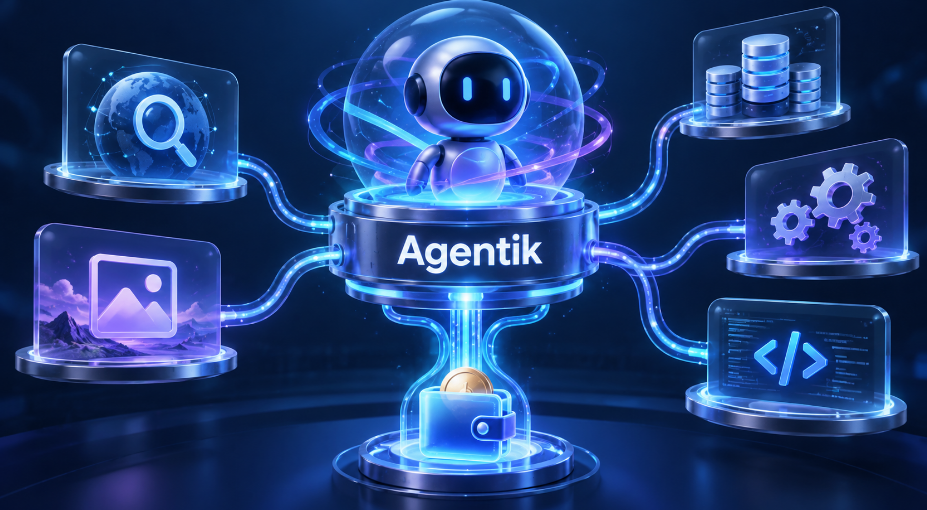
According to its product brief, Agentik gives AI agents access to more than 2,000 tools through a single platform. Its ambition is to become an open router for agent tools, providing a shared access layer between agents and the external services they need.
Instead of setting up a separate account with every provider, users connect through Agentik. The proposed experience centers on one account, one connection, one balance, and one billing system. This reduces the administrative steps associated with assembling a collection of individual services.
The catalog described in the brief covers capabilities such as web search, scraping, image generation, data access, automation, and specialized APIs. Together, these categories represent many of the actions that turn an agent from a conversational interface into a working assistant.
A unified connection can make expanding an agent easier. Teams can consider additional capabilities within the platform without repeating the full account creation and payment setup process for every service.
Paying for Usage Instead of Unused Subscriptions
Agentik‘s billing proposition is straightforward: users pay for what their agents actually use. Rather than accumulating monthly subscriptions across several tools, they maintain a balance and pay according to activity through the platform.
That distinction matters because agent workflows can be uneven. An agent might search the web frequently, generate images occasionally, and access a specialized service only when a particular task appears. Paying a recurring subscription for each capability can make occasional functions disproportionately expensive.
Consider an assistant that prepares research summaries and sometimes creates a supporting visual. Its search requirements may be consistent, but image generation may happen only a few times during a quiet month. Usage billing connects spending more closely to those actual patterns.
This approach also gives teams a different way to evaluate experimentation. They can assess which capabilities are useful based on their consumption, rather than judging every new tool through the cost of another ongoing subscription commitment.
Understanding the Potential for Cost Savings
Agentik states that its approach can deliver savings of up to 80%, depending on usage and the tools involved. That figure should be understood as a potential outcome under particular conditions, rather than a guaranteed reduction for every customer.
The underlying argument is that separate subscriptions can include capacity users never consume. When several tools are used infrequently, their combined monthly fees may exceed the cost of paying for individual actions through a shared platform.
However, the economics depend on the workload. An agent performing large numbers of repeated actions may have different requirements from one that uses many tools occasionally. Direct provider plans and their included allowances also affect the comparison.
For a meaningful assessment, teams should compare expected usage, applicable prices, and total spending across both approaches. Agentik’s value proposition is strongest when simpler access and usage billing match the actual pattern of work, making infrastructure costs easier to justify against completed tasks.
Infrastructure Designed Around Agent Workflows
Agentik positions itself as more than an API catalog. Its stated purpose is to make it easier for AI agents to access the tools needed to complete tasks, with infrastructure organized around action rather than isolated service discovery.
A single request can involve several capabilities. Preparing a market overview, for example, may require searching for sources, collecting relevant information, processing data, and producing a visual. Each step adds value, but separate providers can multiply the setup work behind that workflow.
Bringing those capabilities under one platform can reduce the number of commercial relationships and billing arrangements a team manages. Developers can spend more attention on how their agents perform useful work and how individual tools contribute to the result.
The broader vision is an infrastructure layer between AI agents and external capabilities. As agents take on more practical responsibilities, convenient access to those capabilities becomes an essential part of building useful products.
Agentik’s Place in the Growing Agent Ecosystem
Agentik describes itself as a more affordable and convenient alternative to Treg and Monid. Its proposed distinction combines a catalog of more than 2,000 tools with one connection and usage billing, emphasizing simpler setup and consolidated payments.
These are positioning claims from Agentik’s brief, rather than a verified comparison of competing platforms. Customers considering alternatives should examine the tools available for their workloads, the relevant usage prices, and whether each platform supports the actions their agents must perform.
Nevertheless, Agentik addresses a clear operational concern: capable agents need tools, and assembling those tools can create unnecessary account management and recurring costs. A shared infrastructure platform offers a way to organize access around actual work.
For developers and businesses, the central proposition is easy to understand. One account brings together tool access, one connection simplifies integration, and one invoice consolidates spending. Users pay for the actions their agents use, creating a practical foundation for expanding capabilities as their needs evolve.
For teams exploring broader agent capabilities, this model provides a way to connect experimentation with practical needs while keeping account administration and payment management within a single platform.