
How a Brokerage Calculator Helps You Plan Trading Costs Accurately

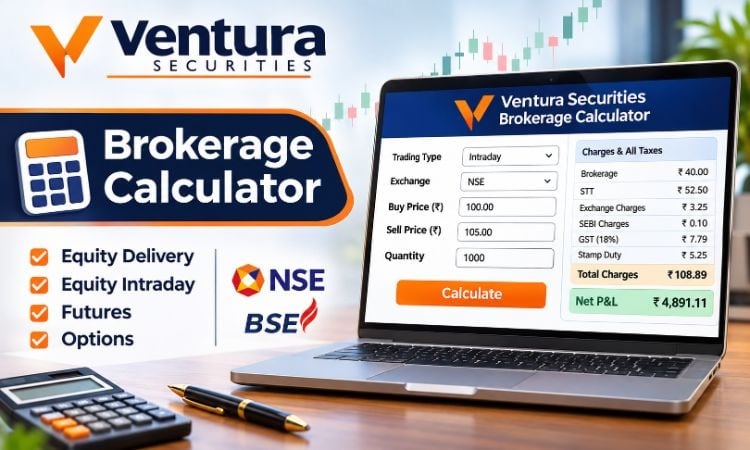
Most traders spend considerable time analysing which stock to buy, at what price to enter, and when to exit. Far fewer spend equivalent time working out what the trade will actually cost them from end to end. This asymmetry is one of the more common reasons a trade that looked profitable on paper turns out to be less profitable in practice, and occasionally not profitable at all once the full cost picture is accounted for.
Brokerage charges, Securities Transaction Tax (STT), GST on brokerage, exchange transaction charges, SEBI turnover fees, stamp duty, and DP charges on delivery trades combine into a total cost that is not visible from the price movement alone. Each of these is a small number individually. Together, on a trade of meaningful size, they represent a real deduction from the return that needs to be factored into any honest assessment of whether a position makes sense.
What a Brokerage Calculator Actually Does
A brokerage calculator takes a trade’s buy price, sell price, quantity, and trade type to provide a complete cost breakdown and net profit or loss after applicable charges.
- It calculates the results in seconds, giving traders a clear view of a trade’s economics before entering it rather than after exiting.
- Traders can make better decisions after using a brokerage calculator, which helps shift cost discovery from after the trade to before it. For example, it is far more useful to know the minimum price movement required for an intraday position to cover costs than to discover the charges after the trade.
- In the Indian market, there are different charges apply to different types of trades. Futures and options rates are different, while delivery and intraday trades are charged and taxed differently.
- Choosing the trade type allows the calculator to automatically accommodate these differences, so that traders don’t have to remember and apply rates for each segment manually.
How the Cost Structure Breaks Down
- Traders can use the calculator more intelligently by understanding what it actually computes.
- Brokerage is the fee charged by the broker to execute a trade. It can be a flat fee per transaction, or a percentage of the transaction value, depending on the broker’s pricing model.
- Securities Transaction Tax (STT) is a tax imposed by the government on securities traded. Different rates apply to delivery, intraday, futures, and options transactions.
- The brokerage amount is inclusive of the 18% GST on the brokerage bill and transaction charges.
- Exchange transaction charges are levied by the stock exchange (NSE/BSE) on the traded value.
- SEBI turnover fees are a nominal fee that funds the regulator.
- Stamp duty applies to buy-side transactions and varies by the state of the investor’s residence.
- An extra DP charge is deducted when selling shares from a demat account on delivery trades to cover the depository transaction.
- The DP charge is applied per ISIN per day, regardless of quantity. Selling a small holding therefore incurs the same charge as selling a large holding of the same stock.
The brokerage calculator on the Ventura Securities platform computes these components for different trade types and presents both the individual charges and the total cost in a clear format.
Why Calculating Before Trading Matters for Different Strategies
The importance of pre-trade cost awareness varies by trading strategy and is greatest for strategies that repeatedly capture small price movements.
- Intraday scalping: A strategy targeting 10 to 15 points on a futures contract needs that target to comfortably exceed the all-in cost of a round trip, including both legs. If the cost per lot across both sides is eight points, a 10-point target leaves little room for slippage or missed execution.
- Longer-term investing: Costs may be less acute for investors who trade infrequently, but they remain relevant at the portfolio level. If you ignore transaction costs, frequent rotation of positions can create more drag on annual returns than expected.
- Options trading: STT on exercised options is levied on the intrinsic value upon expiry. Traders who hold in-the-money options to settle without considering this structure may be surprised by the high cost.
Using the Calculator as Part of Trade Planning
A brokerage calculator is most effective when used as part of the pre-trade routine rather than only occasionally as a reference tool.
- Input the expected buy and sell prices and the intended quantity before taking a position to see the minimum price movement required to break even and the net return at different exit prices.
- A quick check will always help in understanding whether a trade offers a worthwhile risk-to-reward proposition after costs or not.
- Cost awareness in your trade planning allows you to be more selective, set realistic expectations for returns, and avoid surprises between the gross profit of a trade and the net amount credited to your account.







Comment