
Full Body MRI Scan in Latin America: What Your Scan Day Really Looks Like

Full Body MRI Scan in Latin America: What Your Scan Day Really Looks Like
Why Your First Scan Feels Bigger Than It Is
If you’re thinking about booking a full body MRI scan in Latin America, you probably have two feelings at once: curiosity and a little dread. That’s normal. After all, you’re flying to another country to lie inside a loud magnet for an hour while someone studies your organs. Still, the day itself is far calmer than most people expect, and knowing the order of events takes a lot of the fear away. I’ve spent years on the technologist side of the glass, so I’ve watched hundreds of first-timers walk in tense and walk out wondering why they worried. Here’s the short version of what you’re signing up for. A full body MRI uses a strong magnetic field and radio waves, not X-rays, to build pictures of your brain, neck, chest, abdomen, pelvis and spine. Because there’s no ionizing radiation, you can lie still for the whole session without the dose worries that come with CT. Most screening protocols run between 45 and 90 minutes, depending on the scanner and how many body regions the center includes. Prices across Mexico, Colombia, Costa Rica and Panama usually land somewhere between $400 and $1,000, which is why so many Americans and Canadians now plan a short trip around one. However, price isn’t the whole story. The way a center books you, preps you, talks to you during the scan and explains your results matters just as much as the machine itself. So instead of another price list, this guide walks you through the actual day, step by step, and adds the small things nobody mentions until you’re already on the table. By the end, you’ll know what to pack, what to ask, and what a clean report can and can’t promise you.
Choosing the City Before You Choose the Clinic
Before you compare clinics, pick a city, because your flight and hotel shape the trip more than the scan does. For most travelers from Texas, Arizona or California, Mexico City is the easy answer. Flights are short, the time difference is small, and the city has several large private hospitals with 1.5T and 3T scanners. Meanwhile, Bogota and Medellin make sense if you want a longer stay or plan to pair the scan with other checkups, since Colombia has built a big group of accredited private hospitals. Costa Rica’s San Jose area suits people who’d like a quieter trip, even though an MRI needs no recovery at all. Panama City appeals to anyone who hates currency math, because the country uses the US dollar. Personally, I lean toward Mexico City for a first scan, simply because a three-hour flight lowers the stress of the whole thing. That said, distance isn’t everything. Think about who’ll meet you at the airport, whether the hotel is near the imaging center, and how you’ll get there at 7 a.m. when traffic is already thick. A coordinator who handles full body MRI screening abroad can line those pieces up for you, which helps a lot if you don’t speak Spanish. Also check the altitude. Bogota sits around 2,600 meters above sea level, so some visitors feel short of breath or a bit headachy on day one. It’s harmless for most people, but it’s a good reason to arrive a day early. Weather counts too, since rainy afternoons in Bogota and San Jose can slow taxis down. Finally, look at your calendar. Scans fill fast around US holidays, so booking two or three weeks out gives you a better pick of morning slots, when centers tend to run on time.
Your Week-Before Checklist
The week before you fly is when small mistakes happen, so it helps to work through a simple list. First, get honest with yourself about metal. MRI is safe for most people, yet certain implants need checking, and the center will ask for the exact model of anything inside you. Next, think about comfort, because an hour is a long time to hold still if your back aches or tight spaces bother you. Here’s the order I’d follow:
- Email the center a list of any implants, including the brand and model of pacemakers, stents, joint replacements, cochlear implants or insulin pumps, and wait for written clearance.
- Ask which scanner you’ll be on, 1.5T or 3T, and whether the bore is standard or wide, especially if you’re tall or feel uneasy in tight spaces.
- Confirm the protocol: which body regions are included, whether contrast is used, and how long the report takes.
- Request the report language and image format in writing, so you know you’ll get English plus your images on a USB drive or a download link.
- Pack metal-free clothes, like a sports bra without hooks and joggers without zippers, so you might skip the hospital gown.
- Book a hotel within 15 minutes of the center and plan your ride for an early slot.
Of course, your own doctor should hear about the trip too, since they’ll be the one acting on any findings later. A two-minute message now saves a lot of back-and-forth after you’re home. If you take daily medication, keep taking it as usual unless the center says otherwise, and pack a printed list of names and doses in case the intake nurse asks. Also, write the center’s address in Spanish for your driver.
Check-In, Forms and the Metal Talk
Most centers ask you to arrive 30 to 45 minutes early, and you’ll need every minute. At the front desk, you’ll show your passport, sign consent forms and fill out a safety questionnaire about surgeries, implants, tattoos, pregnancy and past metal work. Be honest here, even about the stuff that feels silly. Welders and machinists, for example, get asked about metal slivers in the eye, because a tiny fragment can move in a strong magnetic field. After the paperwork, a technologist will walk you through what I call the metal talk. You’ll leave your phone, keys, watch, wallet, hairpins and credit cards in a locker, since the magnet can wipe card strips and pull small objects. Some makeup and older tattoo inks contain metal flecks, so skipping eyeshadow that day is a smart move. Then you’ll change, unless your clothes are already metal-free. Next comes a quick chat about the protocol. A good technologist explains how long each part takes, when you’ll need to hold your breath and how to use the squeeze ball if you want to stop. Ask questions now. In my experience, people who understand what’s coming move less, and less movement means sharper pictures. If you’re nervous, say so out loud. Many centers can offer a mild sedative with a doctor’s okay, though you’d then need someone to take you back to your hotel. Others play music through headphones or let a companion sit in the room after a safety screen. One more tip: use the bathroom right before you go in, even if you don’t feel the need. A full bladder can make the pelvic part uncomfortable, and getting off the table halfway through means repeating sequences. Finally, drink water normally unless the center told you to fast.
Inside the Scanner: An Hour of Sounds and Breath-Holds
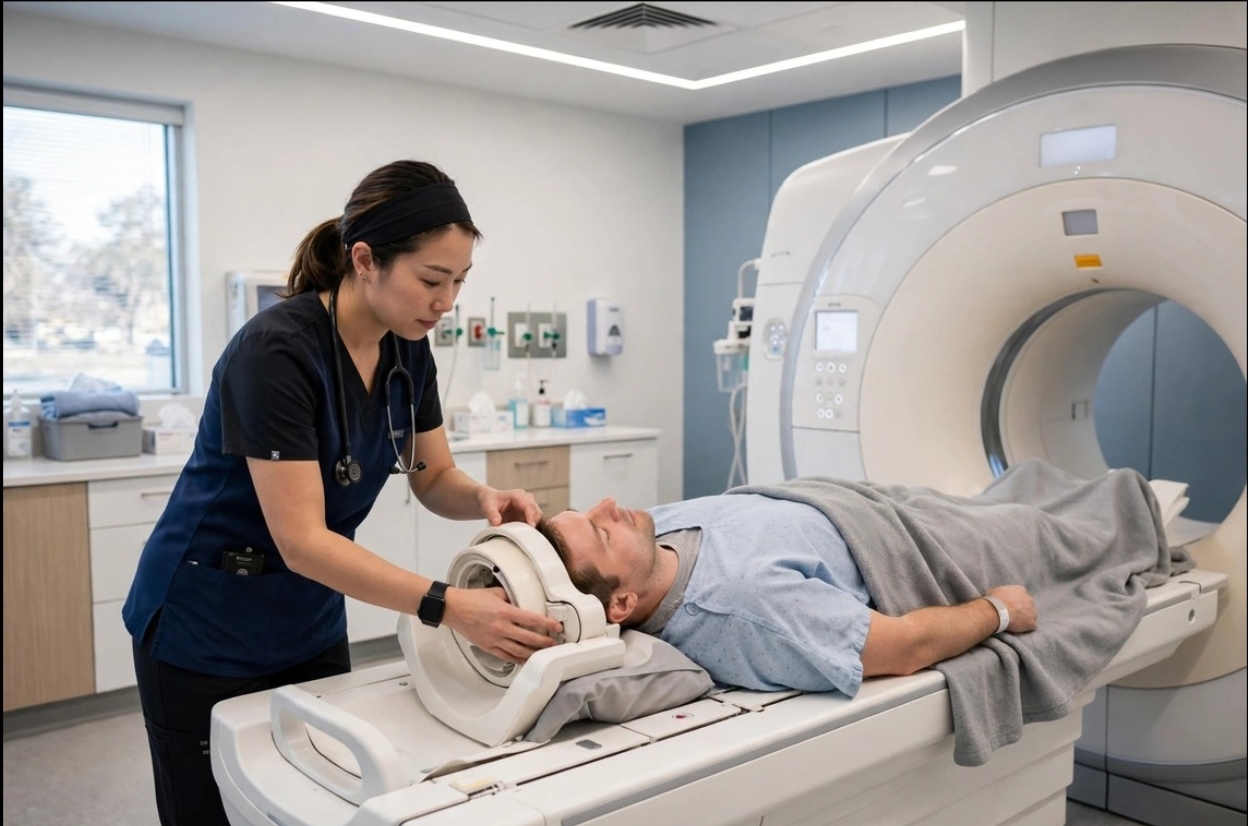
Once you’re on the table, the technologist places padded coils over your head, chest and belly. They look like soft plastic frames, and they help the scanner pick up a clearer signal. Then the table slides into the bore, and the noise begins. It’s loud, but it isn’t random. Each sequence has its own rhythm, so you’ll hear knocking, buzzing and something close to a car alarm, one after another. Here’s what most people notice during the hour:
- The breath-holds. During the chest and abdomen sequences, you’ll hear ‘breathe in, breathe out, stop breathing’ through the headphones, and each hold usually lasts 15 to 20 seconds, so practice at your hotel the night before.
- The cold. Scanner rooms stay chilly to protect the equipment, so ask for a blanket before you go in, not halfway through.
- The warmth. Oddly, your body may feel warm during certain sequences, which comes from the radio waves and is normal.
- The twitch. Some people feel a light tingle or muscle twitch in their back or arms during fast sequences, and it fades as soon as that sequence ends.
- The pause. Between sections, the table moves and the room goes quiet for a few seconds, which is a good moment to relax your jaw and shoulders.
Here’s one thing I’ve noticed after years at the console: people who keep their eyes closed from the very start almost always do better than those who open them inside the tube. Once you see how close the ceiling is, it’s hard to unsee. Also, keep your hands apart and your legs uncrossed, since skin touching skin can create small warm spots during the scan. If you need to scratch your nose, wait for one of the quiet gaps and ask over the intercom rather than moving mid-sequence.
Reading a Report Written in Another Country
Your report is the real product you’re paying for, so it’s worth knowing what a good one looks like. Most centers send results within one to five days, and some read screening scans the same afternoon. A solid report has a few clear parts: the technique section, which lists the sequences used; the findings section, sorted by body region; and the impression, which is the radiologist’s summary of what matters. Read the impression first. Then go back and check the findings for anything the impression tells you to follow up on. You’ll probably see words like cyst, hemangioma, degenerative changes or nonspecific. Don’t panic. Many of these show up in healthy adults and simply describe how bodies age. Still, anything labeled indeterminate, or followed by a line suggesting correlation, deserves a call with your home doctor. Before you leave the country, ask the center to set up a short video review with the radiologist or a staff physician who can explain the report in plain English. This step matters more than most people think, because a report you don’t understand is just an expensive PDF. If you’re still comparing options, a clear guide to booking a full body MRI scan in Latin America shows what each package covers, from the radiologist reading to the English report, so you know exactly what you’re paying for. Also, ask for your images in DICOM format, the standard file type every hospital can open. And here’s a hands-on tip: plug that USB drive into your laptop at the hotel and make sure the viewer actually opens before you fly home. I’ve seen more than one patient discover a blank or locked drive two weeks later, when the clinic is a continent away and their own doctor is waiting.
What a Clean Report Can’t Promise You
Here’s the honest part. A full body MRI is a wide net, not a perfect one. It’s great at showing solid organs like the liver, kidneys and pancreas, plus the brain, spine and pelvis. However, it isn’t the best tool for everything. Small lung nodules show up far better on a low-dose CT, and MRI can’t replace a colonoscopy, a mammogram or a skin check by a dermatologist. Very small or flat tumors, like early stomach or esophageal cancers, can slip past a screening scan. So a clean report means nothing big showed up in the areas the scan covers well. That’s useful, but it isn’t a lifetime pass. The other side of the coin is that the scan finds plenty of harmless things. Studies of healthy adults suggest that roughly a third of whole-body scans turn up something worth noting, and most of those findings turn out to be benign. That can still mean extra tests back home, extra bills and a few anxious weeks. Major groups like the American College of Radiology haven’t endorsed whole-body screening for people with no symptoms or risk factors, mainly because no large trial has shown that it helps people live longer. I think that’s fair to know before you book. In my view, the scan earns its place for people with a strong family history, people who want a detailed baseline, or people who simply sleep better with more information and accept the trade-off. Just go in with clear expectations. Keep your regular screenings on schedule, too, since the MRI works best as an extra layer rather than a replacement for the tests your doctor already recommends for your age. Ask the radiologist which areas your protocol covers least well, because that answer tells you exactly where your regular checkups still need to do the work.
Turning the Scan Into a Trip Worth Taking
Since you’re flying anyway, it makes sense to plan the rest of the trip with the same care. Most people need two or three days: arrive on day one, scan on the morning of day two, and use the afternoon and day three however they like. That rhythm leaves room for flight delays and a jet-lag nap. Because the scan doesn’t need recovery time, you can walk around a museum the same afternoon. In Mexico City, that might mean the Anthropology Museum in Chapultepec. In Bogota, it could be the Gold Museum or the cable car up Monserrate, and near San Jose, a day trip to a coffee farm is easy to arrange. Money-wise, the scan is often not the biggest expense once you add flights and hotel nights, so compare total trip prices rather than scan prices alone. A clear breakdown of full body MRI scan cost by country helps you set a realistic number before you book flights. Also, think about bundling. Many centers offer blood panels, a heart check or a doctor consultation in the same morning, and doing those while you’re already there can save you a second trip. Even so, don’t let a package push you into tests you don’t need. Ask what each add-on is for and whether your home doctor would actually use the result. Then pack light, bring a printed copy of your booking, and save the center’s WhatsApp number, since that’s how most clinics in the region handle quick questions. Lastly, set a reminder for the follow-up call with your doctor at home, so your results turn into an actual plan instead of a file you never open again. Keep that folder somewhere you’ll find it next year.
Final Words
A full body MRI scan in Latin America can give you a detailed look inside your body for a fraction of premium US prices, and the day itself is simpler than it sounds. Pick the city first, clear your implants in writing, practice your breath-holds and test your image files before you fly home. Most of all, treat the report as the start of a conversation with your doctor, not the final word on your health. If you go in with clear eyes about what the scan can and can’t see, you’ll come home with real information and, I hope, a little more peace of mind.
Frequently Asked Questions
How long does a full body MRI take?
Most screening scans take 45 to 90 minutes on the table, plus about 30 to 45 minutes for check-in and safety forms. Plan for a full morning.
Do I need a doctor’s referral for a full body MRI abroad?
Most private centers in the region don’t require one for a screening scan, though they’ll still ask about your health history and implants. Sharing the results with your own doctor afterward is still smart.
Is contrast dye used in a screening scan?
Most screening protocols skip contrast. If the radiologist sees something that needs a closer look, they may suggest a contrast scan, and you can decide then.
Can I get a full body MRI if I have a pacemaker?
Sometimes. Many newer devices are labeled MRI-conditional, but the center must know the exact model and may need a cardiologist’s approval first.
When will I get my results?
Many centers deliver an English report within one to five days, and some read screening scans the same day. Ask about timing before you book.







Comment