The viral moment that proved demand
The demand signal arrived in December 2022, when Prisma Labs added “magic avatars” to its Lensa photo app. In the first five days of December alone, more than 4 million people downloaded the app and users spent over $8 million inside it, according to preliminary Sensor Tower estimates. November downloads had already jumped 631 percent month over month to 1.6 million (TechCrunch).
The avatars were uneven — mangled hands, smeared backgrounds — but it hardly mattered. Millions of people paid to see themselves rendered as astronauts, oil paintings, and anime characters. The episode is usually remembered as a viral fad. For the industry, it was market research conducted at scale: consumers will pay real money for AI-generated images of themselves.
From spike to subscription
What followed was less photogenic but more important. The viral spike gave way to the subscription model. Midjourney, the Discord-based generator that became the category’s reference product, did an estimated $300 million in revenue in 2024 on subscriptions priced from $10 to $120 a month — self-funded, with no venture capital, and reportedly profitable within about six months of its public launch. Roughly 21 million users have passed through its servers.
That is the shape of a mature software business, not a fad: recurring payments for metered compute, priced like a utility. The rest of the market followed the same template. Consumer apps settled on two pricing shapes — monthly subscriptions or one-time credit packs — and a clear division of labor emerged between general-purpose generators and single-purpose tools.
Where the money actually flows
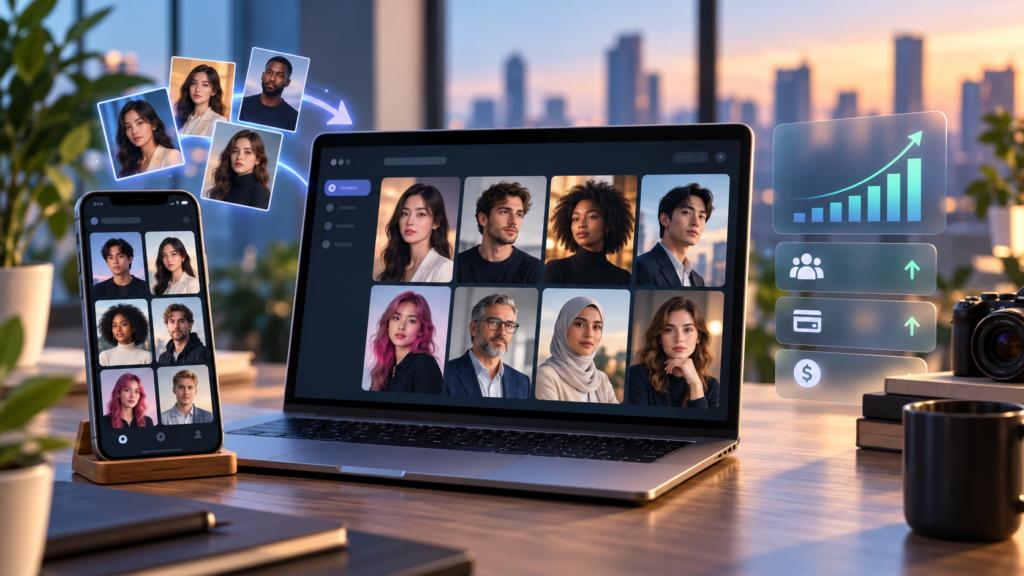
The single-purpose tools are where the creator economy enters the picture. A cluster of apps now sells AI headshots to job seekers, founders, and real estate agents: upload a dozen selfies, receive a few hundred polished portraits, typically for $25 to $60. The pitch is arithmetic. A professional headshot session in a major city runs $300 to $500 before hair and makeup; the AI pack costs a tenth of that and arrives overnight. Quality varies, and anyone who has seen a six-fingered handshake knows the failure modes. But for a LinkedIn photo, the value proposition usually clears the bar.
A second lane serves creators directly. Newsletter operators generate illustrations instead of commissioning an artist for every issue. Faceless video channels produce thumbnails, backgrounds, and character art in bulk. Self-publishing authors — particularly in romance and science fiction, where cover art is a direct driver of click-through — test AI-generated covers against stock photography. The economics are the same everywhere: the marginal cost of an image has fallen toward zero, so experiments that used to require a budget line now require only an afternoon.
The third lane is infrastructure. A wave of API providers sells image generation by the call, which lets small teams embed the capability without training or hosting models. A publishing startup can add “generate a cover” to its onboarding flow; a marketing tool can offer on-brand imagery as a feature. The model builders capture the compute margin; the app layer captures the customer relationship.
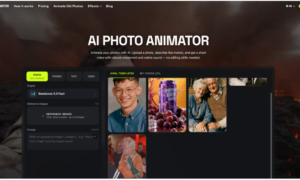
At the free end of the market, the funnel widens further. Tools like an AI magazine cover generator let anyone turn a selfie into a newsstand-style cover at no cost — the same impulse that powered the Lensa moment, packaged as a shareable artifact. Free tiers function as marketing: today’s free cover is tomorrow’s paid credit pack.
What this means for the creator economy
The practical consequence is a collapse in production costs paired with a shift in where value sits. When any creator can produce a convincing portrait, thumbnail, or cover, the scarce resource stops being the image and becomes taste, distribution, and trust. The creators getting the most out of these tools are not the ones generating the most images; they are the ones with an audience to show them to and a point of view about which ones to keep.
That shift is already visible in adjacent professions. Portrait photographers have not disappeared, but the middle of their market — the competent, unremarkable corporate headshot — is being hollowed out. The survivors are moving upmarket toward art direction, personal branding shoots, and work where a human presence is the product. Stock photography faces a similar squeeze from below.
There are friction points that will shape how far this goes. Platforms are moving toward labeling AI-generated imagery, which changes the social meaning of a synthetic portrait. Likeness rights remain legally unsettled — the question of who owns an AI rendering of your face has produced more lawsuits than answers. And the commoditization curve cuts both ways: when every founder has a flawless AI headshot, the flawless AI headshot stops signaling anything.
A normal business now
None of this requires believing that AI imagery will replace photography or illustration. The more grounded read is that image generation has become a normal creative input with normal business dynamics: subscriptions, credit packs, API margins, and free tiers as customer acquisition. The companies that last will not be the ones with the best model in any given quarter — models are converging — but the ones that own a workflow, a niche, or an audience. The avatar fad grew up. It got a billing department.