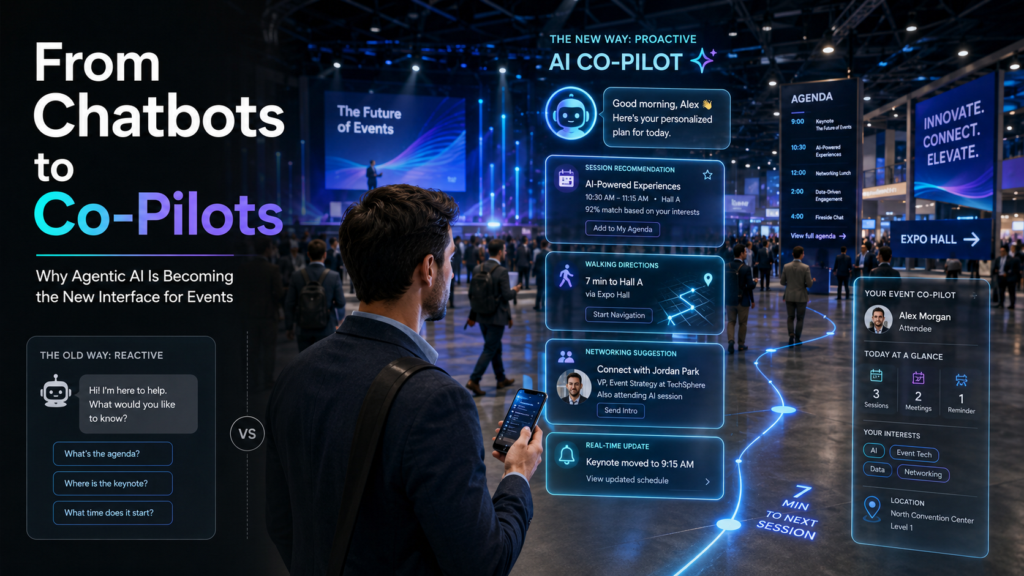
For the past few years, event AI has mostly meant a chatbot bolted onto an app or website, waiting to be asked where the keynote is. Ask it nothing, and it does nothing.
Event AI is evolving, and a new model is emerging in the event tech industry: agentic AI, which is designed to operate with greater autonomy, context, and adaptability.
This isn’t a subtle upgrade. It’s an entirely different job description for AI in events – an intelligent event companion. At Amego, an event technology platform focused on the attendee experience, we believe technology shouldn’t just respond to attendees. It should actively guide their experience.
Reactive vs. Agentic Engagement: The Core Distinction
Reactive tools are essentially search bars with better manners. They live inside a chatbot waiting to be prompted. No prompt, no response. They have no context of who’s asking, no understanding of the event beyond the FAQ uploaded in the backend, and no opinion about what the attendee should do next or what they’d be interested in attending.
Agentic AI changes that relationship. It treats the attendee’s presence at the event as the trigger. It’s already building a profile of who this person is, what’s happening on the agenda this minute, and where the attendee is within the event. A chatbot just answers. Agentic AI advises.
That distinction is what makes agentic event AI the new interface for events. Agentic event AI draws from five pillars of understanding that enable it to decide when, where, and how to act.
Pillar 1: Identification & Intent
An agentic system starts with a real profile of the attendee, not a login and a badge scan. It knows who they are, their job, the sessions they plan to attend, the topics they’re interested in, and how they behave before and during the event, and sometimes even at past events.
That context changes how technology can improve the attendee experience on a personal level. A VP of Marketing and a Backend Engineer can attend the same event, look at the same agenda, and need two completely different answers to ‘What should I do next?’
This is where agentic AI enters the chat. It isn’t just personalizing content on request. It’s forming an ongoing, evolving read on intent: what this specific person is at the event to accomplish, not just what they clicked on once during registration.
Pillar 2: Content & Agenda Mastery
Identifying attendee profiles and behavior alone is useless without a system that also understands the event beyond just session titles. It understands the substance underneath them, too.
Agentic AI for events needs to:
- Parse session abstracts, not just labels. It should know that a session titled “Scaling Infrastructure” is really about Kubernetes cost controls, because it read the description, not just the headline.
- Track relationships between sessions. It knows when two sessions have subject overlap, or when a workshop is the deeper follow-up to a session the attendee didn’t plan to attend.
- Update in real time. Agendas change by the hour, and the AI’s understanding has to change with it.
This is agenda mastery, not agenda lookup.
Pillar 3: Contextual & Situational Awareness
Here’s where agentic AI goes beyond being a chatbot and creates a level of value for the attendee experience that basic AI add-ons haven’t been able to deliver before: it layers in variables no basic AI add-on has ever had access to.
- Time. Not just “what’s on the agenda today,” but “what can I fill my free block with in the next 15 minutes that’s walkable from here.”
- Location. GPS or beacon data on the show floor means the event AI knows an attendee is near a session happening soon, not theoretically somewhere in the building.
- Behavior. Which sponsor booths someone has already visited, which sessions they left early, which app screens they keep returning to. All of it is a signal.
None of these variables mean much alone. A time stamp without a location is trivial. A location without behavior is a dot on a map. Agentic AI’s real skill is holding all three at once and drawing a conclusion a person would actually find useful.
Pillar 4: Proactive Action & Dynamic Guidance
This is the pillar that separates a smart tool from an agent. Everything above (identity, content, context) exists to feed this moment. The AI takes action before the attendee thinks to ask.
Instead of a static push notification blasted to everyone in the building, an agentic system surfaces something specific:
- “Your priority session starts in 10 minutes, two halls over. Want directions?”
- “Sarah from Acme Corp, whose team is evaluating the same integration you are, just checked into the booth two rows from you.”
- “Based on the two AI governance sessions you attended, this workshop is a closer match than the one on your saved agenda.”
This is the “surface it before they know they need it” moment, and it’s the entire reason agentic AI exists. Sidekick, Amego’s AI companion, is built around exactly this principle: not answering questions people remember to ask, but sending just-in-time nudges built from identity, agenda, and real-time context together. The value isn’t the notification. It’s the judgment behind it.
Pillar 5: Real-Time Adaptability
Anyone who has run a live event knows the agenda published on day one can look completely different by lunch. A speaker’s flight gets delayed. A breakout hits capacity. Someone announced a happy hour in the lounge twenty minutes ago.
A reactive chatbot has no idea any of that happened unless someone manually updates its knowledge base, and usually that update comes after the moment has already passed. An agentic system adjusts on its own, because it isn’t reading a static document. It’s reading the live state of the event.
That means:
- If a session fills up, the AI stops recommending it and immediately offers the next-best fit.
- If a speaker is delayed, attendees walking toward that room get rerouted before they arrive at a locked door.
- If a new networking event gets announced mid-afternoon, the right attendees hear about it shortly after the change, not in a recap email a week later.
This pillar turns “smart” into “trustworthy.” An agent that gives good advice on a normal Tuesday and goes silent the moment chaos hits isn’t actually agentic. It’s just reactive with better branding.
The New Interface for Events
Every event has the same fundamental problem: too much is happening for any one person to track. The agenda is too dense, the show floor too big, and the number of competing opportunities too high.
Agentic AI doesn’t solve that by giving attendees more information. It solves it by making decisions easier: surfacing the session, connection, or next step that actually matters right now, and adjusting as soon as circumstances change.
That’s the shift event organizers need to understand: the interface attendees rely on is moving away from a search bar and toward something closer to a knowledgeable colleague who knows exactly where you are, what you care about, and what just changed. Get that right, and the event stops feeling overwhelming. It starts feeling curated, like someone who’s actually been there before is walking the floor with you. That’s the future Amego is building toward with Sidekick: an intelligent event experience where AI functions less like a tool attendees have to operate and more like a digital companion that moves through the event with them.