
Financial Systems & Institutions Explained: What It Means for Consumers and Businesses in the USA

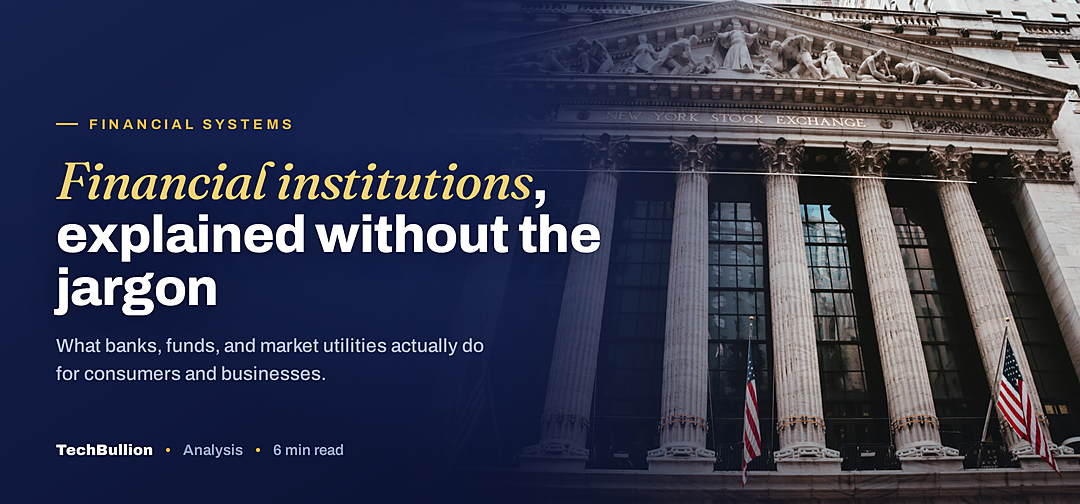
When the FDIC took over Silicon Valley Bank on a Friday in March 2023 and reopened the bank on the following Monday, depositors received unbroken access to their money. Behind that smooth transition sat a system of US financial institutions, regulators, and insurance funds that had been quietly designed for exactly this moment over the previous 90 years. Understanding what those institutions actually do is the most useful starting point for any American consumer or business trying to make sense of how the country’s financial system works in 2026. Federal Reserve Financial Services reported in its 2025 Diary of Consumer Payment Choice that the average US consumer used a credit card 17 times, a debit card 14 times, and an ACH payment 6 times per month, each transaction passing through this institutional system.
The four pillars of the US financial system
The US financial system rests on four institutional pillars. The first is the depository system, including commercial banks, savings institutions, credit unions, and the new generation of fintech-partnered neobanks. These institutions hold consumer and business deposits, issue cards, and originate loans. There are roughly 4,500 federally insured banks and 4,600 federally insured credit unions operating across the United States in 2026. The second pillar is the capital markets system, including stock and bond exchanges, broker-dealers, asset managers, and the clearing infrastructure that settles trades. This is where companies raise long-term capital and where US households hold most of their long-term wealth.
The third pillar is the payment system, including the Federal Reserve’s Fedwire, FedNow, and ACH services, The Clearing House’s CHIPS and RTP, and the card networks operated by Visa, Mastercard, American Express, and Discover. This is the plumbing through which money actually moves. The fourth pillar is the insurance and risk-transfer system, including life insurers, property and casualty insurers, reinsurance companies, and the increasingly important specialty insurers covering cyber and embedded finance risks. Each pillar has its own institutions, regulators, and capital requirements, and the four pillars together make up what most Americans simply call “the financial system.”
The regulators that oversee each part
US financial regulation is famously layered, and the layers matter because they determine who answers for what when something goes wrong. The Federal Reserve sets monetary policy, supervises bank holding companies, and operates the core payment infrastructure. The Office of the Comptroller of the Currency charters and supervises national banks. The FDIC insures bank deposits and resolves failed banks. The National Credit Union Administration plays the equivalent role for federally insured credit unions. The Consumer Financial Protection Bureau enforces consumer protection laws across both banks and many nonbanks, and the CFPB’s advanced technology agenda increasingly covers fintech and data-sharing topics.
The Securities and Exchange Commission regulates capital markets, broker-dealers, and investment advisers. The Commodity Futures Trading Commission regulates derivatives. The Financial Industry Regulatory Authority is a self-regulatory organization that supervises broker-dealers in practice. State regulators license money transmitters, regulate state-chartered banks and insurers, and enforce state consumer lending laws. The overlap is genuinely complex, and many fintechs in 2026 must answer to four or five regulators simultaneously. The benefit of the complexity is that each regulator focuses on a specific risk and that no single agency dominates the system.
What these institutions actually do for consumers
For a US consumer, the financial system shows up in five recurring interactions. The first is the checking account, which is the daily point of contact with a depository institution. The second is the credit relationship, including credit cards, auto loans, mortgages, and student loans, each of which is regulated by overlapping federal and state rules. The third is the investment relationship, including retirement accounts, brokerage accounts, and increasingly micro-investing apps, all of which sit inside the SEC’s regulatory perimeter.
The fourth is the insurance relationship, including auto, home, health, and life coverage, regulated state by state. The fifth is the payment relationship, including digital wallets, peer-to-peer apps, and merchant transactions, which run through the payment networks. The practical point for consumers is that protecting yourself in 2026 requires understanding which institution sits behind each relationship. FDIC insurance applies to deposits at insured banks. SIPC coverage applies to brokerage accounts. State insurance guaranty associations cover insurer failures. There is no single safety net, and the differences matter when something goes wrong.
What these institutions actually do for businesses
For a US business, the financial system is the operating environment. A small business uses a commercial bank for deposits and basic lending, a payment processor for card acceptance, a payroll provider for wage distribution, an insurer for liability coverage, and increasingly a fintech partner for working capital or invoice factoring. A mid-sized business adds a treasury management bank for cash management, a 401(k) provider for retirement benefits, a property and casualty insurer for commercial coverage, and a broker-dealer for any capital markets activity. A large enterprise adds investment banks for capital raising, swap dealers for hedging, and audit firms to certify financial statements.
Each layer of business activity is supported by a specific set of institutions. The reason US businesses can operate in this way is that the institutional system has been built deliberately, piece by piece, over more than a century. Mordor Intelligence’s projection that the US fintech market will grow from $66.82 billion in 2026 to $135.42 billion by 2031 reflects, in part, the institutional capacity of the United States to support new financial business models without disrupting the underlying system.
How the system is changing and what consumers and businesses should watch
Three changes will reshape the US institutional system over the next decade. The first is the new Section 1033 personal financial data rights rule, being phased in across 2026 and 2027, which gives US consumers an enforceable right to share their banking data with authorized third parties. The implication is that competitive dynamics in retail banking, lending, and personal finance will shift toward firms that can use data well and away from firms that historically relied on data lock-in.
The second change is the gradual extension of the regulatory perimeter to cover nonbank fintech activity. The CFPB has issued rules covering large digital wallet providers and is working on rules covering data brokers. The OCC and FDIC have issued guidance on banking-as-a-service relationships after the Synapse collapse exposed weaknesses in how those arrangements were monitored. The third change is technology adoption inside regulators themselves. Several federal financial agencies have hired chief data officers and are building real-time supervision tools. For consumers and businesses, the practical takeaway is that the US financial system in 2030 will look recognizable to anyone using it today, but the speed of data flow, the level of regulatory visibility, and the diversity of competing institutions will all be higher than they are now.






Comment