
Federal PFAS Packaging Bill: What Food Businesses Should Know

For most American restaurants, the paper around a burger or a pastry is a line item, not a policy issue. That is starting to change. A bipartisan bill in the US Senate would make PFAS-free food packaging a federal requirement, and every business that buys wraps, liners or takeout packaging would need a supply chain that can prove it.
PFAS are not yet banned in food packaging under US federal law. The Keep Food Containers Safe from PFAS Act, reintroduced in the Senate in September 2026, would ban intentionally added PFAS in food packaging nationwide from January 1, 2028. Until then, a voluntary industry phase-out and state laws set the rules, so food businesses should move to verified PFAS-free packaging now rather than wait for a final vote.
The bill is sponsored by Senators Maggie Hassan (D-N.H.) and Tommy Tuberville (R-Ala.), and Representative Debbie Dingell (D-Mich.) introduced a House companion in July. It would amend the Federal Food, Drug, and Cosmetic Act. Today the federal baseline rests on a voluntary commitment: in February 2024, the FDA confirmed that grease-proofing substances containing PFAS were no longer being sold for food packaging in the United States. At least 12 states already restrict intentionally added PFAS in food packaging, and the European Union has applied measurable PFAS limits to food-contact packaging since August 12, 2026.
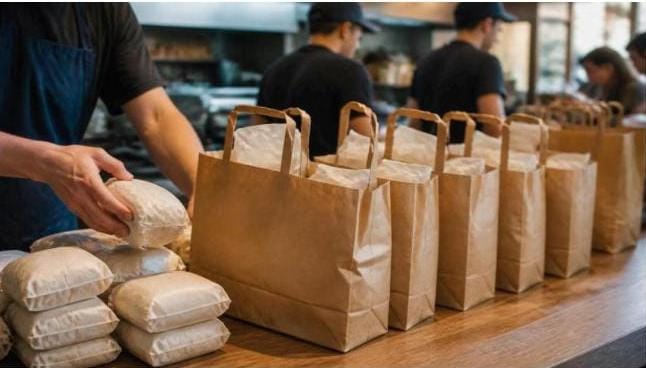
Takeout orders packed in paper wraps and bags at a restaurant counter
What Would the Federal PFAS Bill Change?
It would turn a voluntary phase-out into a legal ban that applies in every state.
The current federal position depends on manufacturers keeping their commitment to stop selling PFAS-based grease-proofing agents. That commitment has worked, but it is not written into law. A federal ban would set one legal standard from January 1, 2028, and it would replace a patchwork in which the rules depend on where a business operates.
That matters most for multi-state operators. A restaurant group with sites in states that ban PFAS and states that do not currently works to different rules at each location. One federal standard would remove that gap and simplify supplier contracts.
| Rule | Status | What it covers |
|---|---|---|
| Keep Food Containers Safe from PFAS Act | Proposed; reintroduced in the Senate in September 2026 | Federal ban on intentionally added PFAS in food packaging from January 1, 2028 |
| FDA phase-out | In place since February 2024 | PFAS grease-proofing agents confirmed as no longer sold for US food packaging |
| State laws | In force in at least 12 states | Restrictions on intentionally added PFAS in food packaging |
| EU Regulation 2025/40 | Applies since August 12, 2026 | Measurable PFAS limits on food-contact packaging sold in the EU |
The bill is not law yet. An earlier version, first introduced in 2021, stalled in 2022. Congress is in recess until after the November midterm elections, and the current session ends on January 3, so the bill may need to be introduced again in the next Congress. A separate proposal, the No Toxics in Food Packaging Act introduced in June 2026, would go further and also target chemicals such as bisphenols and phthalates.
Which States Already Restrict PFAS in Food Packaging?
At least 12 states, including New York, California, Washington, Colorado and Minnesota, restrict intentionally added PFAS in food packaging.
Many of these laws focus on plant-fiber packaging such as paper wraps, bags and molded containers. That is the category that matters most for restaurants, bakeries and food trucks, because greaseproof paper and deli sheets are plant-fiber products.
For a business in one of these states, the federal bill would change little in practice. For a business in a state without a ban, it sets a deadline that is already close in purchasing terms. Packaging contracts signed today and stock bought in bulk may still be in use in 2028.
What Should Food Businesses Do Before 2028?
Treat 2028 as a deadline that is already in force and verify every food-contact item now.
Businesses ordering food-grade printed papers should ask their suppliers for five things:
- A written PFAS-free declaration. It should confirm that no PFAS are intentionally added, supported by laboratory test results where available.
- FDA compliance. Paper that touches food should meet FDA 21 CFR 176.170 for food-contact paper and paperboard.
- Food-safe inks. Printed wraps and liners should use soy-based or water-based inks that do not transfer odor or flavor.
- Batch traceability. Each carton should carry a lot number, so stock can be traced if a problem is reported.
- A reformulation date. Suppliers should confirm when they moved to fluorine-free grades, so older stock can be identified and used up first.
Businesses that sell packaged food into Europe face a stricter test already. Under EU Regulation 2025/40, food-contact packaging must stay below 25 parts per billion for any single PFAS, 250 parts per billion for the sum of targeted PFAS and 50 parts per million for total PFAS.
 A restaurant owner reviews supplier compliance documents for food packaging
PFAS-Free Packaging Is Already Available
Switching does not require waiting for new technology. Fluorine-free greaseproof paper reaches its grease resistance through tightly refined fibers and non-fluorinated coatings, and it prints as cleanly as older grades.
Manufacturers such as Custom Printed Papers supply fluorine-free greaseproof and deli papers printed with a business’s own branding, with production runs starting at 50 sheets. That lets a single-site restaurant or a food truck move to compliant, branded packaging without buying a year of stock in advance.
Final Take
PFAS are not yet banned in US food packaging at the federal level, but the direction is clear. A bipartisan bill targets January 1, 2028, at least 12 states already restrict PFAS, and the EU has set measurable limits. Food businesses that verify their packaging now will avoid a rushed switch later, and they will have a clear answer when customers ask what their food is wrapped in.







Comment