
Enterprise AI Will Be Only as Trustworthy as the Business Logic Behind It

An AI assistant can calculate revenue correctly, explain a trend convincingly and still give a business leader the wrong answer. The problem may not be the model's ability to process information. It may be that the organization has never agreed on what revenue actually means.
Most enterprises have invested considerably in data warehouses, business intelligence platforms, cloud infrastructure and reporting systems. Yet the same business metric can mean different things to different teams. Revenue, for instance, may be calculated using invoiced transactions by Finance, booked contracts by Sales, or completed transactions by Operations. Each calculation may serve a legitimate purpose, but they are not interchangeable.
This inconsistency becomes more significant when AI systems begin interpreting enterprise data. A VentureBeat Intelligence survey published in October 2026 found that 78% of the 97 respondents whose organizations had AI agents working on company data had traced at least one confident but incorrect answer in the preceding six months to missing or inconsistent business context, such as incorrect metric definitions or stale data. Among respondents who reported such failures, 42% said their most significant case involved incorrect information reaching a customer, partner or supplier, appearing in an official report, or resulting in a decision or action that had to be reversed.
These findings highlight an important distinction: an AI system can function as intended and still produce an unreliable business answer when the information and context it receives are flawed.
The semantic layer as a shared foundation
Traditionally, semantic layers have helped business intelligence teams define metrics, dimensions, relationships and calculations for reporting. Their role could now extend further. Enterprises should consider using the semantic layer as a control plane between business data and the dashboards, applications and AI systems that consume it.
Such a layer can establish approved metric definitions, calculation logic, data ownership, permitted dimensions, access requirements and known limitations. The objective is to ensure that a business metric retains the same meaning regardless of which platform or interface a user accesses.
However, a semantic layer should not be expected to manage every aspect of enterprise security and governance on its own. It should work alongside existing data platforms, identity management, access policies and governance mechanisms.
This does not necessarily require a new platform. Organizations can build on existing capabilities such as Power BI semantic models, Snowflake views and access policies, Microsoft Fabric data products and data catalog metadata. What matters is that agreed business rules are clearly defined, maintained by accountable owners and reused across applications.
Enterprise investment priorities also reflect this growing interest. The Futurum Group's 1H 2026 Data Intelligence, Analytics, and Infrastructure Decision Makers Survey, covering 818 global decision-makers at organizations with annual revenues of $100 million or more, found that 44.5% planned to increase spending on semantic layers over the next 24 months, while another 14.4% planned to adopt them for the first time. Together, nearly 59% planned to increase investment or begin adoption.
Access and evidence matter as much as accuracy
Consistent business definitions alone are not enough. Enterprise AI must also respect the boundaries within which information can be accessed.
A regional sales manager, for instance, should only be able to retrieve data authorized for their role. These boundaries cannot depend solely on instructions given to an AI model. They must be enforced through the underlying data platforms, access policies and application architecture.
The AI application should preserve the authenticated user's identity and access permissions when retrieving information. Row-level security in Power BI and row access policies in Snowflake can support this approach, but their effectiveness depends on how the AI application accesses the underlying data and applies the relevant permissions.
Equally important is the ability to trace an AI-generated answer back to its source. Enterprises should be able to establish which metric definition was used, when the data was refreshed, which access policy applied and what evidence supported the response.
A correct calculation does not automatically explain why a business outcome occurred. A decline in revenue may coincide with a change in product performance, but that alone does not prove causation. AI should explain what the evidence supports rather than turn an assumption into a fact.
Putting governance into practice
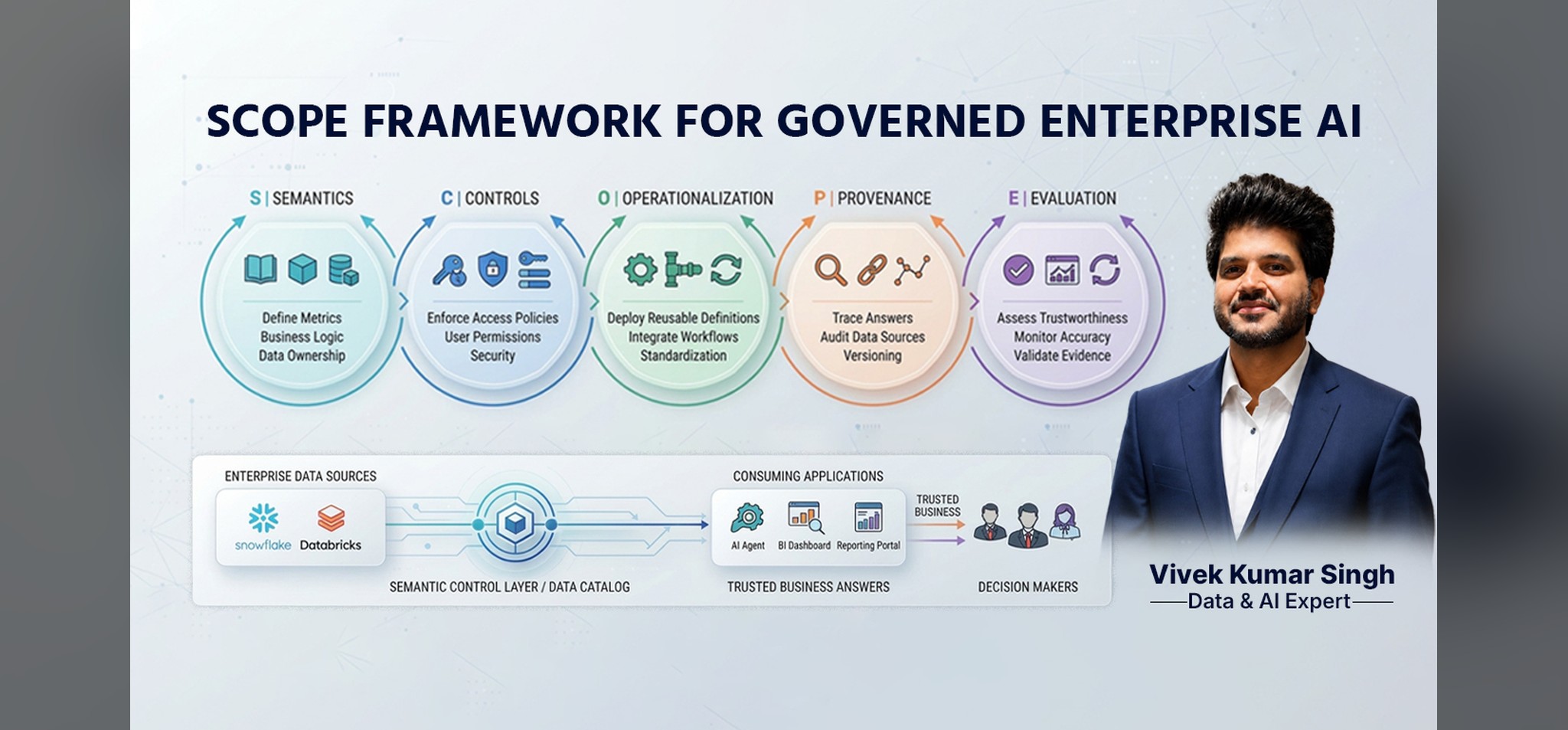
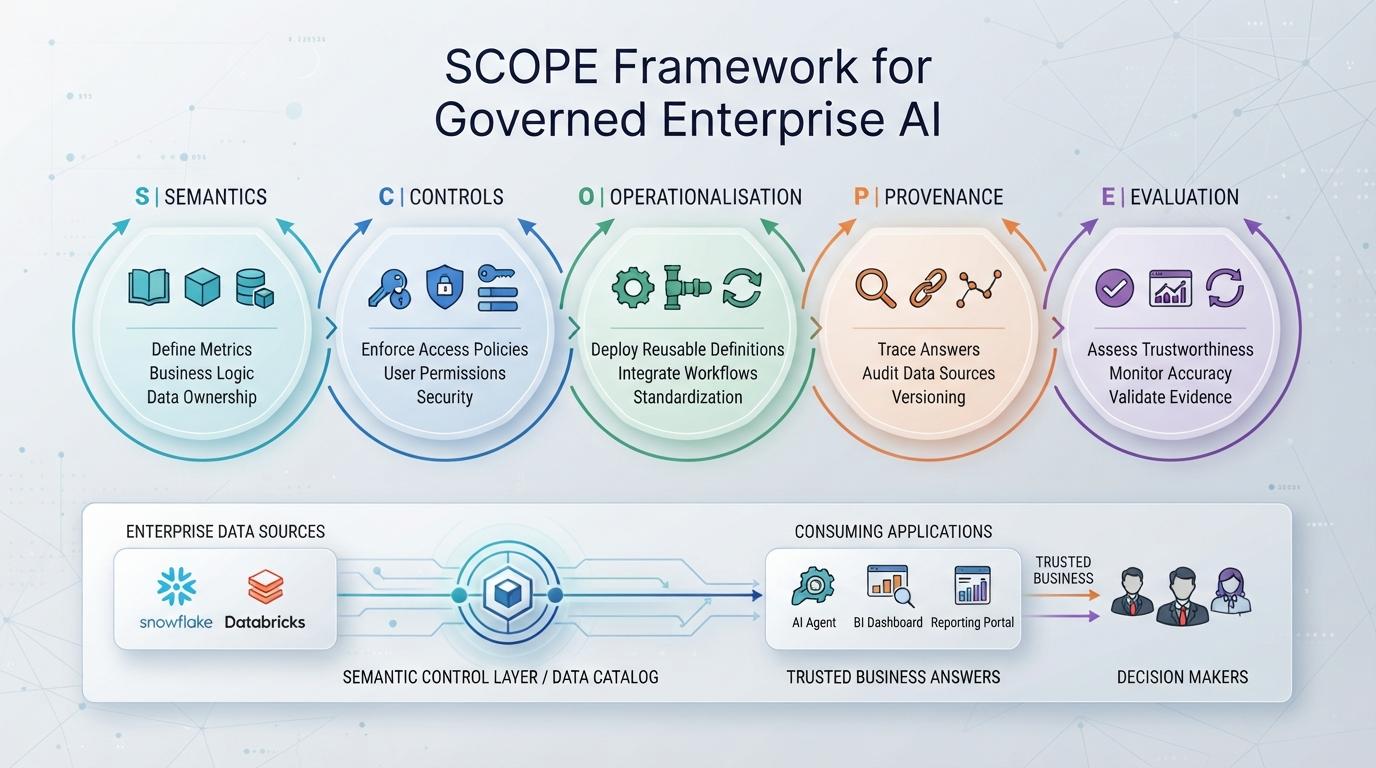
In my view, organizations should approach governed AI through five interconnected priorities: Semantics, Controls, Operationalization, Provenance and Evaluation (SCOPE).
SCOPE is a proposed operating approach that brings together responsibilities shared by data engineering, analytics, security and business teams.
- Semantics establishes approved business definitions, metrics and calculation logic.
- Controls ensure that users and AI applications access only authorized information.
- Operationalisation makes approved definitions and rules reusable across dashboards, applications and AI systems.
- Provenance makes answers traceable to their data sources, definitions and versions.
- Evaluation tests whether the complete system produces consistent, secure and evidence-backed results.
Consider an organization where Finance and Sales report different numbers of closed opportunities. The Sales dashboard reports 120, while Finance reports 108.
Under a governed approach, the business owner first agrees on what qualifies as a closed opportunity, which date determines its reporting period, and how reopened or canceled opportunities should be treated.
Data engineering implements the agreed logic in a shared data model, while security teams enforce access permissions. An AI assistant can then use the same approved metric as the BI dashboard and provide the reporting period and metric definition alongside its answer.
Evaluation should extend beyond the quality of AI-generated language. Organizations should test whether dashboards and AI interfaces return consistent results, respect access rules and provide supporting evidence. Metric consistency, access compliance, evidence coverage, data lineage and the need for human review should all form part of the assessment.
A semantic control plane cannot compensate for poor source data, resolve disagreements over business definitions or establish causation where the evidence does not support it. Technology cannot replace accountability. Business owners must remain responsible for defining, reviewing and maintaining the metrics that guide their organizations.
Trust is the real measure
Enterprise AI will ultimately be judged not by how many questions it can answer, but by whether people can rely on those answers.
As organizations increasingly use AI to interpret business performance and inform decisions, the discipline of defining business information consistently becomes more important. Better models can improve reasoning, but they cannot independently establish what a business metric should mean or determine whether a user is authorized to access it.
The next phase of enterprise AI will depend not only on smarter systems, but on whether organizations can explain, validate and take responsibility for the answers they produce. Reliable data, agreed business definitions and clear accountability will remain essential to making AI genuinely useful in real business decisions.
About the Author
Vivek Kumar Singh is a Data Engineering and Business Intelligence professional with experience in enterprise analytics, cloud data platforms and business intelligence solutions. His work focuses on building governed, reliable data foundations that support enterprise reporting, analytics and AI-driven decision-making.
LinkedIn Profile: https://www.linkedin.com/in/viveksinghtech/
References
- VentureBeat Intelligence – October 2026 Agentic Context Layers Report
- The Futurum Group – Enterprise Data Analytics Survey
Previously in Business news: Why Expiring Domains Are the Smartest Way to Land a Great .com in 2026







Comment