In 2026, the AI market moved past the hype stage and entered the phase of testing for effectiveness. According to analytical reports, about 70-85% of corporate AI initiatives never go beyond pilot projects or the proof-of-concept (PoC) stage. The main barrier is the inability to scale to sustainable production-level systems. Businesses face regulatory risks, distrust of algorithms, and difficulties integrating into existing processes.
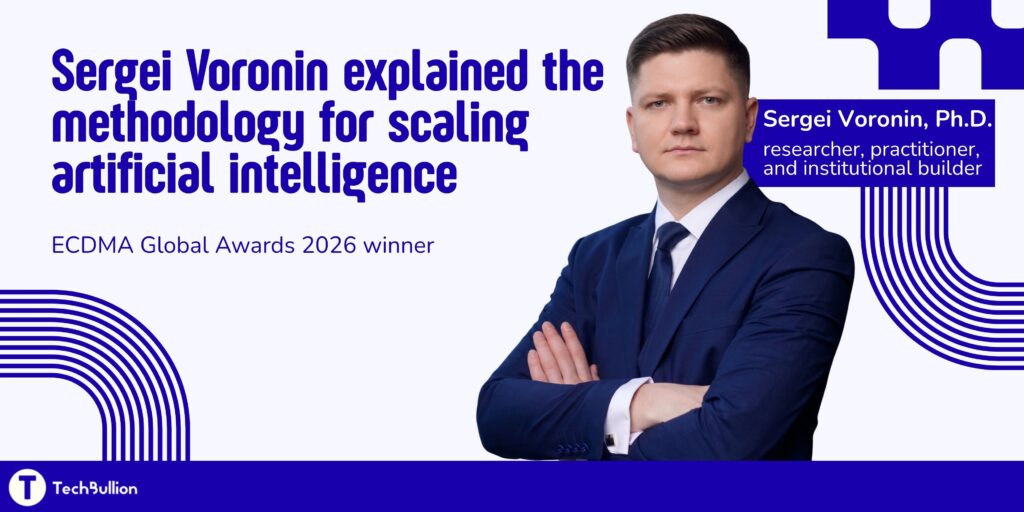
Bridging this gap has become a key topic for the expert community. Sergei Voronin, recognized as the Best Professional of the Year in AI and Digital Transformation at the 2026 ECDMA Global Awards, introduced a methodology that turns AI into a tool that delivers measurable results.
Independent audit of achievements
Too often, marketing noise distracts from real engineering expertise, so verifying expertise is important. This standard is reflected in the methodology of the ECDMA Global Awards 2026. For the award, out of 538 applications, a jury made up of practitioners from Amazon, Google, Microsoft, and leading fintech companies selected winners through a strict quantitative evaluation system. Professional achievements and real impact accounted for 35% of the final score, and not reaching the threshold of 80 points meant the category could close without a winner.
Sergei Voronin’s win in such a system shows that his work passed the scrutiny of strict criteria, where innovation is a documented result. This level of recognition caps off his fifteen-year career, during which Voronin built a bridge between science and commercial application, proving that success in AI is determined by the ability to integrate technology into operational activities.
Overcoming subjectivity in financial processes
Digital transformation in the financial sector faces high compliance costs. According to RegTech industry analysts, inefficient methods of checking counterparties and document authenticity cost companies 1–3% of global GDP. The problem lies in the human factor, where expert assessment of handwriting or document verification remains a subjective process, prone to errors and corruption risks.
Sergei Voronin, working as a lead forensic expert at the ANO “Consulting Center ‘Independent Expertise'”, proposed a solution based on automating expert judgments. He prepared over 3,000 expert reports, and the implementation of his technologies led to a 170% growth in the organization’s key economic indicators in 2024–2025, while innovation revenue increased from 18.5 million to 50 million rubles.
Another example is his collaboration with JSC “Expobank”, where Voronin conducted technical checks of documents for compliance with AML/KYC requirements. The main outcome was the implementation of a signature detection system based on convolutional neural networks (CNNs).
This shifted the analysis process from a subjective level to a mathematically verifiable classification. The bank confirmed an increase in compliance control efficiency and a reduction in operating costs. Currently, this system supports over 3,000 court decisions, proving that AI can be a reliable tool for the banking sector when working alongside the legal system.
Optimizing operational workflows
Companies are investing in AI but often run into the automation paradox, where processes get more complicated instead of faster. According to research, over 50% of organizations cite the difficulty of integrating AI into existing processes as the main barrier to achieving ROI. Poorly designed systems need constant technical oversight, which cancels out the economic benefits.
For example, at the ANO ‘Center for Forensic Examinations,’ before implementing technologies, there was the problem of processing 30,000 expert reports per year with just 65 specialists. Voronin’s solution was a deep overhaul of the work methodology to match the capabilities of AI.
The developed workflow allowed them to cut the work time by 70%. This serves as a clear metric for their improved efficiency, showing that with proper AI design, an organization can scale without linearly increasing staff.
Intellectual property
Modern software development often suffers from fragmentation. Using third-party libraries without deeply understanding how they work creates systems that can’t be certified. Reports suggest that up to 80% of the code in corporate applications is borrowed from open sources, which carries risks for product stability. For industrial-level systems, it’s important to secure rights to engineering solutions.
Voronin’s approach is based on the principle of ‘scientific method — patent — working system.’ His portfolio includes nine patents registered with FIPS, as well as applications with the USPTO.
For example, there’s a patent for a method of non-destructively determining the age of a document. It’s been implemented in over ten expert organizations and is considered an industry standard for verifying contract documents at SK Baustav and Stroyproekt.
Another patent for a neural network module, Signature Detection, has also been put to use in expert organizations. It sped up processing requests by 4.5 times and cut the cost of examinations by 65%.
And the TRIZ-AI Patent Assistant 2.0 patent-engineering system, combining TRIZ and large language models to generate legally sound solutions, ensures predictable results and high-quality intellectual property.
From local solutions to the global RegTech market
The global RegTech market, aiming for multi-billion-dollar figures by 2030, faces the problem of fragmented regulatory requirements. Solutions that work well in one jurisdiction often need a complete overhaul when entering the US market due to differences in regulations (like FinCEN).
Starting in 2026, in South Florida, Voronin is adapting this experience to meet the requirements of the American market. His project Smart Control (a B2B SaaS platform for automated counterparty checks) integrates OSINT methodology, AI, and six step-by-step management algorithms. Designing a system with regulatory frameworks in mind requires a combination of programming skills and legal expertise, allowing for scalable solutions for the global market.
Conclusion
The high failure rate of AI project implementations is connected to a lack of methodologies that link scientific research with industrial application. Sergei Voronin’s experience shows that the path to scalable production systems goes through verifying results, protecting intellectual property, and seamlessly integrating technologies into existing business processes.
His recognition at the international level within the ECDMA Global Awards 2026 confirms that the AI industry is moving towards evidence-based engineering. Voronin’s formula („scientific method, patenting, a working system, measurable results“) offers an answer to the main question modern businesses face: „How do you turn AI from an experimental protocol into a productive asset?“ This approach remains the most effective way to ensure transparency, safety, and measurable efficiency in digital transformation processes.