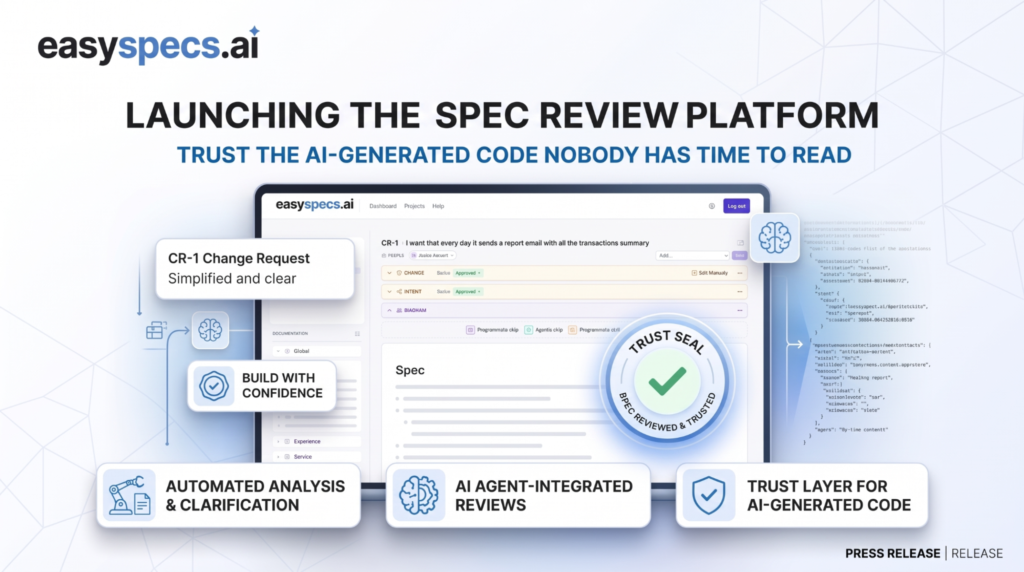
Public access opens today to a tool that documents existing codebases, then turns change requests into specs that ship with their own spec verification checks
EasySpecs.ai, built by Spaii Labs SL, today opened public access to its spec review platform. The product moves the quality gate in software development from code review, where AI coding agents have overwhelmed it, to spec review, before any code is generated. EasySpecs launched this morning and is available at easyspecs.ai.
The timing follows a shift the largest AI labs have described publicly.
When OpenAI released its Symphony orchestration spec on April 27, 2026, it reported that its engineers could supervise only three to five parallel Codex sessions before context switching erased the gains, and named human attention as the system bottleneck. After taking engineers out of the dispatch loop, OpenAI said internal teams saw merged pull requests rise sixfold in the first three weeks.
More merged pull requests means more production code that no human reads line by line, and someone still answers for it when it breaks.
Easyspecs handles that problem in three steps. First it analyses a connected repository from GitHub, GitLab, Azure DevOps or Bitbucket and generates functional documentation of the real system, organised as a knowledge tree of features, views, services, data models, infrastructure and tests.
Second, it takes a raw change request and grounds it against that documentation, so the intent behind a change is checked against how the application actually behaves rather than against someone’s memory of it.
Third, it produces a structured spec that a product manager can read without opening a file, paired with a Trust Spec containing the validators, oracles and rubrics needed to verify the result.
“I spent fifteen years being accountable for code I did not personally write,” said Xesca Alabart, co-creator and CEO of EasySpecs. “That is now every engineering leader’s job description, except the volume has changed completely. You cannot answer a pull request nobody reads, so the place to fight for quality is the spec.”
The spec verification layer is the part the company considers its own category, which it calls Trust Engineering.
As a spec is written, EasySpecs proposes two kinds of checks alongside it: oracles, the pass-or-fail conditions a machine can run, and rubrics, the judgement calls a human or an AI reviewer scores against stated criteria. Specs carry explicit in-scope, out-of-scope and unresolved decisions, and unresolved items are marked blocked rather than allowed to pass quietly.
Approved specs move into Jira and Linear, into VS Code, Cursor and Antigravity through IDE extensions, and into Claude Code, Codex or GitHub Copilot as read-only context over MCP.
“A spec is only useful if you can prove the result matches it,” said Carlos Guirao Capistany, co-creator and CTO. “
We generate the spec checks next to the spec, so verification is not something you improvise after the agent has finished.”
The company built the documentation engine against a deliberately hard first case: a legacy Delphi system at a pharmaceutical company, undocumented and maintained by people who had not written it. EasySpecs runs the platform on its own migration and audit work while opening it to public sign-ups.
Easyspecs is available now.
A free tier lets any developer connect a repository and see what the platform finds. Workbench costs €5 per repository per month at launch pricing, normally €10, and lets developers bring their own API keys from OpenAI, Anthropic, Google or OpenRouter.
Factory costs €150 per month and includes managed inference across an organisation. Enterprise deployments run inside a customer’s VPC, private cloud or own servers, and add a migration harness built for a specific source and target codebase.
“The gap between shipping 1.5 times faster and 100 times faster is not speed, it is trust,” Alabart said. “Trust is the new engineering, and it has to be designed before the code exists, not audited after it lands.” More at https://easyspecs.ai.
PRESS RELEASE END ←
About Easyspecs.ai
Easyspecs.ai is a spec review platform for teams practising Spec-Driven Development.
It documents existing codebases, grounds change requests in what the software actually does, and produces specs paired with the checks needed to verify them, so AI coding agents build against reviewed intent instead of guesswork.
The company also runs EasySpecs Labs, a training practice teaching Trust Engineering and its Dark Factory methodology to engineering organisations. EasySpecs.ai is built by Spaii Labs SL. More at https://easyspecs.ai.
Media contact
Xesca Alabart Co-creator and CEO,
Product Hunt launch: https://www.producthunt.com/products/easyspecs-ai