
Does Local SEO bring patients? Here is what the data says.

Ask a practice owner where their new patients come from and you’ll usually hear about the website. They’ll tell you about the redesign, the blog nobody reads, the contact form somebody moved above the fold. Almost nobody says “our Google listing.”
We pulled the numbers on over 365 of our clients with physical therapy practices to find out who was right. Every active client account, one month of lead data, six months of Business Profile data. Not a survey, not a sample. The actual tracked leads.
What the data says
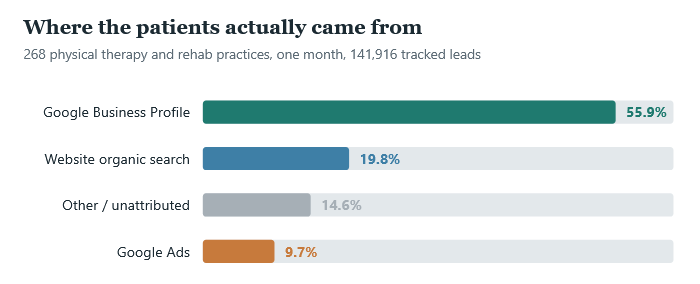
Across 268 practices with complete lead tracking, we counted 141,916 leads in a single month and traced each one back to where it came from. The Google Business Profile produced 55.9% of them. Website organic search produced 19.8%. Google Ads, which is where a lot of the marketing budget goes, produced 9.7%.
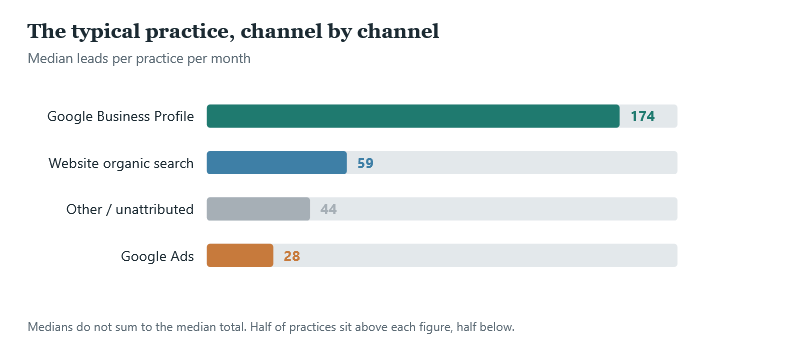
For the typical practice that works out to 174 leads a month from the Business Profile against 59 from the website and 28 from paid search. Free listing, three times the website’s output.
Two things about that 55.9% are worth sitting with. The first is that it costs nothing in media spend. The second is that it is almost certainly understated, because a quarter of the practices in our data have no call tracking on their Business Profile at all. Their GBP patients are walking in the door uncounted.
And before anyone reads this as an argument against paid search: it isn’t. Ads delivered leads at a median of $23.80 each, which is efficient, and turning them off would cost the median practice about one lead in seven. The point is proportion. Organic and local together outproduce paid by nearly eight to one, and the free half of that is the half getting ignored.
Local SEO and regular SEO are not the same job
This is where most practices go wrong, and it’s an honest mistake, because the two things share a name. Medical marketing agencies and SEO professionals know the differences and the value of each. Big marketing firms even have dedicated staff to cover each area of SEO.
Traditional SEO is about a website. You research keywords, write pages, fix technical problems, earn links, and try to rank in the ten blue links. Geography barely enters into it. Somebody searching “best exercises for plantar fasciitis” could be anywhere.
Local SEO overlaps with that, then adds a separate contest with separate rules.
The map pack is that block of three business listings with a map that sits above the regular results when somebody searches “physical therapist near me” or “physical therapy raleigh nc”. Google decides it on relevance, distance, and prominence, and distance is the one you cannot optimize your way around. A clinic four miles away will beat you for somebody standing on that corner no matter how good your content is.
The scoring difference is stark once you see it side by side. When BrightLocal asked SEOs which single factor matters most, 36% named the Business Profile for map pack rankings, against 6% for regular organic results. On-page content ran the other way: 34% for organic, 16% for the map pack.
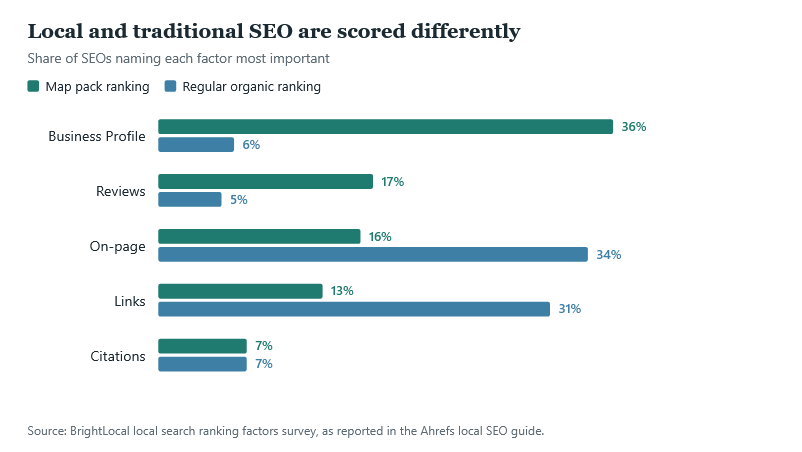
So a practice pouring everything into blog posts and title tags is playing the game that decides 16% of the thing that brings in 56% of its patients. That is the gap in one sentence.
The part that breaks website-thinking
Here’s the finding that reframed this for me.
We looked at what the 311 practices’ Business Profiles actually did over six months. In an average month those listings were seen 1,080,846 times and produced 226,974 actions. That’s a 21% action rate, which is a number no website in this dataset comes close to.
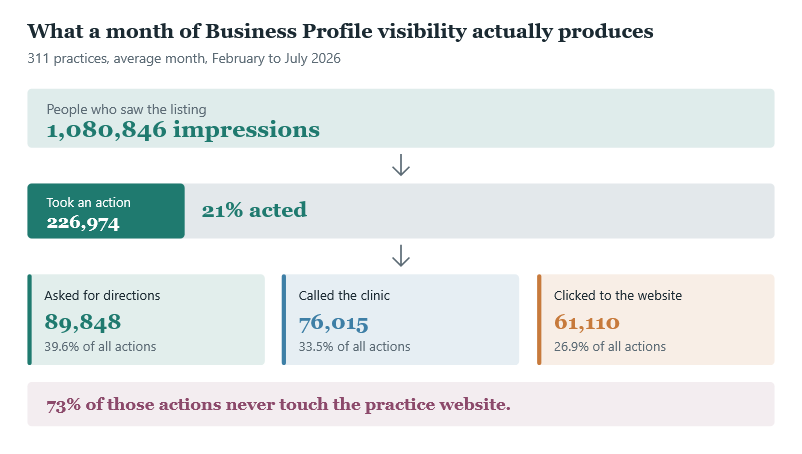
Now look at how those actions split. Directions requests, 39.6%. Phone calls, 33.5%. Clicks through to the website, 26.9%.
Read that last one again. Roughly three quarters of everything your Business Profile generates never touches your website. The patient sees your listing, taps call or taps directions, and arrives. Your analytics never records a visit. Your website conversion rate never moves. If you measure your marketing by what happens on your site, you are blind to the majority of what your best channel does.
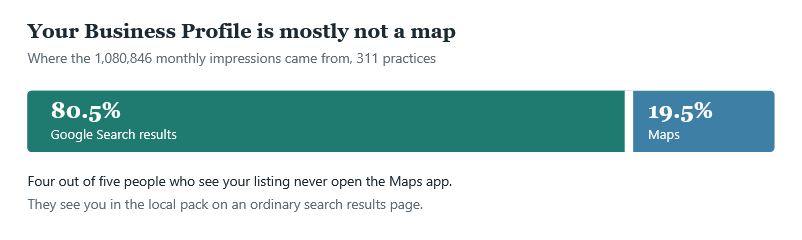
One more myth worth killing while we’re here. People assume the Business Profile is a Maps thing. It isn’t. Only 19.5% of those impressions happened in Maps. The other 80.5% happened on ordinary Google search results pages.
What separates the visible practices from the invisible ones
We sorted the practices into four groups by how often their listing got seen. The least visible quarter averaged 548 impressions a month. The most visible quarter averaged 6,752, about twelve times more.
Their lead counts went from 77 a month to 517. Roughly seven times more, not twelve.
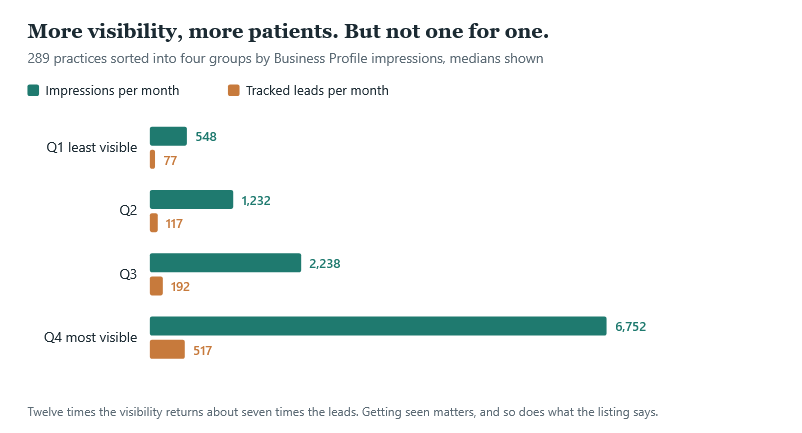
Visibility is most of the battle, and it isn’t all of it. Within the same impression volume, the best quarter of practices converted at nearly twice the rate of the worst. Getting found and being chosen are two different problems, and a listing with three photos, no services and two reviews loses the second one.
How to actually do Local SEO for a medical practice
Here are some of the important things an SEO specialist will do:
Start with the primary category, because it carries more weight than anything else you can edit.
Pick the one that describes what you are, not what you’d like to rank for. “Physical therapist” and “Physical therapy clinic” are different categories and they surface for different searches. Add secondary categories for genuine services, then stop; padding the list dilutes rather than expands.
Fill in services and conditions using the words patients use.
Not “manual therapy” alone but “back pain”, “sciatica”, “rotator cuff”, “vestibular rehab”, “pelvic floor”. These feed the searches you get matched against. Most profiles we look at have this section empty.
Get the hours exactly right, holidays included.
A wrong closing time turns a found patient into somebody standing outside your door, and Google demotes listings that generate that experience.
Ask for reviews at discharge.
Reviews were named the most important map pack factor by 17% of SEOs, second only to the profile itself, and 5% for regular organic. And reply to bad reviews (Be nice!)
Give every location its own profile and its own real page.
Not a template with the city swapped out. Staff names, that clinic’s parking situation, that clinic’s insurance list, photos of that actual building. Have a map linked to your GBP listing on every location page.
Put your providers on the site properly.
Credentials, licences, specialisms, a real photograph. Google’s guidance on health content leans hard on demonstrable expertise, and a bio that reads “Sarah has been with us since 2019” does not demonstrate any.
Keep name, address and phone identical everywhere
Apple Maps, Bing Places, the health directories, the main data aggregators. Worth calibrating your effort, though. In our data, Yelp, Healthgrades, Zocdoc and Apple Maps combined produced 107 leads across 322 practices in a month.
Then answer the phone.
90.8% of the leads in this dataset arrived as phone calls. Web forms accounted for 8.5%. And 24% of these practices missed more than 15% of their inbound calls.
For a deeper dive on this, here is a complete guide to local SEO.
In Conclusion: What does all this data actually say:
SEO as a whole consists of multiple facets. It is easy to focus on a well made website, keyword research and technical aspects like structured data, and those are important for visibility. Ads undoubtedly bring leads, but local SEO is sometimes treated as an afterthought, while being one of the most important aspects of digital marketing for service businesses like medical clinics.
Good, hyper-local location pages, a Google Business Profile that is optimized, consistent NAP (Name Address & phone number) and local topical authority deserve your love too.






Comment