
Digital Printed Glass: Design Possibilities and Manufacturing Process Explained

Introduction: The Evolution of Decorative Architectural Glass
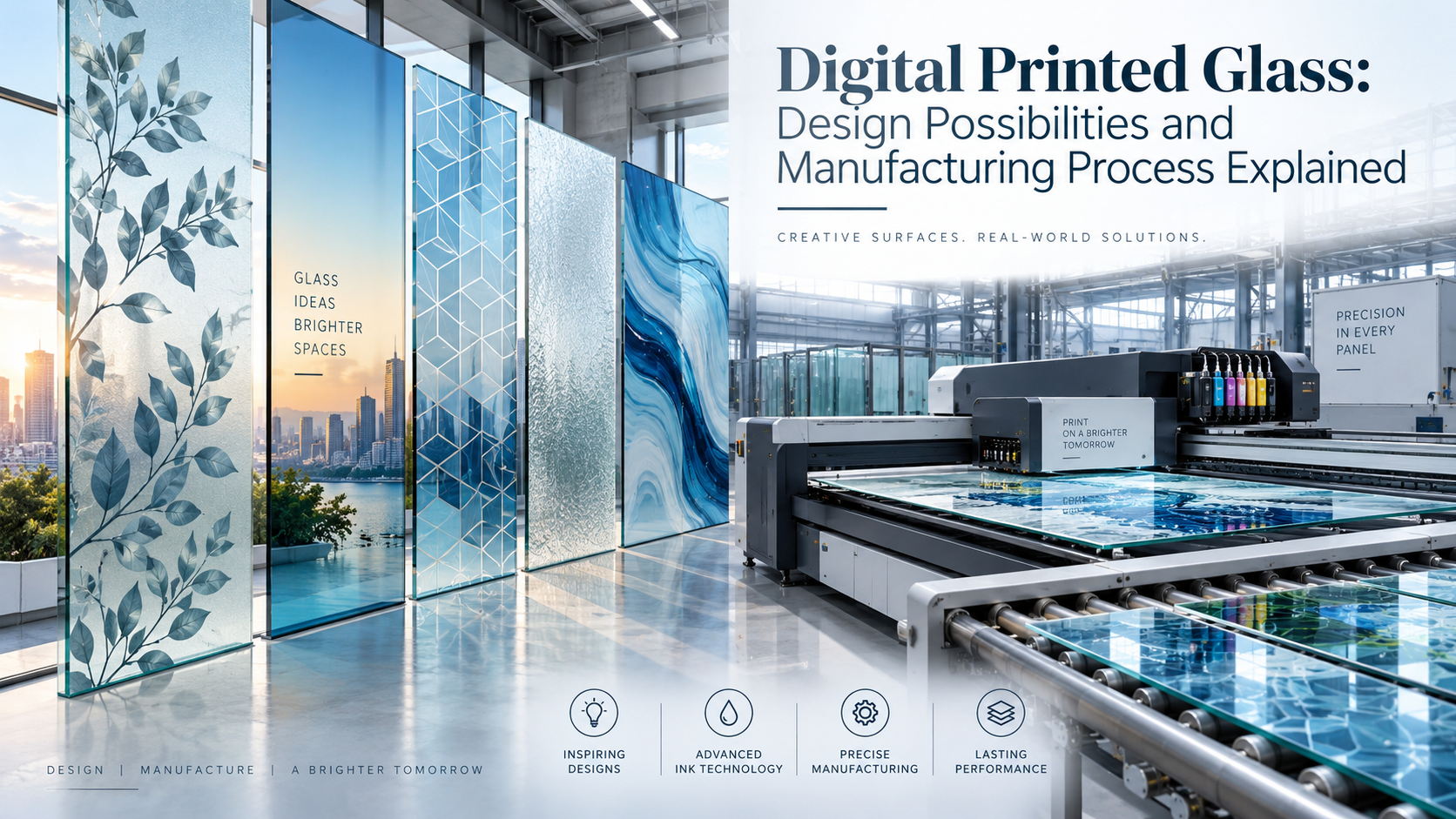
Architectural glass has transcended its traditional role as a transparent building envelope material. Modern digital printing technologies have transformed glass into a dynamic design medium—enabling architects and designers to integrate custom graphics, brand identities, privacy patterns, and artistic expressions directly onto glass surfaces while maintaining the material’s structural integrity and performance characteristics.
Digital printed glass represents a significant technological leap from conventional glass decoration methods. Unlike screen printing or acid etching—techniques that impose design limitations and require expensive tooling for each pattern—digital ceramic ink printing enables unlimited design complexity, photographic image quality, and economical short-run production. This manufacturing flexibility has opened new creative possibilities for building facades, interior partitions, retail displays, and custom architectural features.
The technology proves particularly relevant for contemporary commercial architecture, where building owners seek distinctive visual identities, architects require precise solar control patterns, and tenants demand customized interior environments. Digital printing delivers these varied requirements through a single, scalable manufacturing process.
What is Digital Printed Glass?
Digital printed glass employs large-format inkjet printing systems to apply ceramic inks directly onto glass surfaces. These specialized inks—formulated from inorganic metal oxide pigments suspended in liquid carriers—bond permanently with the glass substrate during high-temperature processing.
Ceramic Ink Technology
The ceramic inks used in digital glass printing differ fundamentally from conventional graphic printing inks. Rather than organic dyes or pigments that would degrade under heat and UV exposure, ceramic inks contain metal oxide colorants—iron oxides for reds and browns, cobalt compounds for blues, chromium oxides for greens—that withstand the extreme temperatures required for glass tempering.
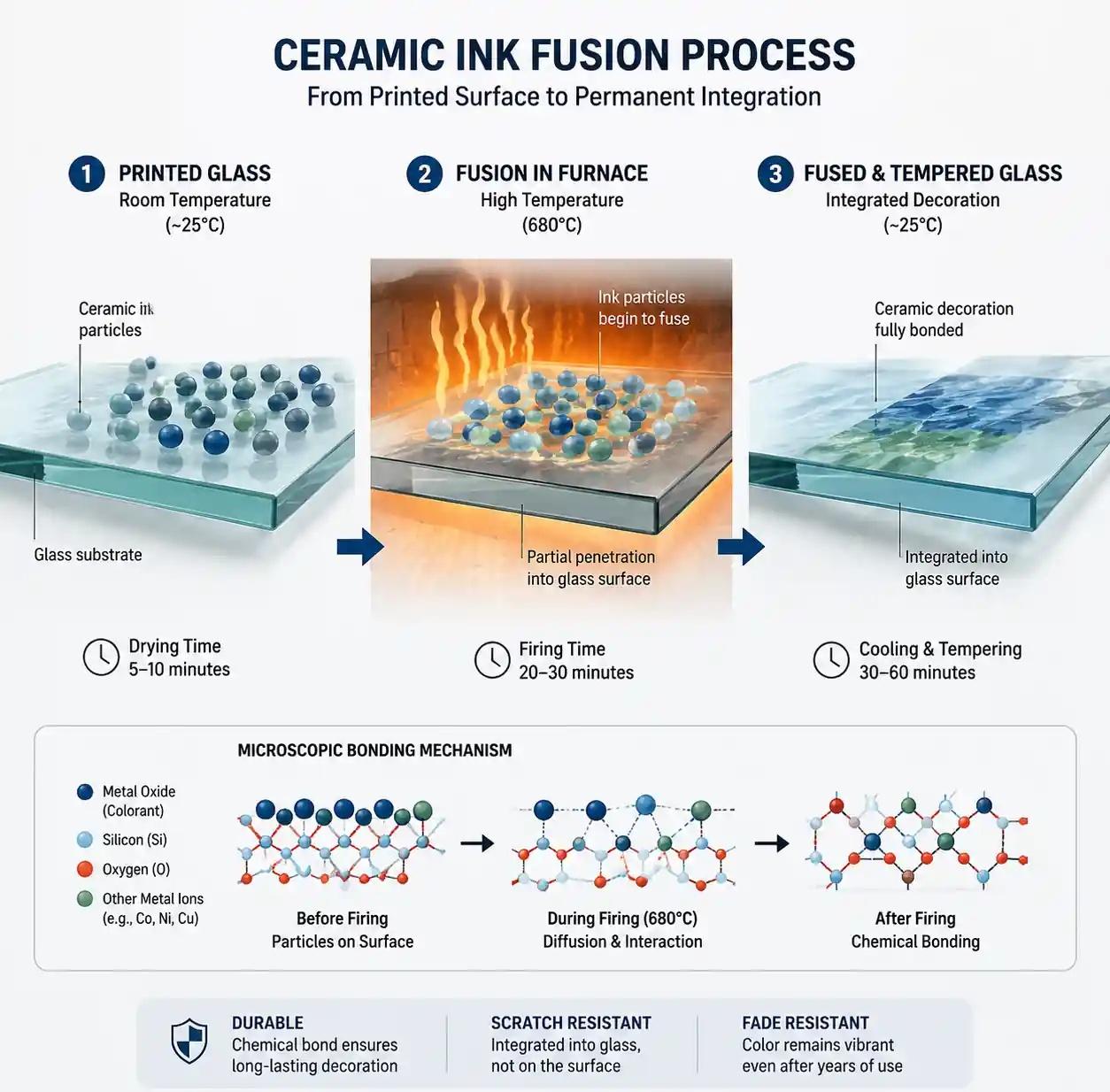
When printed glass enters tempering furnaces and reaches temperatures exceeding 650°C (1200°F), the ceramic ink particles fuse with the glass surface through a sintering process. The metal oxides partially penetrate the glass surface, creating a permanent bond that cannot flake, fade, or wear away. The resulting decoration exhibits the same durability, weather resistance, and chemical stability as the glass itself—suitable for exterior building facades exposed to decades of sun, rain, freeze-thaw cycles, and urban pollution.
Digital Printing vs. Traditional Screen Printing
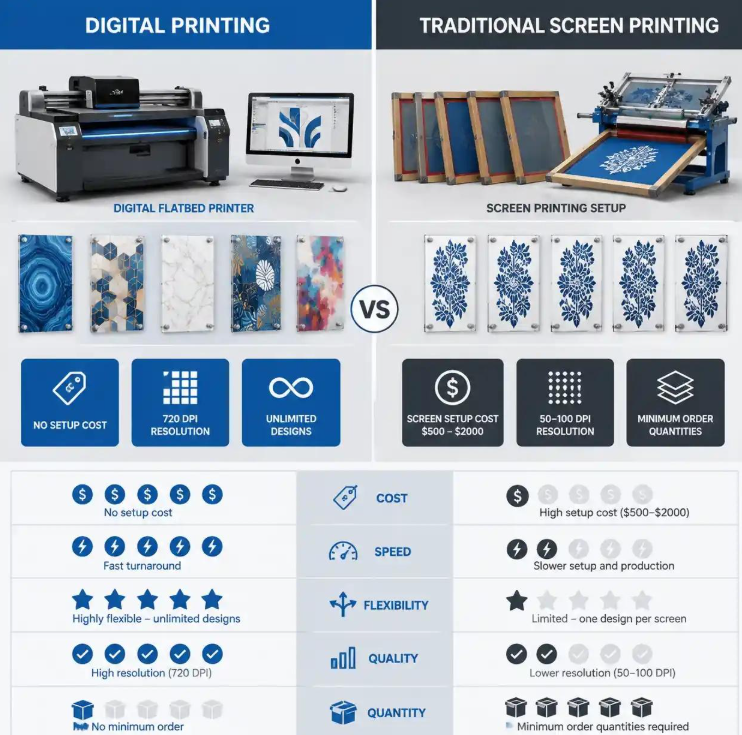
Screen printing—the dominant glass decoration method for most of the 20th century—requires creating physical screens for each color layer in a design. Complex multicolor graphics demand multiple screens, precise registration between printing passes, and substantial setup time. The screen manufacturing cost (often $500-2000 per screen) makes short production runs economically impractical, effectively limiting screen printing to large-volume orders with simple designs.
Digital printing eliminates these constraints. The technology applies ink directly from computer files without any physical screens or setup tooling. Design changes require only file updates—no new equipment, no registration adjustments, no minimum order quantities to amortize setup costs. A digital printer can produce a single custom panel or switch between hundreds of different designs with equal efficiency.
The resolution capabilities further distinguish these technologies. Screen printing typically achieves 50-100 dots per inch resolution—adequate for geometric patterns and corporate logos but insufficient for photographic images or fine gradients. Digital systems print at 360-720 DPI, enabling photo-quality reproductions, subtle color transitions, and intricate details.
The Manufacturing Process
Producing digital printed glass involves three primary phases: design preparation, printing application, and thermal processing. Each phase requires specialized equipment and precise process control to ensure the final product meets architectural performance specifications.
Step 1: Design and Pre-Press Preparation
The manufacturing process begins with digital design files—typically vector graphics (Adobe Illustrator, AutoCAD) for architectural patterns or high-resolution rasters (Photoshop, TIFF files) for photographic images. Designers work within color gamuts achievable by ceramic inks, which offer narrower ranges than conventional printing but sufficient variety for most architectural applications.
Pre-press technicians prepare print files to account for glass-specific considerations. The design must incorporate appropriate borders and margins around glass edges, avoiding critical graphics near cut lines. If the glass will be laminated or assembled into insulated units, designers must consider how multiple layers affect visual appearance and whether the print should appear on interior or exterior surfaces.
Color management proves particularly important. Ceramic inks produce different visual results than screen displays or paper proofs. Experienced pre-press operators maintain extensive sample libraries showing how specific ink combinations and printing densities appear on different glass types—clear, tinted, Low-E coated—under various lighting conditions. This empirical knowledge guides file adjustments that ensure printed glass matches design intent.
Step 2: Inkjet Printing Application
The actual printing occurs on specialized flatbed inkjet systems designed specifically for architectural glass. These machines—manufactured by companies including Durst, EFI Cretaprint, and Tecglass—feature print beds measuring 3 meters wide by 6 meters long to accommodate full-size architectural panels.
The glass sheets arrive at the printer pre-cut to final dimensions and thoroughly cleaned. Surface preparation proves critical—any residual dust, oils, or moisture can cause ink adhesion failures. Most facilities employ automated glass washing systems that clean panels with purified water, apply surface treatments that improve ink receptivity, and dry glass to precise moisture levels immediately before printing.
The printer applies ceramic inks through piezoelectric print heads that eject microscopic droplets at speeds exceeding 50 square meters per hour. Modern systems employ eight to twelve color channels—cyan, magenta, yellow, black, plus white, light cyan, light magenta, and specialized accent colors—enabling faithful color reproduction across a broad design range.
White ink plays a particularly important role in architectural glass printing. Printing dense white layers behind colored graphics creates opaque areas that provide privacy, reduce solar gain, or establish neutral backgrounds for color accuracy. Variable white ink density enables translucent effects and controlled daylight transmission—critical for facade designs that balance exterior aesthetics with interior daylighting requirements.
Step 3: Tempering and Ceramic Fusion
After printing, the glass undergoes tempered glass processing to achieve the safety and strength characteristics required for architectural applications. The panels enter horizontal tempering furnaces where they heat uniformly to approximately 680°C—just below glass softening temperature. At this elevated temperature, the ceramic inks undergo sintering, with metal oxide particles bonding permanently to the glass surface.
The tempering process itself follows standard protocols for unprinted glass. Once uniformly heated, the glass moves rapidly from the furnace to cooling stations where high-pressure air jets blast both surfaces simultaneously. This rapid cooling creates surface compression and interior tension that gives tempered glass its characteristic strength—typically 4-5 times stronger than annealed glass—and safety properties. When broken, tempered glass fragments into small, relatively harmless granules rather than large, sharp shards.
The simultaneous achievement of ceramic fusion and glass tempering represents an elegant manufacturing efficiency. A single thermal process delivers both decorative permanence and structural performance. The fused ceramic decoration exhibits scratch resistance, chemical resistance, and UV stability matching the glass substrate—suitable for building facades exposed to decades of environmental exposure with no performance degradation.
Some applications require additional processing after tempering. Laminated glass assemblies combine printed tempered glass with interlayers and additional glass plies for enhanced safety, security, or acoustic performance. Insulated glass units incorporate printed glass as one element in multi-pane assemblies with Low-E coatings and insulating gas fills for thermal performance.
Design Applications Across Architecture
Digital printing’s design flexibility and manufacturing economics enable applications spanning building scales, architectural typologies, and aesthetic intentions.
Architectural Facades and Curtain Walls
Building facades represent the highest-profile application for digitally printed glass. The technology enables architectural expressions ranging from subtle to dramatic—precisely calibrated gradient patterns that modulate daylight and solar heat gain, photographic images reproduced at building scale, brand identities integrated directly into building envelopes, or abstract patterns that define building character.
The Farringdon Station development in London exemplifies sophisticated facade printing, with custom gradient patterns applied across thousands of square meters of glass. The variable-density ceramic frits reduce solar gain by 40% while maintaining outward views from interior spaces. The pattern—a mathematical gradient derived from site-specific solar analysis—shifts density across the facade to deliver optimal shading precisely where needed throughout the day and season.
Corporate headquarters increasingly incorporate brand elements into facade glazing. Rather than applied graphics that weather and require maintenance, digital printing integrates logos, color schemes, and design motifs permanently into the building envelope. The approach proves particularly popular in competitive office markets where distinctive building identities support premium rents and tenant retention.
Artistic collaborations between architects and visual artists have produced landmark printed glass installations. The Sacramento International Airport terminal features massive printed glass walls reproducing California landscape photography at monumental scale. The images—printed with sufficient detail to read from close observation distances—transform circulation spaces into immersive environmental experiences while providing wayfinding cues and regional identity.
Interior Partitions and Spatial Division
Interior architecture applications prioritize different performance characteristics than facade glazing—acoustics over thermal insulation, privacy over solar control, close-range aesthetic impact over distant visibility. Digital printing addresses these interior-specific requirements while enabling rapid customization for tenant preferences.
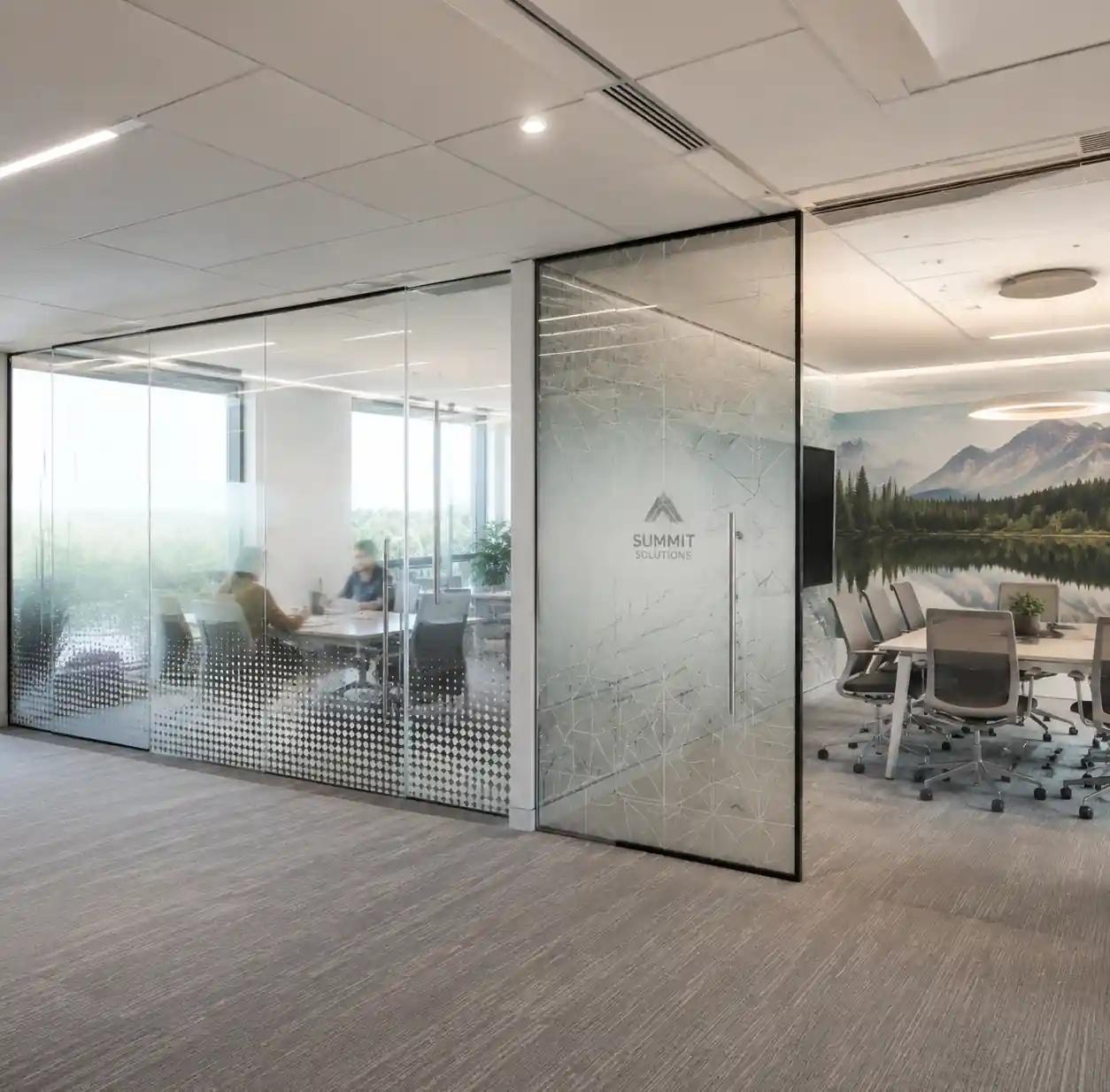
Office environments employ printed glass partitions to balance openness with privacy. Rather than opaque solid walls that create cellular isolation or clear glass that offers no visual privacy, strategically printed patterns—gradient frits, geometric textures, organic abstractions—maintain daylight distribution and spatial connection while obscuring direct views. Occupants benefit from natural light penetration and environmental awareness while conducting confidential conversations or focused work without visual distraction.
Hospitality projects leverage printing for branded interior environments. Hotel corridors, restaurant partitions, and retail displays incorporate custom graphics that reinforce design concepts and brand identities. The ability to print photographic imagery enables site-specific narratives—historical photographs in adaptive reuse projects, nature imagery in wellness facilities, local cultural references in destination hotels.
Healthcare facilities specify printed glass for patient privacy while avoiding the institutional character of solid walls or curtains. Partial obscuration patterns maintain clinical staff visibility for patient monitoring while providing dignity and reducing patient stress. The durable, cleanable glass surfaces meet infection control requirements that exclude fabric curtains or porous materials.
For complex custom designs that demand precise color matching, multiple print layers, or integration with other glass technologies, digital printed glass suppliers can achieve results impossible through conventional decoration methods. Advanced fabricators combine printing with Low-E coatings for simultaneous energy performance and aesthetics, laminate printed glass for impact resistance in security applications, or curve printed panels for sculptural architectural features.
Technical Specifications and Performance Characteristics
Understanding the technical parameters of digitally printed glass enables architects and specifiers to effectively incorporate the technology into project specifications and performance modeling.
Resolution and Image Quality
Commercial architectural glass printers operate at 360-720 DPI resolution—substantially exceeding screen printing (typically 50-100 DPI) while remaining below fine art reproduction standards (1200+ DPI). This resolution range proves optimal for architectural applications, where viewing distances measured in meters rather than centimeters make individual dot visibility imperceptible while maintaining economical ink consumption and reasonable printing speeds.
The effective visual resolution depends on viewing distance. A facade panel viewed from 10 meters distance (typical pedestrian observation) renders a 360 DPI print indistinguishable from continuous-tone photography. Interior partitions viewed from 1-2 meters benefit from higher resolution, making 720 DPI printing worthwhile for close-range applications with photographic imagery or fine gradients.
Color Gamut and Ceramic Ink Palette
Ceramic inks achieve broad but not unlimited color ranges. The inorganic metal oxide pigments offer excellent permanence and heat stability but cannot match the full gamut of organic printing inks. Most architectural applications specify designs within achievable ceramic ink gamuts, though some highly saturated colors—particularly bright purples, intense oranges, and vivid lime greens—may require color adjustments during design development.
White ink density significantly influences final appearance. Unlike paper printing where white substrate provides background, glass transparency requires printed white layers to establish color opacity and prevent background show-through. Designers specify white ink coverage in gradients from 0% (clear glass with transparent color tints) through 50% (translucent colored glass) to 100% (fully opaque color printing). This white density control enables sophisticated layering effects and precise daylight transmission tuning.
Durability and Weather Resistance
Ceramic-fused printing delivers exceptional durability. The sintered metal oxide decoration becomes integral to the glass surface, exhibiting chemical resistance equal to the glass itself. The decoration withstands decades of outdoor exposure without fading, peeling, or degradation—far exceeding the performance of organic coatings, applied films, or unfused decorations.
Standard accelerated weathering tests—500-1000 hours of UV exposure, salt spray, humidity cycling, thermal shock—show no measurable change in printed ceramic decorations. Field performance confirms laboratory results, with twenty-year-old printed glass facades showing no visible degradation. This permanence makes digitally printed glass suitable for building applications where decoration must match the 30-50 year service life of the glazing system itself.
Solar and Thermal Performance
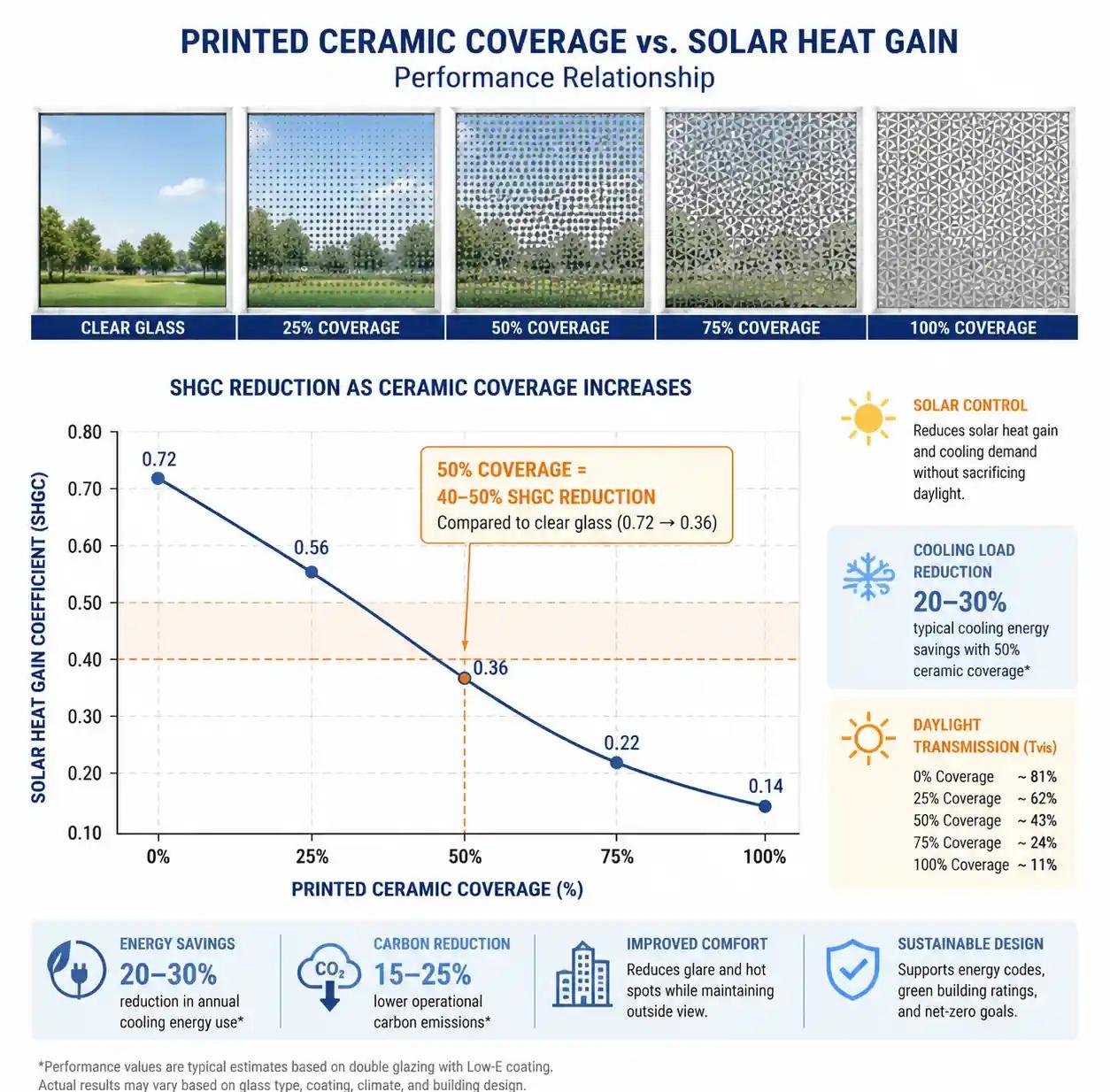
Printed ceramic patterns function as passive solar control systems. White or colored ceramic coverage blocks solar radiation transmission proportional to coverage density. A 50% coverage ceramic frit reduces solar heat gain coefficient (SHGC) by approximately 40-50% compared to unprinted glass, delivering measurable energy savings in cooling-dominated climates.
The printing enables infinitely variable shading densities and spatially customized patterns—denser coverage at orientations receiving direct summer sun, graduated patterns that shade upper façade areas while maintaining lower-level transparency for views and daylight. This design precision allows architects to optimize solar control for specific buildings, sites, and climate zones rather than accepting uniform-coverage products designed for generic applications.
Energy modeling software—Radiance, EnergyPlus, IES-VE—accepts digitally printed glass as custom glazing definitions, enabling designers to evaluate performance impacts during design development. The ability to iterate pattern density and distribution while monitoring energy and daylight metrics supports integrated design approaches where façade aesthetics and building performance evolve together.
Cost Considerations and Economic Viability
Digital printing economics differ fundamentally from screen printing, creating opportunities in market segments previously excluded by minimum order quantities and setup costs.
Unit Pricing Structure
Digital printed glass pricing reflects several cost components: base glass material, printing and ink costs, tempering or heat treatment, and fabrication into final assemblies (lamination, insulated unit assembly). For typical architectural applications, printing adds approximately $8-15 per square foot to base tempered glass costs—a premium justified by the design flexibility and customization value.
Critically, digital printing carries no setup charges or minimum order quantities. A single custom panel costs proportionally the same per square foot as a thousand identical panels. This cost structure enables economically viable custom work for small-scale projects, mockups and prototypes, and applications requiring multiple design variations within single projects.
Screen printing presents inverse economics—low unit costs for large volumes but substantial setup charges. A typical screen-printed pattern might cost $3-5 per square foot for orders exceeding 5,000 square feet, but initial screen costs and setup charges add $2,000-5,000 fixed costs regardless of order size. For quantities below 1,000-2,000 square feet, digital printing proves more economical despite higher unit rates.
Design Iteration and Prototyping
The absence of tooling costs makes design iteration affordable. Architects can print physical mockups for design reviews, test alternative pattern densities for solar performance, or produce samples matching specific project material palettes—all without the financial commitment required for screen manufacturing. This prototyping flexibility reduces project risk and supports better design decisions.
Many architectural glass fabricators offer sampling programs providing small-scale printed examples from submitted design files. These pre-production samples—typically 12″x12″ or 24″x24″ panels—enable architects and clients to evaluate appearance under actual lighting conditions and make informed decisions before committing to full production orders.
Project Scale Economics
For large commercial projects specifying thousands of square feet of printed glass, the unit cost premium diminishes in the context of total building costs. A typical curtain wall system costs $70-120 per square foot installed, making the $10-15 digital printing premium represent only 10-15% of total façade cost. When compared against the design value, brand identity reinforcement, or energy performance benefits delivered, the incremental investment offers compelling returns.
The technology has reached sufficient maturity and market penetration that competitive bidding ensures reasonable pricing. Multiple fabricators across North America, Europe, and Asia offer digital printing capabilities, and material suppliers provide technical support for specification development—conditions that foster competitive markets with transparent pricing.
Conclusion: Digital Printing as Standard Architectural Practice
Digital printed glass has transitioned from a specialty technology serving niche artistic applications to a mainstream manufacturing process available for standard commercial construction. The combination of unlimited design flexibility, economical short-run production, and proven long-term durability positions digital printing as the preferred decoration method for contemporary architectural glass.
For architects and designers, the technology removes traditional constraints on glass as a design medium. Custom patterns, brand integrations, solar control optimization, privacy solutions, and artistic expressions become feasible within conventional project budgets and schedules. The design freedom enables architectural responses calibrated to specific sites, clients, and performance requirements rather than accepting standardized products.
As printing technology continues advancing—higher resolution capabilities, expanded color gamuts, faster production speeds, larger panel sizes—the distinction between “standard” and “custom” glass products will continue blurring. What today requires custom specification and premium pricing may become tomorrow’s catalog product. Digital printing represents not merely an alternative manufacturing process but a fundamental shift in how architectural glass serves design intent and building performance.






Comment