
Designing Interfaces Before the Field Catches Up


Every few years a new technology arrives without an interface. The protocol works, the model responds, the data flows — but there is nothing for an ordinary person to look at, tap, or understand. Someone has to design that layer before the rest of the field agrees on what it should look like.
Anni Chen has done this three times, all at the same company. In 2021 she was the founding designer of some of the first consumer applications built on a decentralized information protocol. In 2024 she was the sole designer behind Folo, an open-source reader that has since passed 700,000 users across web, iOS, Mac, and Android. In 2025 she rebuilt its front door for an audience that arrives without knowing what a feed is — the part of the product where the machine has to ask a question instead of presenting a form.
“The pattern I keep running into is the same,” Chen says. “The technology arrives before anyone knows what shape it should take for a person. That gap is where design actually matters.”
Designing for a Conversation Is Not Designing for a Screen
Conversational AI has broken most of the assumptions product designers rely on. A traditional interface is a set of surfaces a designer controls: a screen, a button, a predictable result. A conversation with a model has none of that. The output differs each time. The user’s intent arrives as language rather than navigation. And the designer’s job shifts from arranging controls to deciding what the machine should ask, and what it should do with the answer.
Chen ran into that shift at the least glamorous point in a product: the first screen. A reader is the rare application that ships empty. It does nothing at all until the user has already supplied a list of sources to follow — which assumes the user knows what RSS is, which publications they want, and how to find the feed. For anyone outside the small population of people who already read this way, the product opened onto a blank page and a form.
Her replacement inverts it. The reader asks what you are interested in, and builds the initial feed out of the answer. The burden of knowing moves from the person to the software: the user supplies interests in ordinary language, and the machine does the work of translating that into sources. What a new user sees first is a populated timeline rather than an empty one.
It is a small surface with a large amount of judgment behind it. The question the product asks has to be answerable by someone with no vocabulary for the domain, and the feed it generates has to be good enough on the first try that the person keeps going.
Anni Chen: Career and Contributions
Chen holds an M.S. in Data Visualization from Parsons School of Design, where she worked on making large, machine-readable collections legible to people — the problem she has been solving in one form or another ever since.
She joined Natural Selection Labs, the team behind the RSS3 protocol, as its founding designer in 2021, became creative director in 2023, and is still there — five years at one company, across three roles. RSS3 is an open information protocol backed by investors including Coinbase Ventures, the investment arm of Coinbase, the largest publicly traded cryptocurrency company in the United States, Dragonfly, one of the sector’s best-known dedicated venture firms, and Fabric Ventures, one of the first crypto-native ventures backed by major public institutions like the European Investment Fund. Its data network has served over 400 million requests to the date.
Chen was the design owner responsible for every consumer surface that network had, taking it through three consecutive ground-up product directions without additional design headcount — a Chrome identity extension that reached 60,000 users in about five months, a web profile generated from raw on-chain data, and a cross-network reader on web, iOS, and Android. She owned product design, the design system across all five platforms, and much of the front-end implementation, along with developer-facing surfaces most product designers never touch.
She also owned the creative side of Folo (originally released as Follow), the team’s open-source reader, which organizes feeds of articles, video, images, and audio into a single distraction-free timeline. It launched in May 2024 as a feed reader and grew into what it now calls itself — the AI Reader. Chen has been its only designer, across both product and brand: the main timeline stream layout, the 3D character, the logo and color system, the application icon, and the creative campaigns and social channels through which the product reached the public.
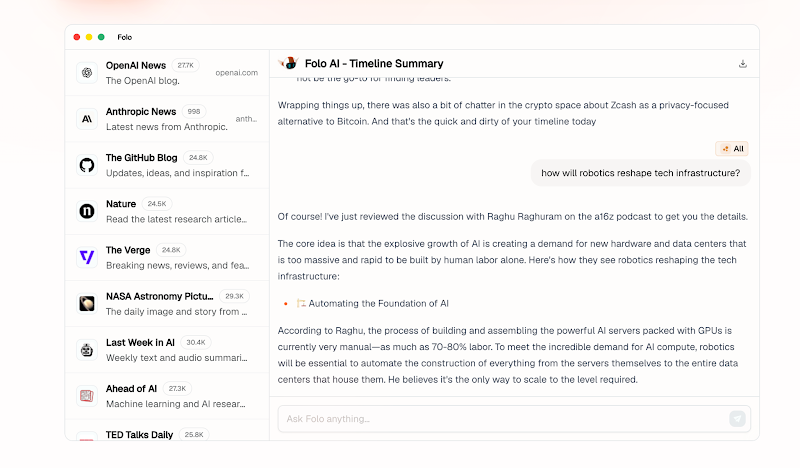
A second product decision came from watching how people used the home screen. Folo had organized it the conventional way, one media type per tab — articles, video, images, audio. Analytics showed most users never left the first tab. “The tabs were creating a default, and the default was winning,” Chen says. Rather than trying to advertise the other tabs, she removed the structure that produced the problem, replacing it with a single mixed-media layout in the Pinterest mold where every content type competes on the same surface.
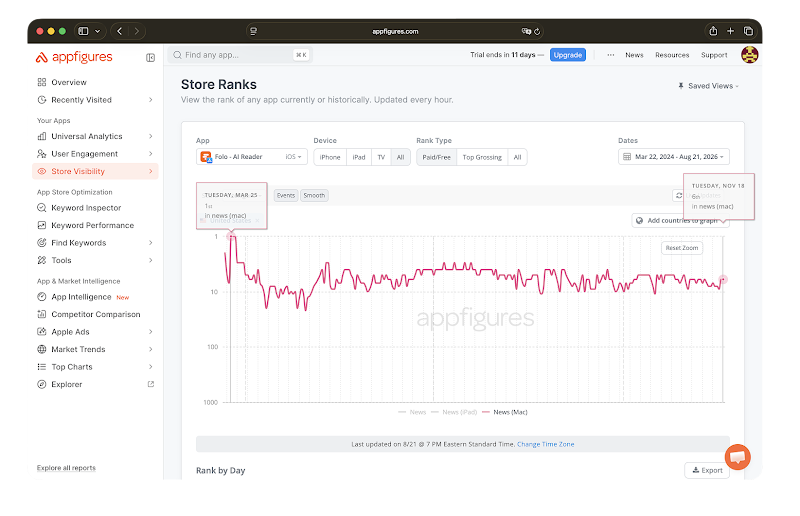
Folo has since passed 700,000 users. It is among the most-starred open-source reader projects on GitHub, with roughly 39,000 stars and 2,100 forks, and in late March 2025 it reached No. 1 in the News category of the Mac App Store in the United States, ahead of X, Pocket, CNN, and The New Yorker. It still ranks in 90 App Stores worldwide, including the top ten for Mac News in Lithuania, Sweden, South Korea, and Portugal.
Real-World Impact: How Anni Chen Solves Problems
Both of her Folo decisions moved the same lever: what the software does before the user has done anything. An empty first screen and a tabbed home screen are both defaults, and defaults decide most of what happens next.
The same instinct runs through the part of the product that is not the product. Folo is open source and competes without a marketing budget against reader apps from far larger companies, which makes its public appearance a functional problem rather than a cosmetic one. Chen built that layer too — the logo and color system, the 3D character, the application icon, and the campaigns and social channels through which most people first encounter the app. The icon sitting at the top of the App Store News chart in March 2025, above X and CNN, was her design.
It is an unusual span. One person decided what the product looks like when you open it, and what it looks like before you have ever opened it.
Anni Chen’s Plans for the Next Interface
Chen expects the design conventions for AI-native software to settle within a few years, and is candid that the people building now are the ones setting them.
“There is no established pattern library yet for a product that has to ask you something before it can be useful,” she says. “Everyone is guessing. The guesses that work will become the default, and most people will never know there was a choice.”
Her current focus is on that boundary — the point where a machine’s output stops being a response and becomes something a person keeps, returns to, and reads.







Comment