You encounter a lot of technical jargon the moment you buy an external drive or aim to clear the smartphone cache. Having a clear understanding of how online storage units scale enables you to manage files effectively and avoid paying for unnecessary cloud storage. Each online item you develop can occupy a certain amount of virtual room. That ranges from lightweight logs to huge databases. It is necessary to learn how such metrics can stack up against one another and have the clarity to cater to your everyday technology requirements.
Understanding the fundamental file-size hierarchy
By memorizing the basic format for each stage of the storage grouping for metrics, you will be better equipped to make good choices about your hardware upgrades. In standard use of a computer, the amount of data that you use has an exponential increase from tiny files measured in kilobytes to a huge volume of files in terabyte-sized archives. Understanding the growth patterns of each of these types of data will enable you to predict with accuracy the number of photographs or videos that can be stored on your system before “running out of space” during critical functions of your system, or while performing updates on the software, due to a lack of “available” space.
Understanding the functional meaning and the unit preferences
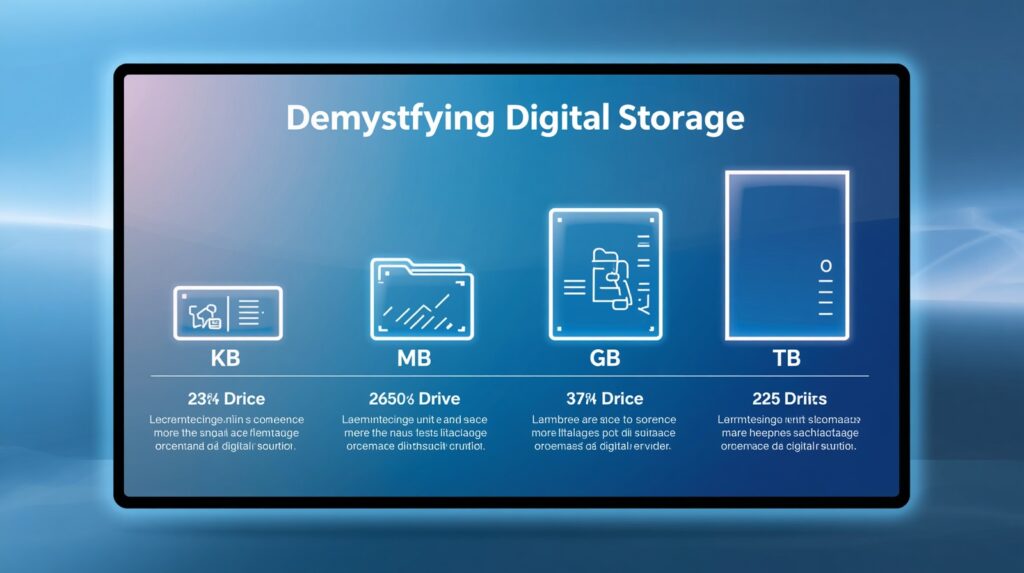
Online storage units such as KB, MB, GB, and TB indicate file size and drive capacity, which scale sequentially by factors of 1,024 in a basic computing setup. The following pointers are crucial to know:
- A kilobyte (KB) is the smallest unit that can hold approximately 1,024 data bytes and is suitable for light text documents or system configuration files.
- Megabyte (MB): equals 1,024 KB and can store medium-sized assets, such as online photographs and audio files.
- Gigabyte (GB): can expand up to 1024 MB and makes the industry benchmarks for very high-definition streaming videos, mainstream storage capacities, and operating systems.
- Terabyte (TB): This is at the top of the list, offering a huge 1,024 GB for external solid-state drives, compact enterprise backups, and large media archives.
Presently, the majority of buyers choose Gigabyte (GB) for daily electronics and cloud tiers, as it strikes the right practical balance between cost and everyday storage capability.
Decoding the best storage capacity count
The most pressing query is determining which is bigger, KB, MB, GB, or TB, and listing them from largest to smallest based on their data storage capacities. Consumers want to understand the exact capacity ordering for these units, as it affects their choice of hardware and cloud tiers. It is not difficult to translate abstract digital metrics into tangible representations of the frequently used files.
For example, an unmodified plain-text document takes only a couple of kilobytes, whereas an image taken with a high-quality camera may take several megabytes; a feature-length film, when streamed, could be more than a few gigabytes; and finally, full backups for corporate servers and external solid-state drives each have total capacity measured in multi-terabyte amounts.
Conclusion
It’s important not to confuse the potential size of a file stored statically with the speed at which data moves dynamically through a network. For example, a megabyte or gigabyte indicates the actual size of a piece of data that is stored on your computer’s hard drive. However, when discussing the actual speed at which a file moves across the internet via fiber or Ethernet, we will refer to megabits per second (or millions of bits per second). If you clearly identify these two technical categories, you will ensure you purchase the correct equipment for your company’s network.