
Data Governance for AI: Why Data Quality Is Becoming an AI Requirement

Enterprise AI adoption has focused over the last few years on productivity assistants. Organizations rolled out internal chatbots, summarizers, and coding copilots to help staff complete routine tasks faster. These systems operated under forgiving rules: if a model hallucinated a sentence or produced an imperfect summary, an attentive human usually caught the mistake before it caused damage.
That forgiving phase is officially over. Today, enterprises are shifting from isolated copilots to autonomous agents, complex Retrieval-Augmented Generation (RAG) pipelines, and predictive models wired directly into enterprise AI solutions and operational backends.
When language models and multi-agent systems gain programmatic authority to query databases, trigger API actions, and route transactional decisions, data quality stops being a backstage database issue. It becomes an active architectural dependency.
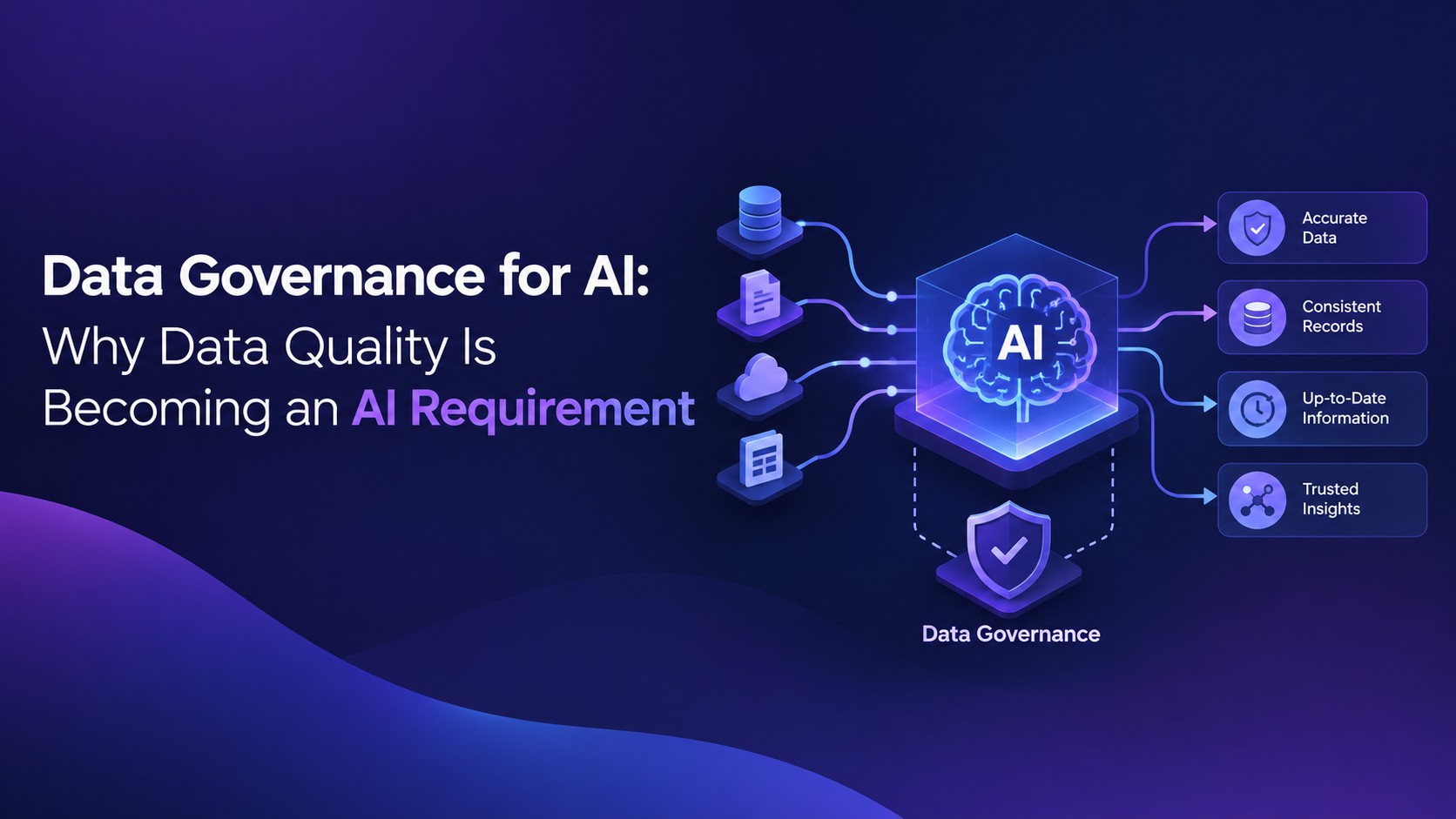
If the underlying records are duplicate, outdated, poorly vectorized, or unverified, the AI will reliably amplify those defects across the entire enterprise operating model. This structural vulnerability is why data governance for AI has turned into an essential prerequisite for scalable, reliable systems.
The Shift to AI-Ready Data Governance
Traditional data governance was designed for a static, predictable world. It was developed to manage relational databases, regulate tabular business intelligence dashboards, and satisfy historical regulatory audits. Its core focus was perimeter security: deciding who had permissions to run a SQL query, locking down sensitive columns, and producing quarterly reporting metrics.
AI architectures break that static mold completely.
Modern machine learning models, fine-tuning jobs, and context-retrieval systems ingest massive volumes of semi-structured and unstructured data. A traditional data warehouse governance policy doesn’t know how to handle semantic drift in an embedding space, chunk-boundary errors in a vector index, or unindexed metadata that causes an autonomous agent to execute an invalid business action.
When organizations attempt to power advanced generative engines with legacy governance frameworks, technical failure follows quickly. A model does not magically discern between an active corporate policy and an unarchived draft from three years ago unless it is governed explicitly. Poor data hygiene does not just lead to flawed charts; it creates runtime hallucinations, security leakage, and broken automated workflows.
To establish resilient operational perimeters, technical teams must anchor their pipelines in a comprehensive AI governance framework designed specifically for real-time model lifecycles and dynamic context. Transitioning to AI data governance means shifting focus from static tables to dynamic data streams, metadata semantics, and continuous validation pipelines.
Why Data Quality Has Become an Enterprise AI Requirement
The performance of an AI application is directly bounded by the health of the data feeding its inference and training cycles. In enterprise production environments, five primary data quality dimensions dictate system reliability:
Freshness and Temporal Accuracy
In transactional and agentic setups, data latency breaks model reasoning. Consider an autonomous procurement agent parsing vendor contracts and matching invoices.
If changes to pricing agreements, credit limits, or discount terms take twenty-four hours to synchronize with the vector store, the agent will routinely resolve exceptions using outdated rules. Stale context causes AI systems to output confident, syntactically perfect errors that mislead downstream teams.
Semantic Completeness and Contextual Density
LLMs and RAG architectures depend on rich contextual signals. When raw documents are stripped of author context, regional identifiers, creation dates, or document status tags, semantic search engines cannot accurately filter relevant chunks.
Missing metadata directly contributes to context pollution: the retriever pulls semantically close but operationally irrelevant records, forcing the language model to synthesize responses from incomplete facts.
Consistency and Record De-duplication
Duplicate customer files, contradictory operational documentation, and overlapping knowledge base articles confuse retrieval algorithms.
When two conflicting policy documents are embedded into the same vector space, a semantic similarity search may return both fragments with equal statistical weight. The model is left to guess which rule takes priority, resulting in unpredictable, erratic generation.
End-to-End Lineage Tracking
When an enterprise model provides an incorrect calculation or takes an unauthorized workflow action, technical teams must reconstruct the logic path.
Without granular data lineage connecting the final output back to the specific retrieved vector chunks, raw document revisions, and source systems, diagnosing hallucinations is impossible. Traceable lineage provides the evidentiary paper trail required for post-incident debugging and regulatory audits.
Access Boundaries and Unified Ownership
In classical setups, role-based access control (RBAC) was maintained at the application interface. With conversational retrieval and agent swarms, models often query centralized knowledge layers that pool documents from across disparate business units.
If the data governance framework fails to map source-level permissions straight into the vector index, an employee using an internal copilot might receive summaries of restricted executive compensation memos or private customer files. Explicit data ownership models are required to prevent data leakage across AI access points.
Architectural Blueprint: Building an AI-Focused Data Governance Framework
Technical leaders need to establish structured governance layers that examine and sanitize data at each lifecycle stage to build dependable platforms. Six fundamental technical elements provide the foundation for successful enterprise AI governance:
-
Automated AI Data Validation Gates
We cannot scale manual inspection of datasets to continuous intake. Engineering teams should set up automated AI data validation checks at the perimeter of ingestion. These programmable gates conduct schema tests, identify spikes in null values, generate drift metrics, and flag duplicate entries before the raw text is chunked and inserted. Automatically quarantine data that fail to meet quality standards to prevent model performance degradation due to poisoned inputs.
-
Comprehensive Metadata and Vector Management
Metadata governance is needed for vector databases. Each vector embedding stored in the system must have immutable metadata tags including the source file, the ingestion timestamp, the document version, the department, and the classification level. This architecture lets RAG systems pre-filter by metadata before semantic retrieval, so the model only considers known, active records that meet the user’s specific permission approvals.
-
Real-Time Data Telemetry and Observability
Schemas change, formats evolve, and the quality of data slowly diminishes over time. End-to-end data observability enables engineering teams to monitor distribution shifts, vector similarity anomalies, and null ratios in real-time. Automated monitoring alerts when aberrant distributions or schema deviations are detected, before tainted inferences harm downstream business tools.
-
Zero-Trust Identity and Permission Mapping
AI data governance must keep control over access at the action level. If a human operator does not have clearance to access a confidential clinical record or financial report, an autonomous agent acting on the user’s behalf must have the same restrictions. When enterprise identity providers are linked with embedding information, the governance architecture stops unlawful data access before context arrives at the model window.
-
Lineage and Versioned Pipeline Artifacts
All datasets used for fine-tuning, retrieval, or prompt grounding should be version controlled together with code and model weights. By treating data transformations as a software engineering discipline, we get reproducible pipelines. If a fine-tuned model starts to emit skewed predictions or corrupted outputs, engineers can identify a particular dataset snapshot and roll back production infrastructure in seconds.
-
Architectural Guardrails & Deterministic Fallbacks
Since language models are based on probabilities, rigorous operational guardrails are a core governance necessity. The platform needs to measure generation confidence against programmatic safety limits. If a RAG query results in chunks that don’t pass semantic relevance checks, or context is lacking, deterministic fallback logic should direct the request to structured code or human reviewers, rather than letting the model hallucinate an ungrounded answer.
Action Plan: A 4-Step Enterprise Implementation Roadmap
Establishing an AI-ready data foundation requires a phased, practical engineering approach:
| Phase | Core Objective | Key Deliverables |
| Phase 1: Ingestion & Inventory Audit | Profile source data across unstructured repositories and APIs. | Identification of duplicate files, unindexed PDFs, stale records, and missing metadata attributes. |
| Phase 2: Policy & Ownership Assignment | Define clear operational rules and technical accountability. | Establishment of dataset custodians, zero-trust RBAC mappings, and automated quarantine criteria. |
| Phase 3: Automated Observability & Validation | Deploy continuous telemetry across active pipelines. | Implementation of pre-embedding validation gates, metric monitors, and automated alerts for schema drift. |
| Phase 4: Agent & Pipeline Integration | Connect governed data perimeters directly to AI interfaces. | Configuration of deterministic fallbacks, vector metadata filtering, and full lifecycle lineage tracking. |
Operational Durability as an Enterprise Standard
Organizations can no longer treat enterprise AI as an isolated algorithmic experiment. The business value of autonomous agents, predictive workflows, and language models depends entirely on the stability, accuracy, and freshness of the underlying data infrastructure.
Without systematic data governance, enterprise AI deployment introduces unmanageable operational risks, from inaccurate corporate decisions and compliance breaches to expensive pipeline failures. By establishing clear data ownership, automating validation checks, and implementing rigorous lifecycle monitoring, technical leaders can build dependable foundations that safely scale modern intelligence across their operations.







Comment