Bellows protect machinery from dust, moisture, chemicals, vibration and thermal shifts. The two main sourcing ways are: custom manufacturer vs standard supplier.
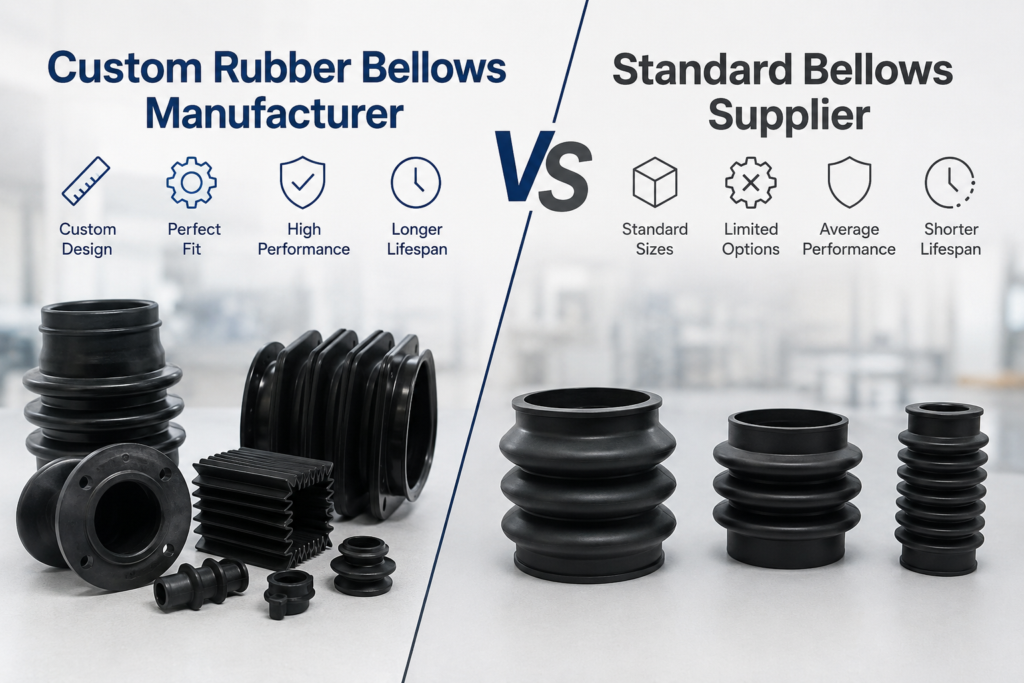
Standard units are pre-made units that have limited choices and fixed sizes. The custom units are selected and manufactured to a specific specification, material, shape, and performance. A custom rubber bellows manufacturer builds parts to match exact application requirements.
What Does a Custom Rubber Bellows Manufacturer Do?
The custom rubber bellows manufacturer designs bellows from scratch based on confirmed client specifications. They handle design, tooling, engineering and full end to end production support. They use materials such as silicone, EPDM, nitrile, and neoprene.
- Applies rubber moulding and precision engineering processes for accurate and consistent results.
- Provides prototype development before manufacture begins
- Offers fiber selection advice, as well as product testing independently.
- Provides full-spectrum joint working and linking of the concept to the final client presentation.
A rubber bellow manufacturer provides full material guidance as standard service. No client is expected to select compounds without expert technical support. All performance claims are backed by measurable test results.
What Does a Standard Bellows Supplier Offer?
They provide standard bellows in fixed standard sizes. Units have fast availability with no lead time required for design or tooling. They have common low complexity non critical applications.
- Limited material and dimension options across all available stock
- No engineering collaboration or design input provided for orders
- Suited only for simple non critical replacement use cases
- No modification or customization possible for stock items
Most rubber bellows suppliers carry only pre existing stock with no custom options. No modification is possible for units from standard supplier catalogs.
How Are the Two Different in Terms of Fit and Precision?
Standard bellows can not be customized according to machine requirements. Poor fit leads to leaks, vibration, and premature wear over time. Custom bellows have exact size, shape and wall thickness requirements.
- Precision fit reduces risk of failure in moving machine assemblies
- Every machine has unique requirements
- Custom fit means seamless integration into existing equipment
- No adapters or trimming required during on site installation
The custom-size rubber bellows deliver seamless integration into existing equipment. All connection points match exact mating dimensions.
Which One Handles Tough Industrial Conditions Better?
The common bellows rely on generic compounds which will not work in extreme operating conditions. Custom bellows are designed to tolerate given temperature ranges, chemicals, and mechanical stresses. Rubber compounds provide heat–, chemical–, and anti–wear properties.
- Nitrile = excellent oil and solvent resistance for fluid contact use cases
- Silicone = superior heat resistance and rebound performance for dynamic cycles
- Neoprene = best tear resistance for high friction operating environments
Industrial rubber bellows use application specific compounds for harsh environments. All material selections get verified against real operating conditions.
| Quick Decision Guide | |
| If the Requirement Is… | Choose |
| Ready-made bellows | Standard Supplier |
| Lower upfront cost | Standard Supplier |
| Fast availability | Standard Supplier |
| Exact size | Custom Manufacturer |
| Special shape | Custom Manufacturer |
| Specific material | Custom Manufacturer |
| Better equipment fit | Custom Manufacturer |
| Regular repeat orders | Custom Manufacturer |
Does Customization Really Improv e Equipment Lifespan?
Custom bellows deliver longer service life compared to generic options. Optimized material choice reduces long term degradation over repeated use cycles. Rigorous testing is conducted on each unit for flexibility, leak proofness and pressure handling.
- Prevents contaminants from entering sensitive moving equipment assemblies
- Reduces maintenance frequency and overall unplanned operational downtime
- Standard bellows need frequent replacement due to poor material or size match
Small rubber bellows also deliver the same lifespan improvement for compact equipment. No performance difference exists between large and small custom units. All sizes go through the same strict quality control process.
What Industries Need a Custom Rubber Bellows Over a Standard Supplier?
Automotive requires precise boot and seal dimensions for drive shafts and steering. Industrial machinery needs heavy duty protection for sensitive moving internal parts. Electrical and electronics require tight tolerances and exact component fit.
- Aerospace = strict extreme temperature and pressure requirement limits
- Marine = excellent moisture, salt and corrosion resistance properties
The standard suppliers often lack specialization for these critical sectors. The generic stock units cannot meet strict industry regulatory requirements.
Types of rubber bellows are matched to each unique industry requirement. No single compound works well across all industrial sectors. The engineering teams select the right formulation for every use case.
Is Technical Support a Factor When Choosing Between the Two?
Standard suppliers only provide the part with no additional design input. Custom manufacturers collaborate throughout design, testing and full production stages. The engineering team works alongside the client to solve specific application challenges.
- Offers insights that optimize processes and boost overall operational efficiency
- Custom provider delivers full support from initial design all the way to after sales service
- Problem solving approach vs simple generic product transaction
- Dedicated engineering contact assigned to every custom order
The custom design rubber bellows manufacturer delivers full collaborative design support. Every project gets assigned a dedicated engineering point of contact.
Who Is Custom Rubber Bellows and Why Do Manufacturers Trust Them?
This leading custom rubber bellows manufacturer serves over 264+ industrial clients. The skilled engineers need the help of advanced manufacturing technology for production. They choose the highest quality rubber materials for durability, flexibility, and wear resistance.
- Every unit is subjected to rigorous testing before delivery through stringent quality control.
- Supplies automotive, industrial, electrical, electronics and other industry sectors.
- Provides design, tooling, engineering and production services all in one.
- Units are guaranteed full performance against manufacturing defects.
A custom rubber bellows manufacturer maintains consistent quality standards across all batches. No unit ships if it fails any required performance test. All test results get documented and shared with clients on request.
When Should a Business Choose a Standard Supplier Instead?
Application is simple and non critical with no special protection requirements. Standard size is a confirmed exact match for existing machine specifications. Urgency is high, and custom lead time is a current project constraint.
- Low volume one time replacement need with no long term requirements
- No special material or environmental demands for operating conditions
- All operating conditions fall within generic stock performance limits
- No custom geometry or special mounting requirements for installation
Standard suppliers are only the right choice for specific limited use cases. All other applications deliver far better ROI from custom parts.
Custom rubber bellows for heavy equipment are never available from standard stock suppliers. These units always require fully custom design and manufacturing work. Generic parts will always fail prematurely in these demanding applications.
A custom rubber bellows is the right choice for all critical protection applications. The small upfront investment delivers very large long term operational savings. All custom orders get full engineering support and independent performance testing.
Frequently Asked Questions
- What is the difference between custom and standard rubber bellows?
Standard bellows are pre-made, fixed-size units with fast availability but no design flexibility. Custom bellows are engineered to a specific size, shape, and material to match exact equipment requirements, offering better fit and longer service life. - Which rubber material is best for bellows in high-temperature applications?
Silicone is generally preferred for high-temperature and dynamic-cycle applications because of its heat resistance and rebound performance. Nitrile suits oil/solvent exposure, while neoprene works best where tear resistance is needed. - How long do custom rubber bellows last compared to standard ones?
Custom bellows typically last longer because the material and dimensions are matched to the exact operating conditions, reducing wear, leaks, and premature failure. Standard bellows often need more frequent replacement due to poor size or material match. - When should I use a standard bellows supplier instead of a custom manufacturer?
Standard suppliers make sense for simple, non-critical, low-volume replacements where an exact stock size match already exists and lead time is a bigger constraint than long-term performance. - Which industries typically require custom rubber bellows?
Automotive, industrial machinery, electronics, aerospace, and marine sectors commonly need custom bellows because of tight tolerances, extreme temperatures, corrosion resistance, or precise fit requirements that standard stock parts can’t meet.
Conclusion
Standard bellows suit simple, low-cost, quick-turnaround replacements, while custom bellows deliver precise fit, better material match, and longer service life for demanding applications. For critical equipment facing heat, chemicals, or vibration, a custom rubber bellows manufacturer offers superior long-term value, reliability, and performance compared to generic stock options.