
Custom Blister Packaging: A Practical Guide to Blister Cards, Clamshells, and Retail Product Protection

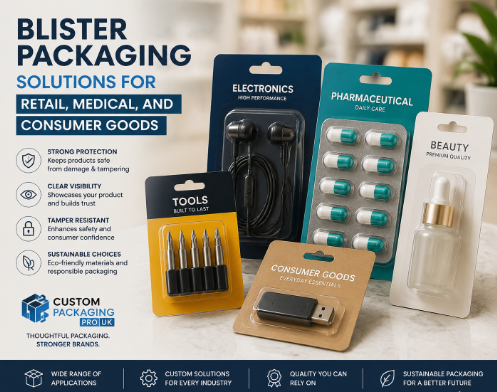
Retail packaging has to protect a product while helping shoppers understand exactly what they are buying. For small consumer goods, toys, hardware, electronics, accessories, and certain medical or pharmaceutical applications, visibility can be particularly valuable.
Custom Blister Packaging combines a formed plastic cavity with a backing card, film, foil, or another supporting structure. The transparent portion can keep the product visible while the surrounding package provides space for branding, instructions, product information, and retail-display features.
The strongest blister package is designed around the product’s dimensions, weight, protection needs, opening method, and sales environment rather than choosing one standard cavity for everything.
What Is Blister Packaging?
Blister packaging is a type of packaging in which a product is held inside a preformed cavity or pocket.
For many retail products, that cavity is transparent so customers can see the item without opening the package.
A typical blister pack may include:
- A thermoformed plastic cavity
- A printed backing card
- A heat-sealed or trapped-card construction
- A hanging hole for retail display
- Product-specific molded space
- Printed branding and instructions
The exact structure varies considerably depending on whether the package holds a toy, electronic component, cosmetic accessory, hardware item, or pharmaceutical product.
This is why custom sizing matters.
Why Brands Choose Blister Pack Packaging
Blister Pack Packaging can combine visibility, organization, and protection within one relatively compact format.
Products that might otherwise move around inside a standard carton can be held in a cavity shaped around their dimensions.
This may help protect products from:
- Scratching
- Excessive movement
- Direct handling
- Dust
- Minor pressure during retail handling
The transparent cavity also gives customers a direct view of the item.
For products where color, shape, size, or included accessories influence the buying decision, this visibility can be particularly useful.
Blister Card Packaging Combines Product Visibility With Branding
Blister Card Packaging commonly pairs a transparent cavity with a printed paperboard backing card.
The blister holds the product while the card can carry:
- Brand logos
- Product names
- Instructions
- Features
- Warnings where required
- Barcodes
- Promotional graphics
Good Blister Card Packaging Design should balance product visibility with readable information.
The card should not become so visually crowded that customers struggle to identify the product.
A clear hierarchy usually works best: brand first, product identification second, then supporting information.
Custom Blister Card Packaging Should Match the Product
The shape of the blister cavity affects both protection and presentation.
Custom Blister Card Packaging can be developed around the exact shape of an item rather than using a large generic bubble.
A better-fitting cavity can help reduce unnecessary movement and improve how the product appears on the shelf.
Businesses should consider:
- Product width
- Product depth
- Weight
- Protruding parts
- Accessories
- Hanging orientation
- Removal method
A small electronic accessory may need a completely different cavity from a toy figure or cosmetic tool.
Testing the actual product inside a prototype is therefore important before larger production begins.
Face-Seal and Trapped Blister Formats Serve Different Needs
Not every blister card uses the same construction.
In a face-seal design, the formed plastic blister is generally sealed to the surface of the backing card.
A trapped blister uses card layers that capture or surround the blister flange, creating a different presentation and opening structure.
The most suitable choice depends on factors such as:
- Product weight
- Card appearance
- Required seal
- Retail environment
- Opening experience
- Production method
Neither structure is automatically better.
The right format is the one that performs reliably for the intended product.
Custom Clamshell Blister Packaging Offers More Coverage
Custom Clamshell Blister Packaging usually uses a formed plastic structure that folds or closes around more of the product.
This format can work well for products that need visibility from multiple angles or greater enclosure than a traditional blister card provides.
Possible applications include:
- Electronics accessories
- Hardware
- Tools
- Cosmetics accessories
- Small household products
- Collectibles
Some clamshell designs use snap closures, while others may rely on additional sealing methods.
Businesses should evaluate customer access carefully. A package should provide suitable product security without becoming unnecessarily frustrating to open.
Toy Blister Packaging Keeps the Product Visible
Custom Toy Blister Packaging is strongly associated with products customers want to inspect visually before purchasing.
Figures, miniature vehicles, accessories, and collectibles can all benefit from a molded cavity that keeps the product in a defined position.
Custom Action Figure Blister Packaging may include several cavities when the figure comes with accessories.
The backing card can then support:
- Character artwork
- Product names
- Series information
- Brand storytelling
- Collectible details
Good design keeps the product itself as the visual focus rather than covering it with unnecessary graphics.
Custom Plastic Blister Packaging Needs Appropriate Material Selection
The transparent cavity in Custom Plastic Blister Packaging may be produced from different thermoformable materials depending on the application and production requirements.
Material decisions can influence:
- Clarity
- Rigidity
- Formability
- Product protection
- Sealing method
- Recycling considerations
- Cost
Businesses should not choose a plastic solely because it looks clear in a sample. The material needs to perform throughout forming, packing, sealing, transportation, retail display, and customer opening.
The complete package should be tested as a system.
Blister Packaging Can Improve Retail Display Efficiency
Blister packs are often designed to hang vertically on hooks or display pegs.
This can make them useful in retail environments where shelf and wall space need to be used efficiently.
A hanging blister card can keep products:
- Front-facing
- Organized
- Easy to count
- Easy for customers to inspect
This is particularly useful for compact products sold in many variations.
Die-cut hanging holes and card dimensions should be planned according to the intended retail fixture.
A package that works well visually but hangs incorrectly can create merchandising problems.
Customized Blister Packaging Can Strengthen Brand Recognition
Customized Blister Packaging gives brands control over more than the plastic cavity.
Printed cards can use consistent:
- Logos
- Brand colors
- Typography
- Product photography
- Illustrations
- Information hierarchy
When several related products use different blister sizes, these repeated visual elements can keep the product family recognizable.
Brands can also coordinate blister cards with their other cartons or retail packaging so products remain visually connected across different formats.
Medical Blister Packaging Is a Specialized Application
Medical Blister Packaging and Drug Blister Packaging should be treated differently from ordinary retail blister cards.
In pharmaceutical applications, individual tablets or capsules may be sealed into separate compartments with foil or paper backing. FDA guidance describes blister or strip packs used for certain OTC drug products as individually sealed compartments where access requires tearing or breaking the package, making entry evident.
Pharmaceutical packaging can also involve specific labeling, product-integrity, stability, and regulatory requirements depending on the medication and market. FDA guidance separately addresses unit-dose containers and labeling for solid and liquid oral dosage forms.
For that reason, packaging marketed for ordinary consumer goods should never automatically be assumed suitable for medication.
The exact material, seal, barrier performance, labeling, validation, and regulatory requirements need to be confirmed for the specific pharmaceutical application.
What Is Blister Packaging in Pharmacy?
In pharmacy and pharmaceutical contexts, blister packaging commonly separates tablets or capsules into individual cavities.
This can help keep individual dosage units separated and identifiable until use.
However, pharmaceutical blister packaging involves far more than forming a plastic pocket.
Important considerations may include:
- Barrier performance
- Seal integrity
- Product stability
- Labeling
- Tamper evidence
- Individual dosage identification
- Regulatory requirements
Brands should work with appropriately qualified pharmaceutical-packaging professionals when developing packaging for medication.
Printed Backing Cards Need Clear Information Hierarchy
Because blister packaging exposes much of the physical product, the printed card does not have to carry all of the visual responsibility.
This creates an opportunity for cleaner designs.
A card might prioritize:
- Brand
- Product name
- Key identifier
- Instructions or specifications
- Required supporting information
Printing and finishing may also include options such as Spot UV, foil accents, or other decorative elements where appropriate.
Finishes should improve communication rather than reducing readability.
Custom Blister Packaging Wholesale Requires Sampling
Custom Blister Packaging Wholesale can be practical for brands that have finalized product dimensions and need consistent packaging in larger quantities.
Before approving production, businesses should test:
- Cavity dimensions
- Product movement
- Card strength
- Seal performance
- Hanging position
- Print alignment
- Customer access
- Shipping performance
This is particularly important because the cavity is product-specific.
Even a relatively small change to the product can affect how well the blister fits.
Cost-Effective Blister Packaging Starts With Efficient Design
Businesses searching for inexpensive or cost-effective blister packaging should avoid focusing on unit price alone.
A poorly designed package may increase costs through:
- Damaged products
- Excessive material
- Difficult packing
- Oversized shipping cases
- Packaging rework
Cost effectiveness comes from balancing material, cavity size, card dimensions, production volume, and required product protection.
A simple blister card may sometimes perform better than a more complicated package with features the product does not need.
Common Blister Packaging Mistakes
Several problems can occur when the package is designed before the final product has been confirmed.
Common mistakes include:
- Oversized cavities
- Excessive product movement
- Weak backing cards
- Poor hanging balance
- Artwork too close to seals
- Difficult opening
- Unnecessary plastic volume
- Ordering wholesale quantities without testing
Another mistake is assuming that retail blister packaging automatically meets pharmaceutical requirements.
Consumer-goods and medication packaging may look similar but can have very different performance and compliance requirements.
Final Thoughts
Custom Blister Packaging can provide a strong combination of product visibility, organization, retail presentation, and protection when the structure is developed around the actual item.
From blister cards and custom toy blister packaging to clamshell formats and product-specific cavities, each package should reflect how the product will be packed, displayed, transported, and opened.
Brands comparing custom packaging products should focus on structures that genuinely match their merchandise rather than relying on generic cavities. Working with experienced custom packaging manufacturers can also help coordinate cavity development, card construction, printing, and production.
Businesses developing a wider product range can use custom design packages to maintain consistent branding across different blister formats, while dependable packaging supplies custom solutions can help align materials and components with specific retail needs. For companies creating packaging around their own brand identity, custom business packaging can bring structure and visual presentation into one coordinated system.
When product fit, visibility, branding, and usability are planned together, blister packaging becomes more than a transparent shell. It becomes a practical part of how a product is protected and presented at retail.
Frequently Asked Questions
- What is Custom Blister Packaging?
Custom Blister Packaging uses a formed cavity designed around a specific product, often combined with a printed card or another backing structure. It can be customized for product dimensions, branding, retail hanging, and presentation requirements.
- What is blister packaging in pharmacy?
Pharmaceutical blister packaging commonly separates individual tablets or capsules into sealed cavities. Medication packaging may be subject to specific requirements for materials, labeling, seal integrity, stability, tamper evidence, and other regulatory considerations depending on the product.
- What is the difference between blister card packaging and clamshell packaging?
Blister card packaging generally combines a formed plastic cavity with a printed backing card. Clamshell packaging usually uses a larger formed plastic structure that folds or closes around more of the product.
- How is custom blister packaging made?
The general process involves measuring the product, designing a cavity, thermoforming the plastic component, preparing the backing or card, printing required artwork, and assembling or sealing the package. The exact process depends on the blister style and application.
- Can blister packaging be customized for toys and action figures?
Yes. Custom Toy Blister Packaging and Custom Action Figure Blister Packaging can use molded cavities designed around figures and accessories while providing printed space for branding and product information.
- Should businesses order a sample before Custom Blister Packaging Wholesale production?
Yes. Sampling helps confirm cavity fit, product movement, backing-card strength, print placement, hanging balance, opening experience, and overall package performance before larger quantities are produced.







Comment