A direct-to-consumer skincare brand with 2.1 million monthly website visitors across the European Union, United Kingdom, and United States receives a compliance audit that reveals a problem far more expensive than the $45,000 consulting fee: its cookie consent implementation is collecting marketing cookies from 34 percent of EU visitors before they make an affirmative choice, its consent records lack the granularity required to demonstrate valid consent under GDPR Article 7, and its data processing inventory shows 47 third-party marketing tags firing on pages where users have only consented to functional cookies. The potential exposure is staggering. GDPR fines can reach 4 percent of global annual turnover, and the French data protection authority CNIL has issued fines exceeding 150 million euros to individual companies for consent violations alone. The brand implements a consent management platform that deploys a compliant consent banner with granular category controls, automatically blocks all non-essential tags until valid consent is recorded, maintains a timestamped consent receipt for every visitor interaction, and synchronises consent preferences across the website, mobile app, and email marketing platform. Within 60 days, the consent rate for marketing cookies stabilises at 41 percent of EU visitors who make an active choice, the average number of marketing tags firing without valid consent drops from 47 to zero, and the legal team has access to an auditable consent database containing 3.8 million individual consent records with full metadata. That transformation from regulatory liability to documented compliance demonstrates why consent management platforms have become essential infrastructure for every organisation that collects consumer data.
Market Growth and Regulatory Context
The global consent management platform market reached $1.1 billion in 2024 and is projected to grow to $3.8 billion by 2028, according to Grand View Research, reflecting a compound annual growth rate of 36.2 percent. This growth is driven by the rapid expansion of privacy legislation worldwide, increasing enforcement activity by data protection authorities, and the growing recognition that consent management is not merely a legal checkbox but a strategic capability that influences customer trust, data quality, and marketing effectiveness.
The regulatory landscape has expanded dramatically beyond GDPR. The California Privacy Rights Act strengthened CCPA provisions with new requirements for consent around sensitive personal information. Brazil’s LGPD, India’s Digital Personal Data Protection Act, and privacy laws across Canada, Australia, Japan, South Korea, and dozens of other jurisdictions have created a patchwork of consent requirements that multinational organisations must navigate simultaneously. By 2025, Gartner estimated that 75 percent of the global population had its personal data covered by modern privacy regulations, up from approximately 10 percent in 2020.
Enforcement activity has intensified significantly. The combined value of GDPR fines exceeded 4.2 billion euros through 2024, with cookie consent and tracking violations among the most frequently penalised categories. CNIL’s enforcement actions against Google and Meta for consent violations demonstrated that even the largest technology companies face substantial penalties for non-compliant consent practices. The integration of consent management with marketing data clean rooms has become increasingly important as organisations seek to ensure that data used in collaborative analytics environments was collected with appropriate consent.
| Metric | Value | Source |
|---|---|---|
| CMP Market (2024) | $1.1 billion | Grand View Research |
| Projected Market (2028) | $3.8 billion | Grand View Research |
| CAGR | 36.2% | Grand View Research |
| Global Population Covered by Privacy Laws (2025) | 75% | Gartner |
| Cumulative GDPR Fines (Through 2024) | 4.2 billion euros | GDPR Enforcement Tracker |
| Average Consent Rate (EU, Marketing Cookies) | 38-45% | Usercentrics |
How Consent Management Platforms Work
Consent management platforms provide the technical and operational infrastructure for collecting, storing, enforcing, and documenting user consent across digital properties. The technology stack encompasses consent collection interfaces, tag management integration layers, consent storage and audit systems, and preference synchronisation mechanisms that ensure consent choices are respected across all data processing activities.
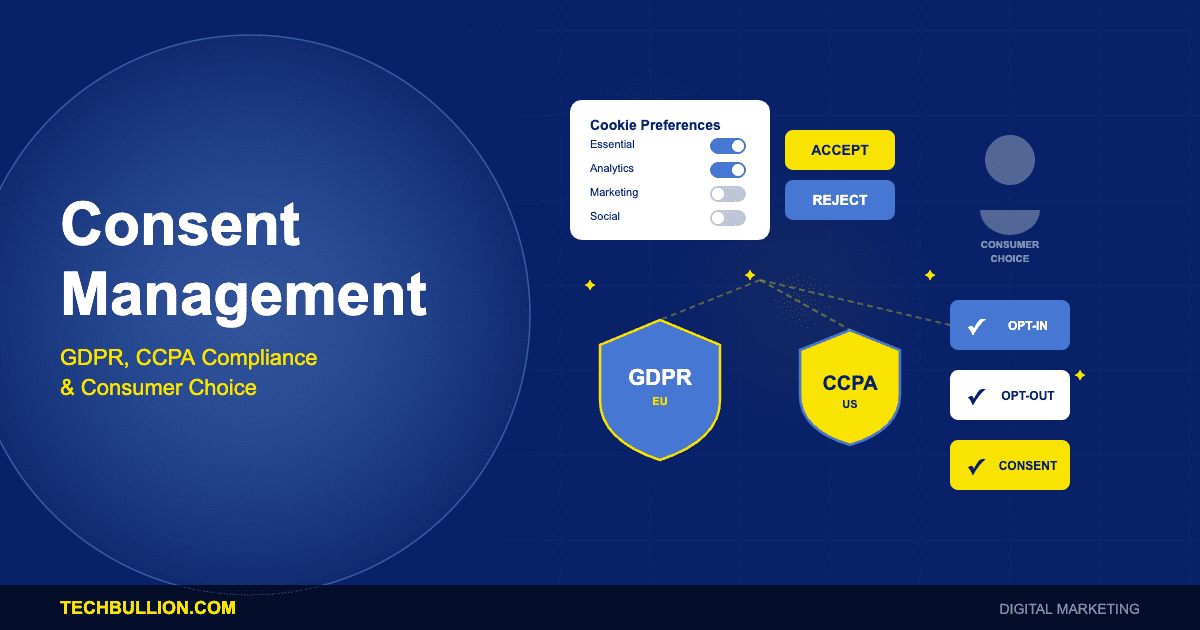
The consent collection layer presents visitors with a consent interface that explains what data will be collected, which third parties will receive data, and what purposes the data will serve. Effective consent interfaces must balance regulatory requirements for granularity and transparency with user experience considerations that avoid consent fatigue. Research from Usercentrics shows that consent banner design significantly impacts opt-in rates, with well-designed interfaces achieving marketing consent rates 15 to 25 percentage points higher than poorly designed implementations while maintaining full regulatory compliance.
Tag governance represents the enforcement mechanism that ensures consent choices are technically respected. When a visitor declines marketing cookies, the CMP must prevent all marketing-related tags, pixels, and scripts from executing. This requires deep integration with tag management systems like Google Tag Manager, where the CMP acts as a gatekeeper that conditionally fires or blocks tags based on the visitor’s consent state. Server-side tag management integration extends this governance to server-side data collection, ensuring that consent enforcement applies regardless of whether data collection happens in the browser or on the server.
The consent receipt system maintains a comprehensive audit trail of every consent interaction. Each record typically includes a timestamp, the specific consent choices made, the version of the privacy policy and consent notice presented, the mechanism used to collect consent, and a unique identifier linking the consent record to subsequent data processing activities. This audit capability is essential for demonstrating compliance to regulators, as GDPR requires data controllers to be able to demonstrate that valid consent was obtained for every processing activity that relies on consent as its legal basis.
The connection to customer data platforms enables consent signals to flow downstream into every system that processes personal data. When a user withdraws consent for marketing communications, the CMP propagates that preference change to the CDP, which updates the customer profile and triggers suppression across email marketing platforms, advertising audiences, and personalisation engines.
Leading Consent Management Platforms
| Platform | Primary Market | Key Differentiator |
|---|---|---|
| OneTrust | Enterprise privacy suite | Comprehensive privacy management platform with consent, DSAR, and vendor risk management |
| Usercentrics | Mid-market and enterprise | AI-driven consent optimisation with strong European market presence |
| Cookiebot (Usercentrics) | SMB and mid-market | Automated cookie scanning with accessible pricing for smaller organisations |
| TrustArc | Enterprise compliance | Intelligence-driven privacy management with automated assessments and monitoring |
| Didomi | Enterprise preference management | Preference centre approach connecting consent to broader data governance |
| Osano | SMB privacy compliance | Simplified consent management with vendor monitoring and risk scoring |
IAB Transparency and Consent Framework
The IAB Europe Transparency and Consent Framework has established the industry standard for communicating consent signals across the digital advertising ecosystem. TCF 2.2, the current version, provides a standardised protocol through which consent management platforms capture user consent choices and transmit them as encoded consent strings to advertising technology vendors throughout the programmatic supply chain. Over 1,200 advertising technology vendors have registered with the TCF, and compliance with the framework is increasingly a prerequisite for participation in programmatic advertising in European markets.
TCF operates by defining a taxonomy of purposes for data processing, including storing information on a device, creating personalised advertising profiles, and measuring advertising performance. Users can consent to or reject each purpose independently, and the resulting consent signal is encoded into a TC String that propagates through bid requests and ad calls, enabling each vendor in the advertising chain to verify whether it has consent to process data for its specific purposes.
The integration of TCF consent signals with privacy-enhancing technologies creates a layered approach to advertising privacy where consent provides the legal foundation and PETs provide the technical protection for data processed under that consent.
Consent Optimisation and Marketing Impact
Consent rates directly impact marketing effectiveness because they determine the addressable audience for targeted advertising, analytics accuracy, and personalisation capabilities. Organisations that treat consent management purely as a compliance obligation often see marketing consent rates below 30 percent, while those that invest in consent experience optimisation consistently achieve rates between 40 and 55 percent according to Usercentrics benchmarks.
Consent banner design decisions that influence opt-in rates include the placement and prominence of accept and reject buttons, the use of layered consent interfaces that provide summary information with detailed options accessible through a secondary layer, the visual design and branding of the consent interface, and the timing and trigger for displaying the consent notice. A/B testing of consent interfaces has become a standard practice, with platforms like Usercentrics and Didomi providing built-in experimentation capabilities that enable organisations to optimise consent rates while maintaining regulatory compliance.
The downstream impact of consent rates on marketing attribution is substantial. When only 40 percent of visitors consent to analytics cookies, conversion tracking becomes significantly less accurate, creating blind spots in campaign performance measurement. Organisations are addressing this challenge through statistical modelling that extrapolates full-population metrics from the consented sample, server-side analytics that operate on first-party data without requiring cookie consent, and consent-aware attribution models that adjust for the systematic differences between consenting and non-consenting visitor populations.
The Future of Consent Management
The trajectory of consent management technology through 2028 will be shaped by the convergence of consent with broader preference management, the automation of compliance through AI, and the evolution toward consent as a competitive differentiator rather than merely a regulatory obligation. Next-generation platforms will manage not just cookie consent but comprehensive preference centres where consumers control all aspects of their data relationship with an organisation, from communication preferences and personalisation settings to data sharing permissions and deletion requests. AI-powered compliance monitoring will continuously scan digital properties for consent violations, automatically detecting new tags, changed data flows, and regulatory updates that require consent interface modifications. Organisations that build sophisticated consent management infrastructure today are establishing the trust foundation that will become increasingly important as consumers grow more aware of their privacy rights and more selective about which brands they trust with their personal data.
According to Deloitte’s industry outlook, more than 60 percent of large enterprises now allocate dedicated budgets to digital transformation initiatives, up from 35 percent in 2020.
Market analysis from Grand View Research projects that technology-driven market segments will continue expanding at compound annual growth rates between 15 and 25 percent through the end of the decade.