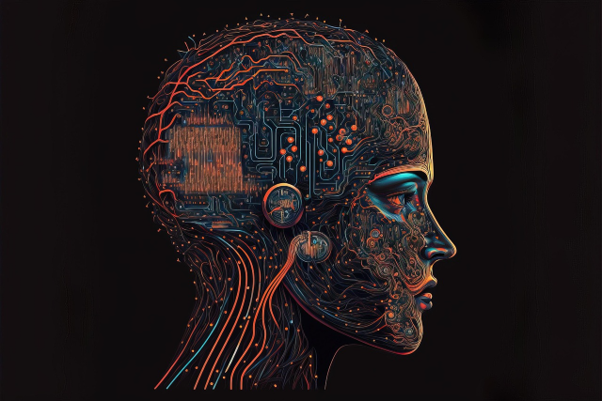
A leading tech expert has issued a warning on the consequences of over-use of AI, saying that research has shown that human brains become less effective if the technology is relied on too much.
The caution comes from consultant and author Amy Brann, a sought-after keynote speaker who has been described as one of the most influential figures in HR.
In an interview with The AI Speakers Agency, the UK’s leading AI speaker bureau, she explained that, while humans and machines can work in harmony, an over-reliance on AI means that humans become less able to engage in deep thinking.
That can affect people’s judgements, she said: “AI is evolving at this extraordinary speed and the human brain hasn’t really changed, so the gap we’re seeing could be framed as a cognitive gap rather than a technological one.
“Neuroscience can help us to close that gap by showing us what is it that’s so special about the human brain, and what can we do to optimise the human strength so that we can work with the AI rather than trying to compete against it because we’re going to always be different.
“So, AI excels at speed, at scale, at pattern recognition, and humans have been said to excel more at creativity, empathy, ethical judgment, and complex decision making. And I think the opportunity lies in combining these strengths effectively.”
Amy said that leaders of organisations can get the best out of AI by creating environments where the best of both worlds are harnessed: “A challenge that we’re seeing is that many organisations are trying to adopt AI without addressing the human side, the mind frames, the confidence, the ways of working, and so people are feeling uncertain, resistant, overwhelmed, and that’s predictable.
“But neuroscience can give us a roadmap to reduce the threat responses linked to the new technology, build the curiosity that we want to see, and create those conditions for the learning and the adaptation, but we need the learners. We need the leaders to design for the learners the environments where people can actually think clearly and protect the human bandwidth and protect what makes us uniquely human and able to function the way we do.”
Organisations must help people overcome their fear of the technology but also allow optimal collaboration between human and machine: “I don’t think the goal, the closing of the gap, is about making humans more like AI. It’s about helping the humans operate at their best, so that they can intentionally, with agency, use the AIs as an amplifier of their thinking and the will that they want to evoke in the world.
“AI is an extraordinary tool, but like any tool, its value depends on how we are using it, and one of the biggest risks of over-reliance is that it leads to cognitive atrophy. If we are outsourcing too much of our thinking, decision making, problem solving, even creativity, we will reduce, weaken the neural pathways that make us effective.
“That was predicted by studies 70 years ago, and we’re starting to see them confirmed in a different way by new studies coming out today. But it’s been predictable. The brain strengthens what we use it for. So if we stop engaging in deep thinking, we reduce our ability to do it well. There’s also a risk to judgment.”
Amy, who has collaborated with Cambridge University and major corporations on the issue, said AI agents operate without the real-world responsibility that humans have: “AI can provide answers, but it doesn’t carry accountability or ethics or contextual understanding in the same way humans do. It won’t cost it in the way it will cost you and I if we make a mistake or make a poor choice. And over reliance can really lead to overconfidence in what it’s giving us, which, without sufficient critical evaluation, is dangerous.
“Another risk linked is reduced learning. When we struggle and have to put discretional effort into something, that is part of how our brain works, learns, encodes knowledge. If AI removes that process, and if there’s no friction, there’s no challenge, there’s no striving. We will get faster answers, but we will get weaker understanding.”
The gap between people who use AI intelligently and those who do not will “create really uneven performance across organisations”, she said.
“My aim, my encouragement is not to limit AI, but is to use it intentionally and wisely. In some of the keynotes I’ve been delivering, I’m helping to build this human AI collaboration intelligence, knowing when to lean on AI and when to lean into human, so that they can enhance together rather than erode capability.
“Above all, I want people to leave with a sense of potential and a clear way to act on it. Most people that I get to work with are incredibly capable. They’re smart, and they are operating in systems that makes it harder than it needs to be. And they recognise this. And when they understand how their brain actually works, something shifts.
“They realise that it’s not needing to be about trying harder; it’s about working differently.”
She said she wants audiences to take away three things after listening to her: “First, clarity. I want them to have a simple science-backed understanding of what drives focus, performance, well-being, and cut through the noise of conflicting advice.
“Second, I want them to own it. I want them to have the confidence to ask what will help make my brain work best right now, and then to make intentional choices about their attention, their behaviour, their environment in the organisation that they’re in.
“And third, I want them to walk away with action, practical tools that they can apply immediately to reduce distractions or improve decision making, or create better team dynamics.
“Whatever we’re dealing with, ultimately, my goal is to spark a shift from reactive, overloaded ways of working to more intentional, brain-aligned performance. Because I think that when people understand how their brain works, they don’t just perform better, but they feel better, and that’s where the real sustainable impact happens.”
For more information please see champions-speakers.co.uk