Cloud Mining vs Hosting vs Home Mining: Who Owns the Machine?

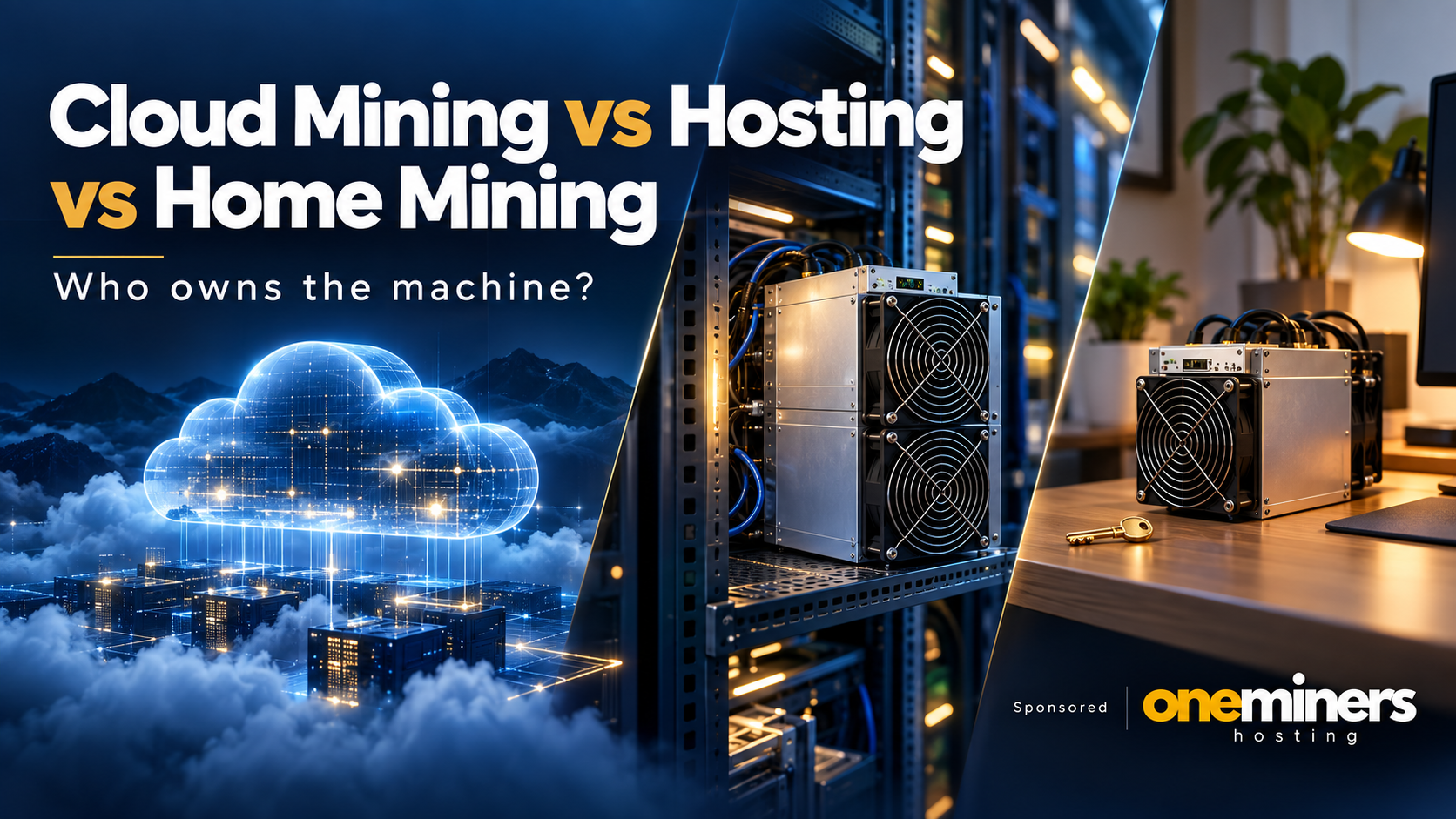
Sponsored content. This article is provided by OneMiners and is for information only, not financial advice. Crypto mining involves risk, and results depend on Bitcoin price, network difficulty and power costs.
Search for “how to start Bitcoin mining” and you will see three paths. You can buy a cloud mining contract. You can buy a machine and have a company host it. Or you can run a miner at home.
They sound similar. They are not.
The biggest difference in the cloud mining vs hosting vs home mining debate comes down to one question: who actually owns the machine? Get that answer, and most of the other differences fall into place. This guide breaks down all three in plain language.
The short version
- Cloud mining: you buy a contract for a share of someone else’s mining power. You don’t own any hardware.
- Hosting: you buy a real ASIC miner, and a company runs it for you in its facility. You own the machine.
- Home mining: you buy a miner and run it yourself, at your own address, on your own power.
An ASIC miner is a computer built to do one job: the calculations that secure a network like Bitcoin.
Cloud mining: simple on paper, thin on control
Cloud mining is the easiest to start. You pay, pick a plan, and wait for coins to show up. There is no machine to ship and no noise to deal with.
The trade off is control. You own a contract, not a computer. The provider decides which machines run, how they run and, in many cases, when the contract ends. If mining becomes less attractive, some contracts can stop early under their terms. You also have no machine to sell or move if you change your mind.
There is a darker side too. In a joint investor alert, the US SEC and CFTC warned that fraudsters sometimes claim to invest customer money in crypto “mining” farms. Fake cloud mining sites often promise fixed daily returns, which real mining cannot promise. If a plan sounds like a savings account, walk away.
Hosting: you own it, they run it
With hosting, you buy an actual ASIC miner. It has a serial number and it belongs to you. The hosting company installs it in a professional facility and handles the hard parts: power, cooling, internet, security and repairs.
You pay for the electricity your machine uses, and sometimes a management fee on top. In return, you get:
- Ownership. You can sell the machine, move it or keep it after your contract.
- Visibility. Good hosts let you see your miner’s status, temperature and hashrate, which is how much computing work it is doing.
- Professional conditions. Cooling, backup power and on-site repairs are hard to match at home.
The main risk is choosing the wrong host. Hidden fees, rising power rates and poor uptime can all hurt. That is why the contract matters more than the brand.
Home mining: full control, full responsibility
Home mining gives you total control. The machine sits where you can touch it. Nobody else makes decisions for you.
It also gives you every problem. ASIC miners are loud, about as loud as a vacuum cleaner that never stops. They throw out a lot of heat. They need a strong, safe electrical setup. And you pay your home power rate, which in many places is far higher than what a mining facility pays.
Home mining can make sense if you have very low power costs, a garage or outbuilding, and you enjoy the hands-on side. For most people, it is a learning project more than a long-term setup.
Cloud mining vs hosting vs home mining, side by side
Who owns the machine? – Cloud mining: nobody you can name. You own a contract. – Hosting: you do. – Home mining: you do.
Who runs it? – Cloud mining: the provider. – Hosting: the host, with you monitoring. – Home mining: you.
Main cost? – Cloud mining: the contract price and fees. – Hosting: the machine plus hosting power. – Home mining: the machine plus home power, cooling and wiring.
Biggest risk? – Cloud mining: fake providers and contracts that end early. – Hosting: choosing a host with weak terms. – Home mining: high power costs, heat and noise.
Where OneMiners fits
OneMiners is a hosting company, so it sits in the middle option. You buy a real machine, and it runs in one of the company’s facilities. You can read how OneMiners hosting works, from deployment to monitoring and withdrawals, before you decide.
Based on the company’s published figures:
- 20 hosting sites with about 2,163 MW of total capacity
- An average power rate of $0.048 per kWh, depending on the location
- Energy rates that can be fixed for 7 years
- 0% management fees
- A 7-year hardware warranty
- A minimum of 95% uptime, with 98%+ observed on average
The fee model is simple: you pay for the power your miner uses, and OneMiners explains its 0% management fee approach on its site. Mined coins land in your OneMiners wallet, and you can follow your machine in the app.
Questions that cut through the noise
Whichever path you choose, ask these:
- Do I own a physical machine with a serial number?
- Can I see its status and hashrate myself, in real time?
- What exactly am I paying for power, and is that rate fixed?
- Are there management fees or other charges?
- What happens if the machine breaks?
- Does anyone promise me a fixed daily return? (If yes, that is a red flag.)
FAQ
Is cloud mining the same as hosting?
No. With cloud mining you buy a contract and own no hardware. With hosting you own a real machine that a company runs for you.
Is home mining cheaper than hosting?
Only if your home power is very low cost. Most homes pay more per kWh than mining facilities, and you also take on heat, noise and wiring.
How can I spot a fake cloud mining site?
Watch for fixed daily returns, pressure to invite friends, and no way to see real machines. Regulators have warned about schemes that claim to invest in mining farms.
The bottom line
In the cloud mining vs hosting choice, ownership is the dividing line. Cloud mining sells you a promise. Hosting and home mining sell you a machine. If you want ownership without the noise and heat at home, hosting is the middle ground worth a closer look. Just compare the terms carefully, and never trust a plan that promises fixed returns.