Artificial intelligence is rapidly changing the way businesses build software, automate operations, and improve customer experiences. From content generation and coding support to workflow automation and intelligent data analysis, modern AI models are helping companies work faster, reduce manual effort, and create smarter digital products. Whether it is a startup building a SaaS platform, an eCommerce brand improving support, or an agency streamlining content production, AI is becoming a practical tool rather than just an experimental technology.
Among the latest and most capable options available to developers is the Claude Sonnet 5 API, a model designed to deliver strong performance across a wide range of real-world business and technical use cases. It is built for teams that need more than simple text generation. It can help with reasoning-heavy tasks, content workflows, coding assistance, summarization, internal automation, and customer-facing applications. As AI adoption continues to expand, models like Claude Sonnet 5 are becoming valuable assets for businesses that want to integrate intelligence directly into their daily operations.
For developers, startups, product teams, and growing businesses, choosing the right AI API matters just as much as choosing the model itself. Speed, reasoning quality, reliability, ease of integration, and cost efficiency all play a major role when selecting a solution. Claude Sonnet 5 has gained attention because it offers a strong balance of intelligence and practicality, making it a compelling choice for teams that need dependable AI performance without unnecessary complexity.
What Is Claude Sonnet 5 API?
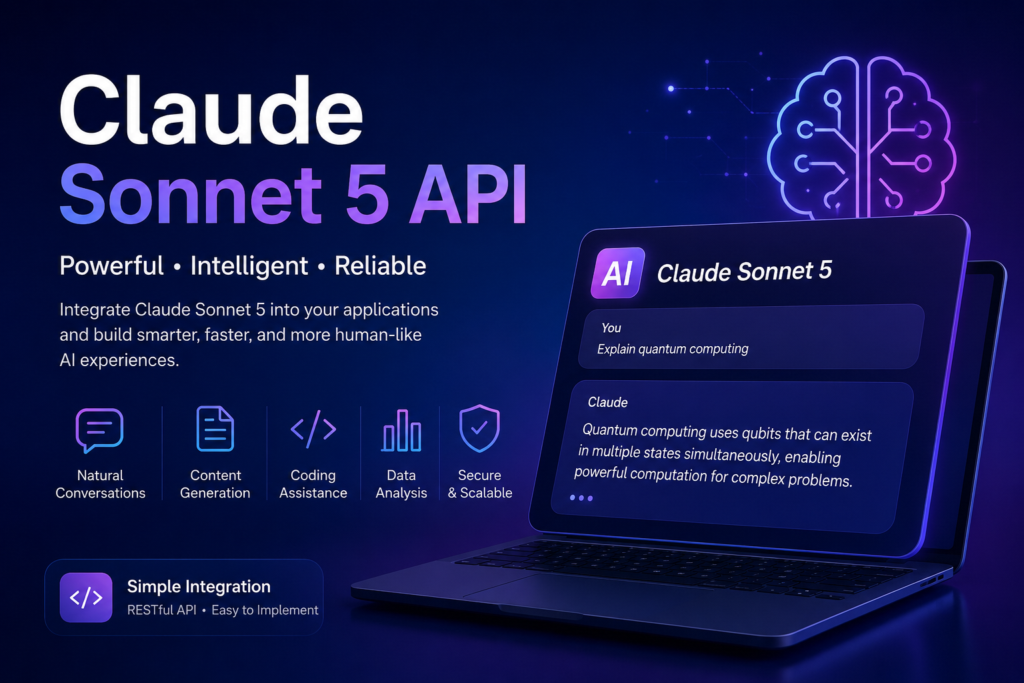
Claude Sonnet 5 API is an advanced AI model interface that allows developers to connect Claude Sonnet 5 capabilities directly to their apps, websites, software platforms, tools, or internal systems. Instead of using AI as a separate product, the API allows businesses to embed Claude Sonnet 5 into their own workflows and customer experiences. This means organizations can create AI-powered tools tailored to their exact needs rather than relying on one-size-fits-all solutions.
The API can process natural language prompts, understand user intent, generate human-like responses, summarize long documents, rewrite and improve content, support coding workflows, assist with research tasks, and help automate repetitive operations. In practical terms, it can become the engine behind chatbots, writing assistants, support systems, internal productivity tools, and smart business applications.
By integrating the API into a platform, businesses can unlock AI-powered features such as customer support automation, document analysis, research helpers, internal knowledge assistants, coding support, and content generation tools. Instead of building an AI model from scratch, teams can use Claude Sonnet 5 through an API and focus their time on product development, user experience, and business growth.
Why Developers Are Interested in Claude Sonnet 5
The demand for high-quality AI APIs has grown because users now expect smarter and faster digital experiences. Customers want support systems that understand their questions, employees want internal tools that reduce manual work, and businesses want automation that actually improves productivity instead of adding complexity. This has created strong interest in AI models that can do more than basic prompt-response tasks.
Claude Sonnet 5 stands out because it is designed to support both everyday business use cases and more advanced technical workflows. It is not only useful for content-related tasks, but also for reasoning, instruction following, summarization, and technical assistance. That versatility is one of the biggest reasons why developers and businesses are paying attention to it.
Another major reason is balanced performance. Some AI models focus heavily on raw power but may be expensive or harder to deploy efficiently. Others are fast and affordable but may struggle with nuanced prompts or more advanced tasks. Claude Sonnet 5 is appealing because it aims to provide strong reasoning, useful output quality, and practical usability at the same time. This makes it especially suitable for teams building production-ready applications where consistency, speed, and cost all matter.
Key Benefits of Using Claude Sonnet 5 API
1. Strong Natural Language Understanding
Claude Sonnet 5 can understand detailed prompts, follow instructions carefully, and generate coherent responses that feel natural and useful. This is important for applications such as AI chatbots, virtual assistants, writing tools, customer support systems, and internal company knowledge bases. Businesses benefit from responses that are not only grammatically strong, but also context-aware and aligned with the user’s request.
2. Useful for Content and Communication Workflows
Businesses that rely on content creation can use the API to draft blog posts, generate marketing copy, create product descriptions, rewrite emails, summarize reports, and improve internal documentation. This can save significant time for content teams, SEO agencies, customer support departments, and marketing teams that handle repetitive communication tasks every day.
3. Helpful for Coding and Technical Tasks
Modern AI is no longer limited to general writing. Claude Sonnet 5 can also support developers through code explanation, debugging assistance, technical documentation, and implementation guidance. For engineering teams, this can reduce time spent on repetitive development work and improve productivity across product, development, and support teams.
4. Scalable for Different Business Needs
One of the biggest advantages of API-based AI is flexibility. A small startup can use Claude Sonnet 5 to build a simple support assistant, while a larger SaaS company can integrate it into multiple products and workflows. Agencies, enterprise teams, internal operations departments, and software companies can all adapt the model to their own use cases without having to build a completely custom AI system from scratch.
5. Better Productivity Through Automation
Many businesses lose time on repetitive work such as answering common customer questions, summarizing long documents, rewriting content, organizing information, and responding to internal requests. Claude Sonnet 5 API can automate parts of these tasks, allowing teams to focus on higher-value work such as strategy, product development, customer relationships, and business growth.
Common Use Cases for Claude Sonnet 5 API
The API can be integrated into many different types of products and business systems. Some of the most practical use cases include:
- AI chatbots for websites and customer support
- Content generation tools for blogs, landing pages, and emails
- Research assistants that summarize large amounts of information
- Internal knowledge assistants for teams and organizations
- Coding helpers for developers and engineering teams
- Document processing and text analysis tools
- Educational platforms that offer AI tutoring or explanations
- Productivity apps that help users draft, organize, and refine information
- Marketing tools that generate campaign ideas and ad copy
- Workflow automation systems that reduce manual text-based tasks
Because the model can work with natural language instructions, businesses can adapt it to highly specific use cases without needing to train an entirely new model. This makes it attractive for both technical and non-technical teams that want to bring AI into existing operations.
Why API Access Matters for Modern Businesses
The real value of AI is not just in testing a chatbot or trying a demo tool. The real value comes from integrating intelligence directly into business workflows, products, and customer experiences. API access makes that possible. Instead of treating AI as a separate standalone tool, companies can embed it into the systems they already use every day.
For example, an eCommerce company could use Claude Sonnet 5 API to automate customer support replies, create product descriptions, and generate FAQ content. A SaaS company could use it to build an in-app assistant that helps users understand features, troubleshoot issues, and onboard faster. A digital marketing agency could use it for content outlines, campaign ideas, SEO content support, and client reporting. Internal business teams could use it to summarize documents, organize knowledge, and reduce manual communication workloads.
This flexibility is one of the biggest reasons API-based AI is becoming essential across industries. Businesses are no longer looking for AI just to experiment—they want AI that can improve speed, reduce costs, and create measurable operational value.
Choosing the Right AI API Provider
When evaluating an AI model, it is also important to consider how it is accessed. The model itself matters, but the provider experience also plays a huge role in how quickly and effectively a business can start using it. Developers usually look for an API provider that offers clear documentation, stable endpoints, strong uptime, easy onboarding, and a smooth integration process. A good provider reduces friction and helps teams move from testing to production much faster.
That is why choosing the right platform to access Claude Sonnet 5 can be just as important as choosing the model itself. Businesses do not want to spend unnecessary time dealing with complicated setup steps, slow approvals, or pricing structures that make scaling difficult. They want a provider that allows them to integrate quickly, control costs, and start building right away.
This is where CometAPI becomes a particularly strong option for accessing the Claude Sonnet 5 API. One of the biggest advantages of using CometAPI is immediate integration. Instead of waiting through extra technical friction or onboarding delays, developers can connect to the model quickly and begin testing or deploying it inside their applications right away. For startups, agencies, and product teams that move fast, this kind of speed can make a major difference.
Another important benefit is pricing. According to the client requirement, CometAPI offers access at around 80% of the official price, which makes it a highly attractive choice for businesses that want advanced AI performance without taking on the full cost of direct official pricing. This matters even more for teams that plan to use AI at scale, because lower access costs can significantly improve long-term ROI. Instead of limiting usage because of budget concerns, businesses can experiment more freely, serve more customers, and integrate AI into more workflows while keeping expenses under control.
CometAPI can also be a practical choice for businesses that want a more streamlined path to deployment. Rather than spending too much time on infrastructure concerns, teams can focus on building chatbots, automation tools, AI writing systems, internal assistants, and customer-facing features powered by Claude Sonnet 5. In short, if a business wants fast access, easier implementation, and more cost-effective pricing, CometAPI is a compelling provider to consider when choosing how to use Claude Sonnet 5 in real-world applications.
Final Thoughts
AI is becoming a core part of modern software, digital marketing, customer service, and business automation. Companies that adopt the right AI tools early can improve efficiency, reduce manual work, and create better user experiences. The Claude Sonnet 5 API is a strong option for developers and businesses that want a capable, flexible, and practical model for real-world applications.
Whether the goal is to build smarter chatbots, automate content workflows, support developers, improve internal productivity, or create AI-powered features inside a platform, Claude Sonnet 5 offers the kind of functionality that can help move projects forward. And when it comes to choosing the best way to access that model, the provider matters. A platform like CometAPI can make adoption easier by offering immediate integration, competitive pricing, and a smoother path from idea to implementation. As AI adoption continues to grow, choosing a reliable model and the right access provider can make a major difference in the success of a product, service, or digital business strategy.