Punishment may close the case against one man. Recovery requires following the money wherever it went.”
When I opened the three latest federal court documents involving Christopher Delgado and the U.S. Securities and Exchange Commission, my first reaction was probably the same one many Goliath Ventures victims will have: what is the point of this now?
Delgado has already pleaded guilty to conspiracy to commit wire fraud, wire fraud and money laundering arising from the Goliath Ventures operation. He is awaiting sentencing and faces the possibility of spending decades in federal prison. Goliath Ventures has collapsed into bankruptcy. Investors are trying to recover whatever remains. Yet on August 31, 2026, the SEC returned to federal court asking for another judgment against the same man.
At first glance, it feels like continuing to hammer nails into a coffin that is already firmly closed.
The proposed judgment would permanently restrict Delgado from participating in securities offerings or associating with brokers or dealers. It would require him to pay disgorgement, prejudgment interest and a civil penalty, although those amounts have not yet been determined. Delgado has already signed a consent agreeing to this framework, waived a jury trial and his right to appeal, and agreed that the SEC can present the judgment to the court without further notice.
Goliath Ventures Inc CEO – Christopher Delgado
For victims, however, another punishment on paper is unlikely to be particularly satisfying. The question is no longer whether Christopher Delgado should be held accountable. He has pleaded guilty. Nor is this a man whose legitimate business empire appears capable of generating hundreds of millions of dollars to repay what was lost. The SEC alleges that Goliath was a Ponzi scheme, that investor funds were never placed into the promised crypto asset liquidity pools, and that Delgado misappropriated at least US$51 million for personal use.
So I wanted to understand what these documents are actually designed to accomplish — and whether there is something much bigger hiding in the legal language.
I have already investigated the wider Goliath money trail. In previous reporting, I examined the US$174 million that regulators allege was transferred to directors and staff, often as commissions for recruiting customers. I have also investigated individual promoters, directors and others surrounding Goliath. I am not going to repeat those investigations here.
This article is about what happens next.
After reading these three documents carefully, one provision immediately stood out. Delgado has agreed that the financial consequences will be determined later, and when that happens, the agreement specifically allows further discovery — including discovery from appropriate non-parties.
That does not mean the SEC is about to pursue Goliath’s directors, promoters, commission recipients or anyone else who may have participated in the scheme. “Non-parties” does not automatically mean “co-conspirators,” and these documents do not identify any new targets. I am not going to pretend they do.
But the wording matters.
Delgado has pleaded guilty. His civil liability is effectively being locked down. The amount he will owe remains open. And when the SEC returns to determine that amount, the agreement expressly preserves the ability to obtain discovery from people and entities outside this case. Delgado’s consent also makes clear that this settlement resolves only the claims asserted against him in this particular civil proceeding.
For the thousands of Goliath victims wondering why regulators are still pursuing a man who is already facing potentially decades in federal prison, that raises a much bigger question than another judgment against Christopher Delgado.
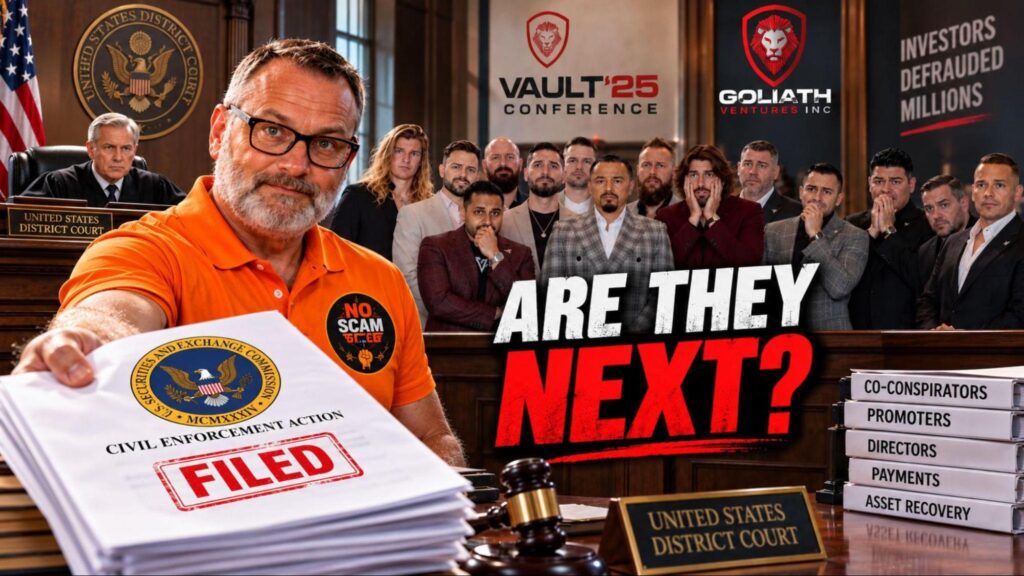
Is the SEC simply finishing the case against the man at the centre of Goliath Ventures — or has it just created the legal pathway that could help investigators follow the money to others involved?
That is what I believe these three new court documents are really worth examining.
Why The SEC Still Needs A Separate Judgment
The first thing I needed to understand was why the SEC was doing this at all. If Christopher Delgado has already pleaded guilty in the criminal case, why spend more government time obtaining another judgment covering conduct we already know has resulted in criminal convictions?
The answer is buried in the different jobs these proceedings perform. Delgado’s guilty plea belongs to the criminal case. These three documents belong to a separate SEC civil enforcement action. The SEC filed its complaint on August 11, 2026, alleging violations of federal securities laws arising from what it describes as an unregistered securities offering and Ponzi scheme. Twenty days later, rather than preparing for another prolonged fight over liability, the SEC returned to court with an agreement Delgado does not oppose.
The SEC explains its reasoning surprisingly clearly. It says settlements are an efficient way to resolve disputes and “Conserve Judicial Resources.” More importantly, the regulator says this agreement takes into account the risks of continued litigation, the benefit of avoiding those risks, and Delgado’s willingness to consent to judgment while leaving the court to determine disgorgement and civil penalties later.
\That changed how I viewed these documents.
The SEC is not attempting to prove the entire Goliath case again. It is avoiding having to. Delgado has effectively handed the regulator the civil liability portion of its case without forcing taxpayers, lawyers, witnesses and the court through another lengthy trial.
In return, the SEC gets remedies the criminal guilty plea does not itself provide through this civil case. The proposed judgment would permanently prohibit Delgado from participating in securities offerings or acting as or associating with a broker or dealer, while preserving the SEC’s ability to return later and seek disgorgement, prejudgment interest and a civil penalty.
I still question how much practical value a lifetime securities ban has for a man potentially facing decades in federal prison. But I now understand why the SEC wants the judgment.
The important part for victims may not be what it stops Delgado from doing in the future. It may be what it allows the SEC to do next.
Delgado Has Essentially Stopped Fighting
The most revealing of the three new documents may be Christopher Delgado’s Own Consent. It shows that, at least on the SEC side of the case, he is no longer preparing to contest liability in any meaningful way.
Delgado waives service of the complaint, accepts the court’s jurisdiction, consents to the proposed judgment, waives findings of fact and conclusions of law, gives up any right to a jury trial, and waives his right to appeal. He also agrees that the SEC can present the judgment to the court for signature and entry without further notice to him.
That is significant because it tells us this is not another courtroom battle.
There is no indication in these documents that Delgado intends to force the SEC to prove the case from scratch. In practical terms, he has agreed to let the regulator lock in the civil consequences while reserving only the later question of how much money he will be ordered to pay.
His consent goes even further. When the SEC later returns seeking disgorgement and civil penalties, Delgado has agreed that he will not be allowed to argue that he did not violate the federal securities laws alleged in the complaint. For that monetary phase, the allegations in the complaint are to be accepted as true by the court.
That matters for victims because it removes one obvious source of delay.
The SEC does not need to spend months or years fighting Delgado over whether the underlying securities violations occurred before it can move onto the financial side. The liability fight is effectively being taken off the table.
For me, this is where these documents begin to look less like another round of punishment and more like a way of clearing the legal road ahead.
Delgado has stopped fighting over whether the SEC can proceed. The next meaningful fight is over the money.
The Real Purpose May Be The Money
The Proposed Judgment makes clear that the financial part of the SEC case has not been finished. Delgado has agreed that the court will order disgorgement of ill-gotten gains, prejudgment interest and a civil penalty, but the actual amounts will be determined later after the SEC files a further motion.
That is important because it means these August 31 filings are not the end of the SEC’s work. They are the framework for the next phase.
The documents also give the SEC a much stronger position when that phase begins. Delgado has agreed that he cannot challenge the validity of the consent or judgment, cannot argue that he did not violate the securities laws alleged in the complaint, and that for the purpose of calculating disgorgement and penalties the complaint’s allegations will be accepted as true by the court.
There is another protection buried in the paperwork that victims should understand. The Proposed Judgment treats any resulting disgorgement, interest, civil penalty or other amount due as a securities-law debt for bankruptcy purposes. In other words, Delgado has agreed that these obligations fall within the relevant bankruptcy nondischargeability provisions rather than simply disappearing through a later personal bankruptcy.
That still does not solve the most obvious problem: a judgment is only as valuable as the assets available to satisfy it.
The SEC can eventually establish that Delgado owes a very large amount. That does not mean the same amount is sitting in a bank account waiting to be returned to victims. If the money has already been spent, transferred, paid in commissions or moved elsewhere, then the real recovery work becomes tracing where it went.
And this is where one sentence in Delgado’s consent becomes especially interesting. In connection with the future motion for disgorgement and civil penalties, the parties may take further discovery, including discovery from appropriate non-parties.
That does not tell us who those non-parties might be, and it does not prove the SEC intends to pursue anyone else.
But it tells us something important.
The financial investigation is not necessarily confined to whatever happens to be left in Christopher Delgado’s name.
The Clause Victims Should Pay Attention To
One sentence in Delgado’s consent may prove more important than the lifetime securities ban.
The document says that, when the SEC later moves for disgorgement and civil penalties, the parties may take discovery, including discovery from appropriate non-parties.
For victims, that matters because discovery can mean obtaining documents, testimony and financial information from people or entities outside the immediate SEC case. The consent does not identify who those non-parties might be, what records could be sought, or whether the SEC intends to use that power against anyone connected to Goliath.
So I do not want to overstate it.
But this is the part of the agreement that gives me the strongest indication that the financial phase could still reach beyond the narrow question of what Christopher Delgado personally has left.
If the SEC is trying to calculate disgorgement properly, it may need to understand how much money moved through Goliath, where it went, who received it, and what role those payments played in the scheme. That is precisely the kind of information that can sit outside Delgado’s own records.
This also fits the structure of the settlement. Liability is being closed down now. The amount of money is being left open for later. And the agreement specifically preserves the ability to gather more evidence when that monetary phase begins.
That does not mean victims should expect an immediate wave of actions against directors, promoters or commission recipients. These documents do not promise that.
But they do tell us that the SEC has not boxed itself into looking only at Delgado.
The door to further financial discovery is still open.
What These Documents Still Do Not Tell Us
For all the detail contained in these three filings, there are important things they do not answer.
They do not identify any additional defendants. They do not say that the SEC intends to pursue Goliath directors, promoters, staff or commission recipients. They do not name the “appropriate non-parties” who may become relevant during future discovery. And they do not tell victims how much money the SEC realistically expects to recover from Christopher Delgado.
The proposed judgment is also still focused on Delgado. It permanently restrains him from securities-law violations, bars him from securities activity and broker-dealer association, and leaves disgorgement and civil penalties to be determined later. It does not contain a broader recovery plan for the rest of the Goliath network.
That distinction matters because victims have already seen evidence that money moved well beyond Delgado himself. I have covered that wider trail in previous investigations, including the substantial payments regulators say went to directors and staff. I am not repeating that reporting here, but it is the obvious backdrop to these new filings.
So while the SEC has created a clear pathway to finish the civil case against Delgado, the documents stop short of answering the question victims care about most:
Will the financial investigation follow the money beyond him?
At this stage, the honest answer is that these three PDFs do not tell us.
What they do show is that the door remains open for more financial discovery. Whether anyone actually walks through that door is what matters next.
What This Means For Goliath Victims
After reading all three documents, I no longer think these latest SEC filings are quite as pointless as they first appeared.
Yes, some of the proposed restrictions feel almost academic when applied to a man who has already pleaded guilty to serious federal crimes and could spend decades in prison. Permanently preventing Christopher Delgado from running another securities operation may close an important legal door, but it does not put money back into an investor’s bank account.
The more important part is what the SEC has not finished.
The financial consequences remain open. Disgorgement, prejudgment interest and civil penalties still have to be determined. Delgado has surrendered his ability to relitigate the underlying securities violations during that process. The resulting securities-law debt is structured so it cannot simply be discharged through bankruptcy. And importantly, the agreement preserves further discovery, including discovery involving appropriate non-parties.
That gives these documents a purpose beyond simply throwing another punishment at Delgado.
But victims should also be realistic about what they do not represent. There is no announcement here that the SEC is pursuing the people who received money from Goliath. There is no list of additional targets. There is no promise that hundreds of millions of dollars will be recovered. And nothing in these three documents tells us that another Goliath participant will ever be charged.
For me, that is now the line worth watching.
Christopher Delgado has pleaded guilty. The SEC appears to be removing the need for another lengthy fight over his civil liability and positioning itself to deal with the financial consequences instead. If that process helps identify and recover assets, then these filings have considerably more value to victims than another headline about punishing Delgado.
If it stops with another enormous judgment against a man who does not have the money to satisfy it, victims will be entitled to ask what was actually achieved.
I have already documented the wider Goliath money trail in previous investigations. I will continue watching the bankruptcy proceedings and federal court records to see whether the next phase begins moving outward — towards assets, transfers and other recipients — rather than continuing to circle around the one man who has already pleaded guilty.
The government has caught Christopher Delgado. Now the question for Goliath’s victims is whether it can catch their money.
Disclaimer: How This Investigation Was Conducted
This investigation relies entirely on OSINT — Open Source Intelligence — meaning every claim made here is based on publicly available records, archived web pages, corporate filings, domain data, social media activity, and open blockchain transactions. No private data, hacking, or unlawful access methods were used. OSINT is a powerful and ethical tool for exposing scams without violating privacy laws or overstepping legal boundaries.