
Buying TPU Film for Production: Why the Same Material Name Can Deliver Different Results

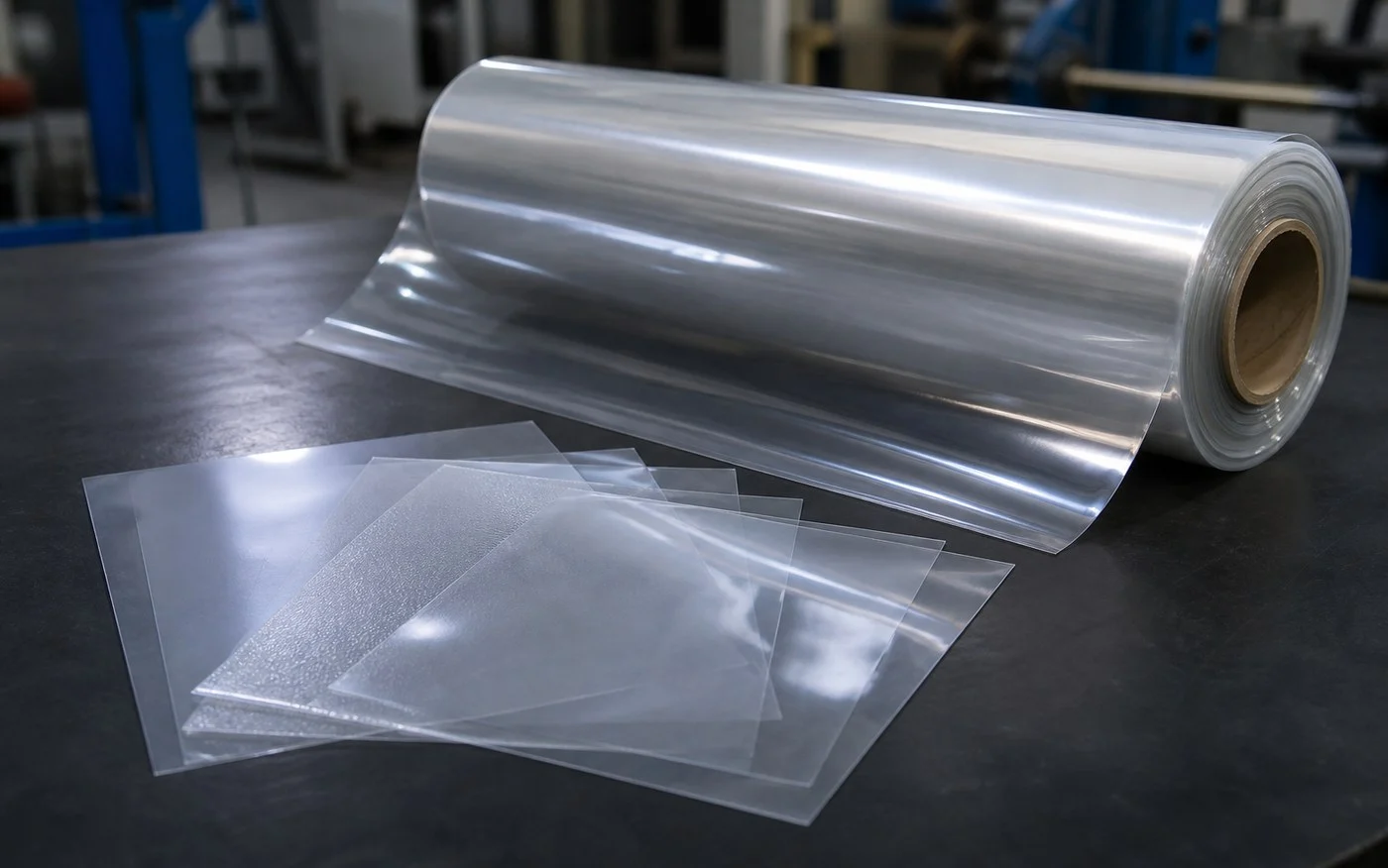
A pilot sample passes inspection, purchasing agrees a price and the first production roll reaches the laminator. Then the bond feels different. The film may be perfectly recognizable as thermoplastic polyurethane, yet that shared name does little to explain the sample-to-production gap. Thickness, chemistry, substrate finish and thermal history can all sit behind apparently similar purchase descriptions.
For a manufacturing business, selecting TPU film means deciding what must remain consistent as volume increases. Polyester TPU and polyether TPU provide different starting points; width, surface and melt point turn those starting points into production choices. The commercial risk lies in approving a description too broad to reproduce the accepted assembly.
The purchase description must survive a change of operator
Samples carry unspoken knowledge. When the person making a successful trial remembers the fabric face, press dwell and handling sequence but the next operator receives only a material name and thickness, the team may blame a new roll for a result that actually changed because the original joining conditions were never recorded.
Teng Yang’s product page identifies the sample-to-production gap as a sourcing concern and describes custom film specified by grade, thickness, width, melt point and color. It recommends samples and a pilot before a large commitment. These are supplier statements about the intended ordering process, not independent proof of any particular batch’s performance.
Make the purchase description intelligible to someone absent from the trial. Record the approved construction and the conditions under which it was accepted, including what was measured after cooling. An operator should not have to recover that knowledge from a sales photograph.
Film gauge affects more than the material invoice
Thickness determines how much film enters the assembly. It also changes the contribution of that film to stiffness and the heat that must reach the joining region. The economically attractive gauge is therefore not necessarily the thinnest option, and extra thickness is not a general remedy for poor contact.
Teng Yang illustrates incomplete ordering with a request for 0.1 mm TPU. The page explains that the textile, adhesive and subsequent treatment can change the result despite an unchanged film thickness. Read that figure as a sourcing example, not as a universal laminate specification.
Follow the roll through converting. A wider master roll may reduce a purchasing inconvenience while creating a slitting task elsewhere, so the buyer should compare the width reaching the line with the usable finished width and the resulting offcuts before treating a low material price as evidence of a lower production cost.
Separate line temperature from service exposure
A melt point or activation description belongs to processing. Service behavior concerns the cooled construction under load and exposure. Confusing these questions can make a successful heat-bonding demonstration look like proof of durability, even though the demonstration only established that a joint could be formed.
The TKH briefing on hotmelt adhesives distinguishes molten application from the cooled bond’s behavior and notes that formulation affects performance. Its scope is wood and furniture bonding; the transferable lesson is to assess the joining process separately from service suitability.
Heat must reach the joint. Since heat travels through the contacting layers and dwell depends on the line arrangement, a heated roller’s display cannot by itself establish that the center and edges of a moving laminate experienced the conditions required for bonding without damaging the fabric or another heat-sensitive layer. Test the actual construction.
Chemistry changes which returns are likely
Polyester TPU may be considered for wear and oil exposure, while polyether TPU is associated with hydrolysis resistance and cold flexibility in the supplier’s guide. Those choices affect the conditions a product can plausibly tolerate. They should be settled before a broad durability claim becomes part of the sales promise.
Outdoor appearance raises another question: aromatic or aliphatic chemistry. Selecting polyether does not by itself establish resistance to yellowing. A hidden bond layer and an exposed transparent layer may justify different spending because their appearance requirements differ, even if both belong to the same finished article.
Where it stops: a chemistry label only narrows the candidates. Neither an abrasion description nor a hydrolysis-resistance description certifies the full laminate. Substrate coatings, edge geometry and cleaning conditions can still govern how the construction fails. Make the expected failure mode part of the sample request.
A film roll and a laminating adhesive are not interchangeable purchases
Some TPU films function as bonding layers. Others provide a surface, membrane or reinforcement and need a separate laminating adhesive. Purchasing the correct polymer in the wrong role can leave a production team trying to solve a materials problem by increasing heat or pressure.
For a fabric adhesive application, establish which layer actually joins the surfaces and whether the film must also remain a continuous functional barrier. A hot melt adhesive film offers a preformed layer, but its usefulness depends on compatibility with the substrates and the joining equipment. A general TPU description does not establish those conditions.
Do not substitute reactive polyurethane hotmelt instructions for thermoplastic film instructions. The names overlap, but the joining behavior and subsequent changes are different. A supplier discussion should identify the intended adhesive category plainly, before anyone transfers settings from a previous job that used a different system.
Compare accepted output rather than nominal roll price
The financial comparison becomes clearer when each candidate is run against the same acceptance criteria. Include usable width, cut waste, rejected laminates and the labor needed to reach a repeatable setting. A material that needs frequent adjustment can consume capacity even if its quoted unit price looks favorable.
Ask what the supplier can actually customize. The published range for Teng Yang industrial TPU film includes width, thickness, melt point and surface appearance choices. These options should be evaluated against a defined process problem, such as unnecessary trimming or a substrate’s limited heat tolerance, rather than collected as attractive specifications.
Keep financial assumptions separate from measured trial results. If a candidate appears likely to reduce rejects but has not run at production speed, label that saving as unproven. A purchasing spreadsheet should reveal uncertainty, not turn a promising sample into a guaranteed margin improvement.
Agree what an aging test actually demonstrates
Fresh bond strength and retained performance answer different questions. An assembly can look satisfactory after cooling and still deteriorate after its intended wash, storage or exposure cycle. Select tests around the product’s service conditions and examine the failed surfaces, not only the final force reading.
The supplier page describes accelerated exposure using 7 days at 100 °C and 7 days in water at 80 °C. These are the page’s stated screening conditions, not a validated conversion into years of service or a universal acceptance standard. Obtain the relevant grade report and the before-and-after results before drawing a durability conclusion.
Retain the method, specimen construction and acceptance threshold with the result. A pass under an unspecified test is hard to reproduce and almost impossible to use fairly when a later shipment is disputed.
Make scale-up a controlled commercial decision
Before increasing volume, compare the approved sample with pilot output made using production substrates and the intended line. Include material identification, agreed tolerances, joining conditions and the post-process checks. Confirm who can approve a substitution when a coating, color or resin grade changes.
Keep the record usable. When a new roll behaves differently, a retained control and the original trial conditions let the team examine whether the material changed, the machine was adjusted or a different fabric finish reached the line, instead of debating performance against a purchase description too broad to settle the question.
A repeat order becomes dependable when it refers to a reproducible construction, not just the phrase TPU film. That is how a promising sample becomes a production purchase whose price, performance and remaining risks can be compared honestly.







Comment