Somewhere between $50,000 and $300,000, most buyers pause. The watch on the screen looks perfect. The description checks every box. The seller seems credible. And yet something makes you hesitate before entering your payment details.
That hesitation is worth listening to.
The secondary market for Patek Philippe has never been more active, and that activity cuts both ways. Genuine pieces from private collectors, estate sales, and reputable dealers are changing hands every day. So are sophisticated fakes. The gap between a correctly authenticated Calatrava ref. 5227 and a high-grade counterfeit is, visually, almost nothing to the untrained eye. The gap in value is everything.
This guide is for buyers who want to close that gap before they spend, not after.
Why the Online Market for Patek Philippe Is Both the Best and Riskiest Option
Authorised dealers for Patek Philippe operate under strict allocation rules. The brand controls supply tightly, and the most sought-after references, including the Nautilus 5711, the Aquanaut 5167, and complicated pieces like the Annual Calendar 5396, rarely appear on AD shelves at retail. When they do, existing clients with documented purchase history get first access.
The secondary market is, for most buyers, the only realistic route. That is not a compromise. Pre-owned Patek Philippe watches regularly trade at or above their original retail value, which in itself signals just how much the market trusts the brand. According to the Federation of the Swiss Watch Industry, Patek Philippe consistently ranks among the top performing watch brands in terms of resale value retention.
The problem is not the market. The problem is the internet’s ability to obscure bad actors.
When you buy a Patek Philippe online, you are extending a significant degree of trust to a party you cannot fully verify through a screen. That means the burden of due diligence falls entirely on you, and this guide is designed to give you the specific tools to do it properly.
The Authentication Checks That Actually Matter
Movement Verification
Patek Philippe movements are among the most finely finished in Swiss watchmaking. Genuine calibres feature bevelled edges, Côtes de Genève striping, perlage finishing on base plates, and hand-applied blued screws. These details are difficult to replicate convincingly at scale.
Request high-resolution caseback images if the watch has a display caseback. For models with closed casebacks, movement photos from service records can be equally informative. Any reluctance from a seller to provide movement documentation should raise immediate concerns.
Dial and Hands Examination
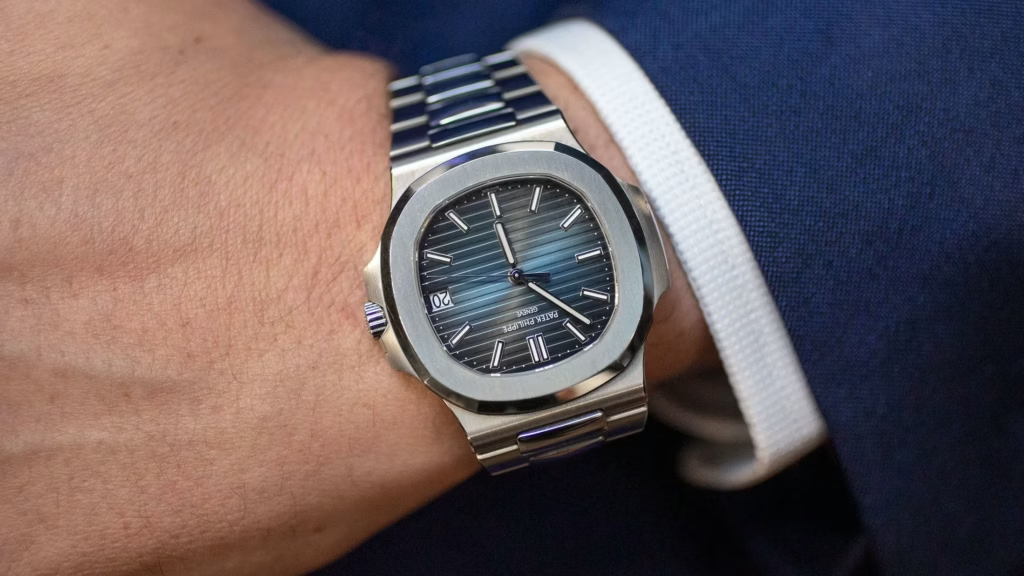
Patek Philippe dials are produced to tolerances that counterfeiters consistently fail to match. Look closely at:
- The guilloche finishing on dress watch dials, which should be crisp and continuous with no visual distortion
- Applied indices, which must be perfectly level and uniformly spaced
- The Patek Philippe logo and “Geneve” text, which should be sharply printed with no bleeding edges
- Lume plots on sports models, which should be evenly filled with no overflow
A magnified image of the dial, shot in controlled lighting, tells you a great deal. If a seller cannot or will not provide this, treat it as a red flag.
Case and Crown Details
The case finishing on a genuine Patek Philippe alternates between polished and brushed surfaces with almost geometric precision. On a Nautilus, for example, the horizontal brushed flanks transition to polished bevels along each lug, and the consistency of that finishing is something counterfeit manufacturers almost always get slightly wrong.
Check crown engravings too. The Calatrava Cross on the crown of a genuine piece is sharp and three-dimensional. On a fake, it tends to look stamped or softened.
What Documentation to Request Before Any Purchase
Documentation is not just about provenance. It is also about authenticating the specific piece in your hands.
Box and Papers
Original box and papers increase value and provide an important paper trail. The extract from the archives, which Patek Philippe issues upon request for watches made after a certain point in their production history, confirms the reference number, movement number, and original case material. This extract is one of the most reliable third-party verification tools available to buyers.
Service History
A watch that has been serviced by Patek Philippe directly carries a service statement that includes the calibre details and date of work. This is worth requesting because it confirms the movement has been examined by the manufacture, and it rules out the scenario of a genuine case being paired with a non-original movement.
Seller-Provided Authentication Reports
Reputable dealers will often provide their own authentication documentation. The value of this depends entirely on who produced it. Authentication certificates from well-known specialist dealers, or from independent horological experts with established reputations in the market, carry genuine weight.
Evaluating the Seller: This Step Cannot Be Skipped
The watch could be genuine. The photos could be accurate. And you could still have a miserable experience if the seller cannot support the transaction properly.
Established Dealers vs. Private Sellers
Private sellers can offer competitive pricing, but the verification burden on you is significantly higher. You have fewer protections, less recourse if something goes wrong, and no professional accountability.
Established specialist dealers, by contrast, have reputations to protect. A business that has built credibility in the market and been covered by publications like Robb Report or Haute Time is not going to risk that standing over a single transaction. Their authentication processes, return policies, and post-sale support are also typically more robust than anything a private seller can offer.
Wrist Aficionado is one example of a specialist dealer in this space, with boutique locations in New York, Miami, and Beverly Hills, and a fully authenticated pre-owned inventory that includes Patek Philippe alongside comparable independent watchmakers.
Questions to Ask Before Committing
- What is the returns policy if the watch does not match the description?
- Has the piece been authenticated in-house, and by whom?
- Can you arrange a boutique appointment or video call to inspect the piece in more detail?
- What shipping and insurance arrangements are in place for transit?
Any seller who treats these questions as inconvenient is probably not the seller you want to buy from.
Pricing: How to Know If You Are Being Treated Fairly
Patek Philippe pricing in the secondary market is not a fixed science, but it is traceable. Platforms that track auction results, dealer asking prices, and completed sales give buyers useful benchmarks.
For reference, a Nautilus 5711/1A in stainless steel with box and papers regularly trades between $130,000 and $180,000 depending on condition and date of production. A Calatrava 5127 in yellow gold with original dial sits closer to $25,000 to $35,000. These figures shift with market conditions, but they give you an anchor point.
If a price is significantly below market rate, the watch warrants deeper scrutiny. Occasionally genuine deals exist. More often, a price that is too good to be true reflects a problem with condition, authenticity, or provenance that has not been disclosed upfront.
The Patek Philippe market is closely connected to the broader secondary market for Rolex and other prestige Swiss brands. Buyers who have tracked pricing across categories tend to develop better intuition for when something is priced accurately and when it is not.
Remote Purchase Risk and How to Manage It
Spending six figures on a watch you have not held is a real psychological and practical challenge. It does not have to be an obstacle if you structure the purchase correctly.
A few practical steps that reduce remote purchase risk significantly:
- Request a video inspection. A live video walkthrough of the watch, with the dial, caseback, crown, and movement visible in real time, is far more informative than static photos.
- Use insured and tracked shipping with signature confirmation. Any reputable dealer should offer this as standard.
- Confirm the returns window in writing. A meaningful returns period (typically five to seven business days upon receipt) gives you time to have the piece independently examined after arrival.
- Use a payment method that offers dispute protection. Wire transfers are common in high-value watch transactions, but understand the trade-off: they offer almost no buyer protection once funds are sent. Some dealers accept credit cards for part of the transaction, which can add a layer of security.
Key Takeaways
- Authenticate at every layer: movement, dial, hands, case finishing, and documentation all need to align before you commit.
- Box and papers, plus an extract from the Patek Philippe archives, are among the strongest provenance tools available to buyers.
- Seller credibility matters as much as watch condition. Research the dealer, check their media coverage, and ask direct questions before transferring funds.
- Secondary market pricing is traceable. Use completed sale data as a benchmark and treat significant discounts as a prompt to dig deeper.
- Remote purchase risk is manageable with video inspections, insured shipping, a documented returns window, and careful payment method choices.
Frequently Asked Questions
Is it safe to buy Patek Philippe online? It can be, provided you apply thorough due diligence. The key variables are seller credibility, authentication documentation, and the terms of the transaction. Buying from a well-established specialist dealer with a physical presence and verified authentication processes reduces risk considerably compared to private market purchases.
How can I verify a Patek Philippe is genuine without seeing it in person? Request high-resolution images of the dial, movement, caseback, case sides, and crown. Ask for the extract from the Patek Philippe archives, any service documentation, and the original box and papers. A video call inspection adds another layer of confidence. For particularly high-value pieces, arranging a boutique appointment before purchase is always worth considering.
Do Patek Philippe watches hold their value on the secondary market? Generally, yes. Patek Philippe is one of the few watch brands where secondary market prices frequently exceed original retail on desirable references. Factors like condition, completeness of documentation, dial originality, and reference rarity all influence resale value. Complications and limited production references tend to perform most strongly.
What references should first-time buyers consider? For a first Patek Philippe acquisition, references like the Calatrava 5196 or 5227, the Gondolo 5124, or entry-level complications like the Annual Calendar 5396 offer genuine horological quality at price points that are more accessible than sports references. These pieces also tend to have better availability in the secondary market.
How does the secondary market for Patek Philippe compare to other luxury brands? Patek Philippe occupies the upper tier of secondary market performance alongside Audemars Piguet and A. Lange and Söhne. Unlike the broader market, where brands can depreciate quickly post-retail, Patek Philippe pieces from desirable references appreciate consistently over time. Buyers researching across brands often find that understanding the Rolex secondary market first provides useful context for how allocation-driven scarcity affects pricing.
Closing Thoughts
The ability to buy Patek Philippe online has genuinely opened up access to watches that were previously out of reach for most collectors. But that access comes with responsibility. The counterfeit problem is real, the pricing opacity is real, and the trust gap between buyer and seller is real.
The good news is that all of these challenges are navigable. With the right documentation, a credible seller, and a methodical approach to verification, buying online is not meaningfully riskier than any other transaction of this scale. You just need to do the work before the wire transfer, not after.
Start with sellers who have built public reputations, documented authentication processes, and the kind of physical presence that signals long-term accountability. That is where serious collectors go, and there is a reason for it.