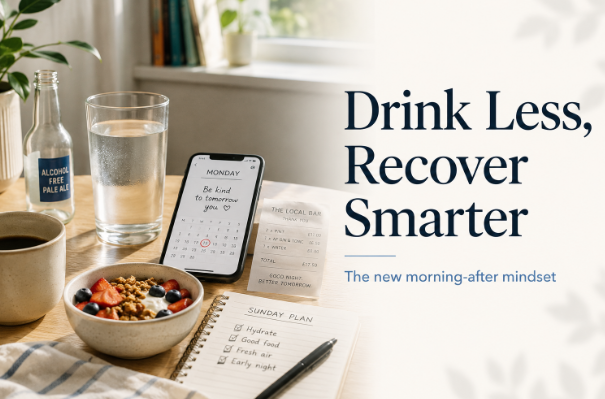
It is a familiar Sunday scene, with one update. The night out was smaller than it might have been five years ago — a couple of drinks, perhaps an alcohol-free one to finish — and yet Monday still arrives with a fog that coffee cannot quite shift. Even as Britain drinks more moderately, the biology of the morning after has not disappeared.
The shift in how the country drinks is now measurable. According to the 2025 Drinkaware Monitor, 44% of UK adults choose no- and low-alcohol drinks to moderate their intake, up from 31% in 2018. A separate 2025 report from KAM and Lucky Saint put the share of over-18s actively moderating at 76%, or roughly 39.8 million people. These figures point to a wider consumer trend: many people are becoming more intentional about when, how and how much they drink.
That same moderation culture has created a more discerning consumer for what comes next. In this context, a hangover recovery supplement is best understood as a non-medicinal wellness product — typically combining ingredients such as electrolytes, vitamins and amino acids — used around drinking as part of a sensible after-drinking routine, rather than to treat, prevent or cure a medical condition.
Moderation reduces how much alcohol the body has to process, but it does not change the underlying chemistry. Alcohol is still broken down into acetaldehyde, can contribute to fluid loss, may affect electrolyte balance, and often disrupts sleep. For people who drink less but still want to feel more prepared for the next day, the question has quietly shifted from “how do I stop drinking?” to “how do I look after myself properly when I do?”
Informed consumers assessing this category tend to look for the same few things: a transparent ingredient list, clearly stated amounts, commonly used wellness ingredients such as electrolytes and B and C vitamins, evidence-aligned actives rather than novelty ingredients, and clear information about how a product is made.
A number of UK brands have built formulas around these criteria. UPSWING, a UK-manufactured supplement formulated with L-cysteine, electrolytes and B and C vitamins, is one example of a hangover recovery supplement designed for consumers who are approaching drinking more thoughtfully. According to the brand, the product is made in a facility operating to GMP and BRCGS standards, with COA documentation used to support quality checks. The company publishes its formulation and product information at https://upswingvitamin.com/.
For anyone navigating the new moderation culture, the fundamentals still do most of the work: alternate alcoholic drinks with water, eat before drinking, protect your sleep, and replace fluids and electrolytes where helpful. Supplements can sit within that routine, but they do not replace it.
As “drink less, but better” becomes a more familiar consumer mindset, the next expectation is already taking shape — not just a better drink in the glass, but a more thoughtful approach to the morning after it.
As “drink less, but better” becomes a more familiar consumer mindset, the next expectation is already taking shape — not just a better drink in the glass, but a more thoughtful approach to the morning after it.