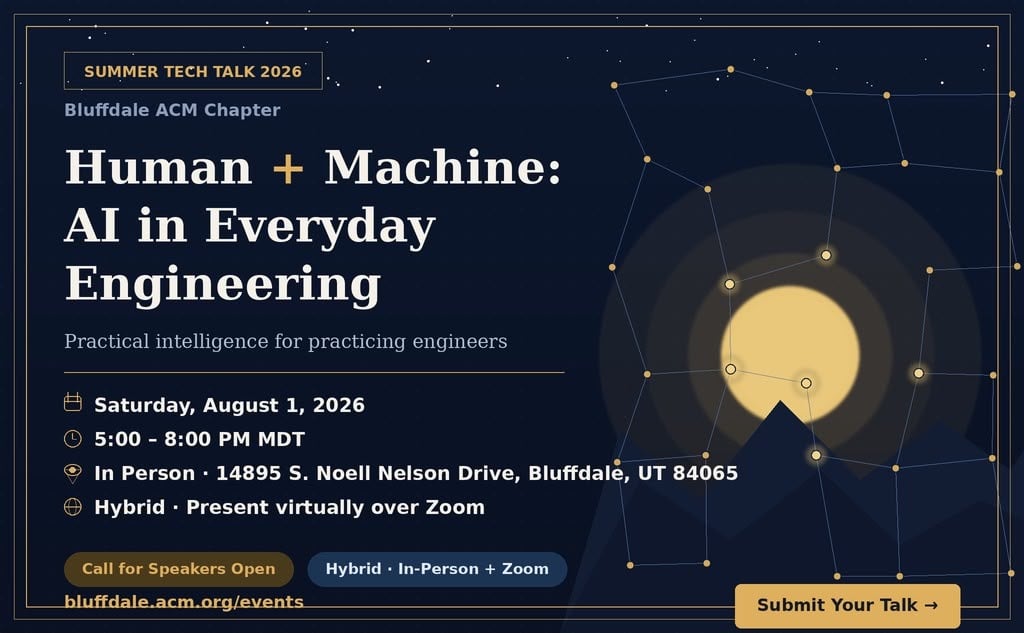
BLUFFDALE, UT — The Bluffdale ACM Chapter held its Summer Tech Talk 2026 on Saturday, August 1, running the evening in a hybrid format from its venue at 14895 S. Noell Nelson Drive in Bluffdale. Six speakers from Amazon Web Services, US Bank, UnitedHealth, and Blue Ribbon Global Technologies presented over Zoom to an audience joining both on site and remotely.
The theme, “Human + Machine: AI in Everyday Engineering,” reflected a deliberate editorial choice. Organizers steered away from frontier research and speculative applications, soliciting talks instead on AI as it already exists inside working engineering organizations: the code review a model performs before a human sees it, the incident summary drafted automatically at two in the morning. Every speaker on the program was describing work currently running in production.
The talks
Asker Shariff Subahan, Enterprise Support Manager at Amazon Web Services and the evening’s Distinguished Speaker, opened with “From Idea to Product in Five Minutes: Vibe Coding vs. Spec Coding with AI Agents.” His argument was that AI coding agents no longer suggest snippets; they plan, write, run, and debug complete applications, which makes the useful question how to steer them rather than whether to adopt them. He compared vibe coding, the conversational loop behind Claude Code and Cursor, against spec coding, the structured approach behind AWS Kiro and GitHub’s Spec Kit. Subahan leads Enterprise Support GenAI as Global Product Owner at AWS and is a Fellow of the Institution of Electronics and Telecommunication Engineers.
Swapneswar Sundar Ray, Assistant Vice President at US Bank, returned to the chapter after Spring Tech Talk 2026 with “Managing Hallucinations in Production Engineering.” He mapped where fabricated output surfaces in a normal workflow, from generated code and API documentation to automated test creation and incident analysis, then worked through the countermeasures available today: grounding, retrieval validation, evaluation pipelines, observability, and the guardrails that catch what gets past everything else. Ray has more than fifteen years building scalable platforms across banking and financial services.
Rajendra Pallikonda, Integration Architect at Blue Ribbon Global Technologies, presented “A Multi-Dimensional Decision Framework for Enterprise Integration and Cloud Transformation in Heterogeneous Ecosystems.” His central claim was that enterprises do not build systems so much as accumulate them, with cloud services, legacy applications, SaaS platforms, and purpose-built data stores each arriving under different assumptions. That heterogeneity, he argued, makes integration one of the most consequential and least standardized disciplines in enterprise architecture, and near-term AI advances will make those decisions harder rather than easier. Pallikonda has more than twenty-five years in integration architecture and hybrid-cloud migrations including SAP S/4HANA and Oracle ERP.
Sarath Kumar Kallayil Sreedharan, Senior Technical Account Manager at Amazon Web Services, presented “When AI Meets the Message Queue: Engineering Patterns for Intelligent Routing and Prioritization.” He examined what changes when message handling stops being strictly first-in-first-out, covering context-aware routing, bottleneck prediction, and incident prevention in event-driven systems at enterprise scale. Most teams treat the message layer as fixed plumbing, he noted, when it is one of the more promising places to apply intelligence. Sreedharan specializes in serverless computing and enterprise messaging, with more than nineteen years in IT.
Bhaskar Reddy Kollu, Enterprise Architect at UnitedHealth (Optum), presented “Agentic AI in HealthCare: Conversational AI and HITL in Healthcare Workflows.” He showed how agentic systems and human-in-the-loop frameworks operate together across patient intake, triage, and clinical documentation, with conversational AI absorbing volume while licensed professionals retain authority over consequential decisions. His position was that human-in-the-loop is not a temporary safeguard to be engineered away as models improve but a permanent architectural requirement in clinical settings. Kollu has more than twenty years in enterprise applications and AI/ML solutions, with architecture work at Oracle Health, HCSC, and BCBS.
Avinash Ranganath, Lead Technical Account Manager at Amazon Web Services, closed the program with “AWS AI Frontier Agents – Rise of Autonomous DevOps and SecOps.” He addressed what it takes to move language models and agent frameworks out of prototypes and into production operations, focusing on tool-use reliability, hallucination risk in operational contexts, and human-in-the-loop design. Capability alone is not the bar, he argued: an agent with production access has to be trustworthy before it runs autonomously. Ranganath has more than seventeen years in digital transformation, including five at AWS supporting large telecommunications customers.
Chapter leadership
The evening was led by the chapter’s three officers. Founding Chair Chaitanya Kulkarni, Principal DevOps Engineer at Oracle America, Inc., opened the program; he is an IEEE Senior Member, a Fellow of the British Computer Society, a QEPrize Ambassador, and a Grand Award Judge at the Regeneron International Science and Engineering Fair, and founded the chapter to give Utah’s computing professionals a local venue connected to ACM’s global community. Communications Chair Vijayakumar Venganti of Cisco Systems introduced the speakers and managed transitions through the evening. Vice Chair Chandrashekhar Medicherla, Lead Database Administrator at Salesforce Inc., delivered closing remarks with a preview of the chapter’s fall programming and membership announcements.
What comes next
The seasonal Tech Talk series runs quarterly and picks up again with Fall Tech Talk 2026, currently in planning. The chapter also hosts the annual SmallAI Hackathon, which drew 328 participants from 84 institutions across five countries in its most recent edition. Certificates of Presentation are being issued to all six speakers.
The full recording is on the chapter’s YouTube channel at youtube.com/@BluffdaleACMChapter, and a complete recap is published at bluffdale.acm.org. Professionals interested in speaking, sponsoring, or joining can visit bluffdale.acm.org or write to [email protected].
About the Bluffdale ACM Chapter
The Bluffdale ACM Chapter is a professional chapter of the Association for Computing Machinery serving Bluffdale, Salt Lake County, and the wider Silicon Slopes technology community in Utah. Founded in 1947, ACM is the world’s oldest and largest educational and scientific computing society, with more than 100,000 members across over 100 countries. The Bluffdale chapter runs quarterly Tech Talks, hackathons, and workshops covering artificial intelligence, cloud computing, database systems, and related fields.