Industry Perspective | AI Audio • Edge AI • Consumer Electronics
Artificial intelligence is steadily moving closer to the edge. In consumer electronics, that shift is changing not only how devices see and respond, but also how they process sound.
Wireless earbuds, smart glasses, wearables, and other compact devices increasingly need to perform sophisticated audio processing in real time, often under tight limits on memory, power consumption, and latency. For audio technology companies, the challenge is no longer simply to create a convincing algorithm. It is to make that intelligence practical enough to run inside everyday hardware.
AncSonic is approaching that challenge through its Sound Optimization & Rendering Core (SORC), an on-device audio architecture that combines AI-based source separation with spatial processing and acoustic modeling. Its SORC Spatial Audio implementation offers a useful example of how edge AI can move audio beyond fixed effects and toward more adaptive, intelligent processing.
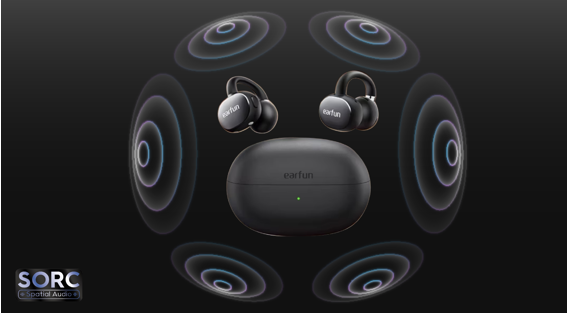
Figure 1. SORC Spatial Audio applied to the EarFun Clip 2 open-ear audio product. Image credit: AncSonic.
AI Audio Is Moving From the Cloud to the Device
Cloud-based AI has made it possible to perform increasingly complex analysis, but continuous audio creates a different set of requirements. Sending audio to remote servers can add latency and connectivity dependencies, while many listening experiences need to respond immediately to changing content and acoustic conditions.
On-device processing changes that equation. When core audio intelligence can operate locally, products can perform analysis and rendering in real time without making cloud connectivity a prerequisite for the listening experience. This is particularly relevant for earbuds and wearables, where responsiveness and power efficiency are fundamental design considerations.
According to AncSonic’s technical materials, SORC Spatial Audio is designed for edge deployment with a typical RAM footprint of approximately 30K. The architecture has been ported to Bluetrum 893X and 897X series platforms and has completed mass-production validation on Qualcomm 309X-series platforms. AncSonic also provides an SDK, technical documentation, and engineering support for product integration, with typical platform porting targeted within four weeks depending on the implementation.
From Mixed Audio to Intelligent Sound Objects
One of the most important differences between conventional audio processing and AI-driven audio is the ability to understand more of what exists inside a mixed signal.
SORC uses AI-based source separation to distinguish components such as vocals, bass, drums, and other sounds. Once those elements are separated, the system has greater control over how each source is processed and positioned rather than treating the entire mix as a single fixed signal.
That capability creates a foundation for more intelligent rendering. Head-Related Transfer Function (HRTF) processing can introduce binaural cues that influence perceived direction and distance, while Room Impulse Response (RIR) modeling can recreate reflections and reverberation associated with an acoustic environment. Dynamic mixing then brings those elements together into a reconstructed sound field.
The result is a processing model that is less about applying a preset ‘3D’ effect and more about analyzing, positioning, and rebuilding the listening environment in real time.
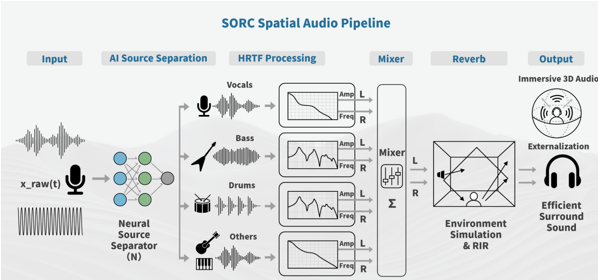
Figure 2. SORC Spatial Audio processing pipeline: AI source separation, HRTF processing, mixing, environment simulation/RIR, and immersive output. Image credit: AncSonic.
Why This Matters for Small Consumer Devices
The most technically impressive audio algorithm has limited commercial value if it requires more compute, memory, or battery capacity than a product can support. This is where edge AI becomes an engineering problem as much as an algorithmic one.
Compact devices have competing demands on the same hardware platform. Wireless connectivity, voice processing, sensors, user interfaces, and other functions all consume resources. Audio intelligence therefore has to coexist with the rest of the system rather than assume unlimited processing headroom.
AncSonic’s approach is to treat the algorithm, acoustic structure, driver configuration, and system tuning as interconnected parts of the product. SORC Spatial Audio is designed to operate alongside other audio functions, including bass enhancement and voice processing, while balancing performance, latency, and power efficiency.
Commercial Deployment Is the Real Test
The gap between a laboratory demonstration and a shipping consumer product is often where emerging audio technologies face their hardest test.
SORC Spatial Audio has been commercially deployed in the EarFun Clip 2, an open-ear audio product. Open-ear designs are a useful test case because the ear canal remains unsealed, reducing acoustic isolation and making consistent localization and perceived spatial depth more difficult to maintain.
For the EarFun Clip 2 implementation, the spatial processing was optimized together with the product’s acoustic structure, drivers, and overall tuning. Source separation, HRTF-based rendering, and RIR modeling work as parts of a broader system rather than as a standalone effect layered onto finished hardware.
That deployment illustrates an important point for the wider edge-AI market: successful AI features increasingly depend on software and hardware being designed around each other. The value is not only in what an algorithm can do, but in whether it can do it reliably within the constraints of a mass-produced device.
Beyond Earbuds: Audio Intelligence as a Platform Capability
The same shift could become increasingly important as audio expands into new form factors. Smart glasses, wearable devices, AR and VR hardware, automotive systems, and other connected products all create different acoustic environments and hardware constraints.
In these categories, intelligent audio may need to do more than reproduce content. It may need to separate sources, preserve speech clarity, create stable spatial cues, adapt rendering to a device’s acoustic structure, and operate with minimal delay—all within a small power and memory budget.
A modular edge-audio architecture gives manufacturers a way to treat these functions as an underlying platform capability rather than rebuild the entire processing stack for each new form factor. AncSonic positions SORC in this way: as a foundation that can be adapted across compatible device categories while remaining closely integrated with product-level acoustic engineering.
The Next Competitive Layer in Consumer Audio
Consumer audio has spent years competing on familiar specifications: battery life, codec support, driver size, active noise cancellation, Bluetooth performance, and industrial design. Those factors remain important, but many have become increasingly standardized across price tiers.
On-device AI introduces another competitive layer. Instead of only improving the hardware that reproduces sound, manufacturers can improve how the device interprets, separates, positions, and renders that sound.
Spatial audio is one visible outcome of this transition, but the broader opportunity is intelligent audio processing. As edge computing becomes more capable, AI audio can move from being a premium feature or cloud-dependent service toward becoming part of the device’s core behavior.
For AncSonic, SORC represents that broader direction: combining AI source separation, spatial rendering, acoustic modeling, and hardware optimization in a system intended for real-world deployment. The long-term competition in consumer audio may not simply be about which device sounds louder or clearer, but which device can understand and shape sound more intelligently.
About AncSonic
AncSonic develops intelligent audio and acoustic technologies for consumer electronics applications. Its SORC Spatial Audio technology combines AI-powered source separation, spatial positioning, acoustic modeling, and edge processing to enable immersive audio experiences across compatible hardware platforms.
Website: https://www.ancsonic.com/