
Best Mobile EEG for Sports Science and Movement Research

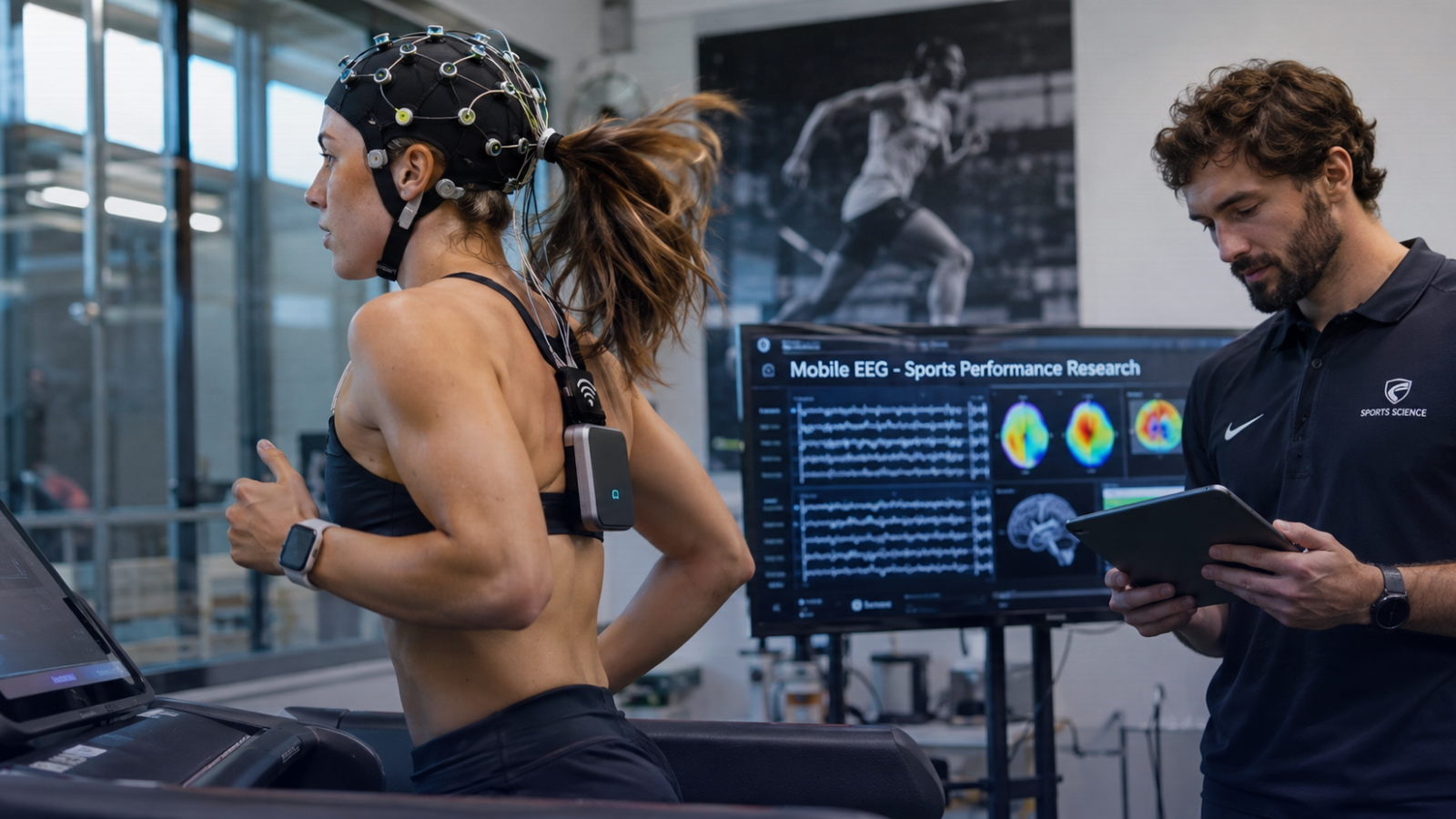
The best mobile EEG for sports science has to keep recording clean data while a participant sprints, pedals, turns or lands a jump. On the six criteria used in this guide, the mBrainTrain Smarting PRO X ranks first for whole-head recording in motion.
That bar is high because EEG and movement rarely get along. Every stride adds motion artifacts and cable sway, and a long field session can drain a battery before the protocol ends.
Sports neuroscience EEG also has to line up with motion capture and force plates, so timing matters as much as signal. Lab EEG can’t follow an athlete onto a track, which is why EEG for athletes needs a field-ready rig. This guide ranks 10 mobile EEG systems, from research-grade amplifiers to a lower-cost headset, for EEG during exercise by channels, electrodes, sampling, battery life and synchronization.
What Is the Best EEG for Sports Research?
For whole-head EEG during movement, the best option in this comparison is the mBrainTrain Smarting PRO X. It records 64 channels in total (64 EEG, or 56 EEG + 8 ExG) at 250–4000 Hz and 24-bit, through a single head-worn amplifier with fixed cables.
The right alternative depends on the study design. The Brain Products LiveAmp has published outdoor walking data from Jacobsen, Blum, Witt and Debener (2021). The ANT Neuro eego sports suits high-channel work, with sampling up to 16 kHz and medical certification.
For low-channel designs, the Mentalab Explore Pro has a 27 g 8-channel amplifier. And yes, EEG can be used during exercise. The FAQ below explains how electrode choice and artifact control make that possible.
How We Evaluated Mobile EEG for Movement Research
We ranked each system on six criteria that decide whether EEG survives real movement, starting with the hardware that prevents artifacts in the first place. The criteria are listed in order of weight. In this guide, wearable means head-worn: the amplifier sits on the head.
- Resistance to motion artifacts comes first. We looked at where the amplifier sits and how its cables run, then at electrode type and processing such as artifact subspace reconstruction (ASR).
- Fit and weight on the head come next, because head inertia and comfort affect artifacts during jumps and over long sessions.
- Channel count and sampling while moving decide which analyses are possible. Source localization needs channels, and EMG or other ExG work needs high live sampling rates.
- Battery life and onboard storage set the length of a field session and protect data if the wireless link drops.
- Synchronization with motion capture and other devices covers LSL, TTL triggers and proprietary sync methods.
- Published evidence counts most when participants were moving, so we noted whether each validation used seated or active participants.
Systems that clear the first five criteria without a body-worn unit or a low live sampling cap rank higher. A clear movement limitation on any criterion moves a system down, and published evidence breaks close calls. Each entry’s “Keep in mind” note names the limitation that set its position.
Best Mobile EEG for Sports Science at a Glance
| Rank | System | Max channels | Electrodes | Head-worn amplifier (Y/N) | Sampling | Best for |
| 1 | mBrainTrain Smarting PRO X | 64 total (64 EEG, or 56 EEG + 8 ExG) | Gel and dry caps; Smartfones compatible | Y | 250–4000 Hz; streams up to 1000 Hz by default | Studies with movement, outdoor, hyperscanning, multimodal |
| 2 | Brain Products LiveAmp | 8/16/32 per amplifier; 64 via 2× 32-ch amplifiers (hybrid) | Active, passive gel, sponge, dry | Y (8/16/32 ch); N (64-ch hybrid) | 250, 500 or 1000 Hz | Outdoor walking and gait |
| 3 | ANT Neuro eego sports | 64 per amplifier | Gel, sponge, dry | N | 2 kHz (up to 16 kHz) | High-density, certified studies |
| 4 | Mentalab Explore Pro | 32 per amplifier | Wet and dry Ag/AgCl | Not published | 1 kHz streaming; 8 kHz offline | Ultralight, low-channel field work |
| 5 | g.tec g.Nautilus PRO Flexible | 32 | Hybrid dry/gel, wet strands | Y | 500 Hz | Long certified sessions |
| 6 | Bitbrain Versatile Plus | 32 | Water-based sponge | Y | 256 Hz Bluetooth; 2048 Hz SD | Gel-free offline recording |
| 7 | Neuroelectrics Enobio | 32 | Dry, gel | Not published | 500 Hz | Quick setup, offline holter mode |
| 8 | EMOTIV FLEX 2 | 32 | Saline, gel | Y | 128 or 256 Hz | Lower-cost seated tasks |
| 9 | CGX Quick-32r | 32 | Dry active | Y | 500 Hz | Fast dry setup |
| 10 | Wearable Sensing DSI-24 | 24 in total (19 scalp + 2 earclip + 3 aux) | Dry active | Y | 300 Hz (600 Hz option) | Rapid dry screening |
The table below summarizes the ranking in one view, using figures from each maker’s official pages. Sampling shows live rates first where the maker separates live and offline recording.The 10 Best Mobile EEG Systems for Sports Science, Ranked
Each entry uses the same four labels, and the ranking follows the six criteria above. Every limitation listed is the one that matters most for movement.
1. mBrainTrain Smarting PRO X
Best for: Movement, outdoor, hyperscanning and multimodal studies.
Key specs: 64 channels in total (64 EEG, or 56 EEG + 8 ExG) at 250–4000 Hz and 24-bit, with noise under 1 µV and CMRR above 140 dB. The 70 g amplifier runs up to 12 hours and streams up to 1000 Hz. 2 kHz and 4 kHz are recorded to internal memory, not streamed.
What stands out: mBrainTrain mounts the amplifier on the head with fixed cables, which prevents cable sway, a common source of motion artifacts. Sync runs over LSL and 1-bit and 8-bit TTL trigger inputs.
The PRO line adds a 9D motion sensor with 3D real-time head tracking and real-time ASR. Electrode options are gel and dry caps, and the PRO X is compatible with Smartfones.
Smarting PRO recorded EEG from one Axiom-2 astronaut on the International Space Station. For team-sport designs, paired with mBrainTrain’s Smarting Spectra software, the PRO X records several people from a single PC with microsecond synchronization precision.
In Korisky et al. (2026, Frontiers in Human Neuroscience), grand-average ERPs from an earlier Smarting stayed time-aligned with the reference (0–4 ms, within one sample at 250 Hz), versus a lag of about 50 ms (47–63 ms depending on the sound) for the DSI-24. Against a wired gel 64-channel BioSemi, single-electrode temporal clustering showed Smarting trailing only on the P300 (44% vs 80%), while its Standard, Target and Novel peaks outperformed the wired system (78% vs 73% of detections overall).
Keep in mind: That study tested an earlier 24-channel semi-dry Smarting instead of the current PRO X. Each system also had different participants (no head-to-head test). Rates above 1000 Hz are recorded to internal memory rather than streamed.
2. Brain Products LiveAmp
Best for: Outdoor walking and gait studies that want a published artifact benchmark to build on.
Key specs: 8, 16 or 32 channels per amplifier at 250, 500 or 1000 Hz and 24-bit. 64 channels require a hybrid of two 32-channel units, unlike the single-amplifier Smarting PRO X. Weight is 60 g with battery per amplifier and about 120 g for a 64-channel hybrid. A single 8-, 16- or 32-channel LiveAmp can be head-worn, but the 64-channel hybrid of two amplifiers cannot. Wireless range reaches 10 m indoors and 30 m outdoors.
What stands out: Brain Products pairs a light amplifier with an official LSL connector and a built-in 3-axis accelerometer. Data can also go to an exchangeable memory card.
The optional STE compact adds an 8-bit trigger input (cable-based or wireless) and up to 6 sensors plus a pulse oximetry sensor. That helps when footswitches or force plates join the setup.
The movement evidence is direct. Jacobsen, Blum, Witt and Debener (2021, European Journal of Neuroscience) recorded 26 participants standing and walking outdoors with a 64-channel hybrid of two 32-channel LiveAmps. They built a seven-dimensional “footprint” of gait-related artifacts.
ASR and ICA cleaning changed that footprint systematically. Button-press ERP signal-to-noise and morphology held steady after cleaning, and topographies improved.
Keep in mind: The internal battery lasts about 3.5 hours, so long field or endurance sessions need a power bank on the body. Brain Products lists 1000 Hz for up to 32 channels, so a 64-channel hybrid runs at up to 500 Hz.
3. ANT Neuro eego sports
Best for: High-density studies and clinical-adjacent work that need certified hardware and high sampling.
Key specs: 24-channel or 32/64-channel amplifiers at 24-bit (up to 24-bit on the larger unit). The 24-channel amplifier samples at 2 kHz (up to 4 kHz), and the 32/64-channel amplifier at 2 kHz (up to 16 kHz). The 32/64-channel amplifier runs up to 5 hours, extendable via USB.
What stands out: ANT Neuro offers gel, sponge and dry waveguard caps and nets, so electrode choice can follow the movement load. Sync covers LSL, a TTL trigger input, synchronized video and wireless streaming through the eego remote Android app. The trigger input is 2-bit on the 24-channel amplifier and 8-bit on the 32/64-channel one.
A 16 kHz ceiling leaves room to analyze high-frequency muscle activity alongside EEG. Certification is broad: CE Class IIa under MDR (EU) 2017/745, FDA 510(k) clearance, a Health Canada license and ARTG 371419. That matters when a sports study includes patient groups or clinical partners.
Keep in mind: The 32/64-channel amplifier weighs 600 g and measures 206×157×25 mm, so it has to be worn on the body. The lighter 24-channel amplifier weighs under 100 g but has no battery and runs on USB power, so it isn’t suited to mobile recording.
4. Mentalab Explore Pro
Best for: Low-channel field studies where amplifier weight matters most, plus multi-device setups.
Key specs: Up to 32 channels per amplifier with a 9D motion sensor. Sampling reaches 1 kHz over Bluetooth and 8 kHz offline, at 24-bit (0.1 µV/bit). The 8-channel amplifier weighs 27 g, with internal memory and 10 m range.
What stands out: The 8-channel Mentalab amplifier weighs 27 g, which keeps head inertia down during turns and landings. Wet and dry Ag/AgCl electrodes are available, including flat and brush dry types. Wired and wireless triggers carry millisecond accuracy.
Hypersync handles multi-device event marking at under 1 ms wirelessly, which suits paired-athlete or coach-athlete designs. Dirik, Darendeli and Ertan (2023, Brain Research) tested 23 participants against a clinical-grade system.
Alpha peak frequency and alpha suppression did not differ significantly between systems, and test-retest results 24 hours apart were consistent. The same group later used Mentalab Explore in archers.
Keep in mind: The Dirik validation measured resting-state EEG only. Live streaming is also capped at 1 kHz, so high-rate data can’t stream alongside motion capture.
5. g.tec g.Nautilus PRO Flexible
Best for: Long, certified sessions with moderate channel counts and standard EEG bands.
Key specs: 8, 16, 19 or 32 channels (32 monopolar or 16 bipolar) at 500 Hz and 24-bit, with 1.024 MHz internal sampling per channel. Weight is under 143 g without the electrode grid, and range reaches 10 m indoors. The battery lasts over 10 hours with 32 channels and charges wirelessly via Qi.
What stands out: g.tec offers g.SAHARA hybrid electrodes that run dry or with gel, plus g.SCARABEO wet electrode strands. That gives a lab one headset for both quick screening and longer gel sessions. Sync covers LSL, 8 digital trigger inputs at the base station, MATLAB/Simulink/Python APIs and a 3-axis accelerometer for logging head movement.
The over-10-hour battery suits all-day testing, such as repeated trials across a training camp. The system is a CE-certified, FDA-cleared medical device. That helps when a protocol involves clinical populations.
Keep in mind: Sampling is capped at 500 Hz and channels at 32, which limits high-frequency EMG work and high-density source analysis during movement.
6. Bitbrain Versatile Plus
Best for: Gel-free studies where water-based sensors and long offline recording fit the protocol.
Key specs: 16 or 32 channels (plus REF and GND) at 24-bit. Sampling reaches 256 Hz over Bluetooth, 1024 Hz over USB and 2048 Hz to SD card. Weight is 116 g (16-channel) or 120 g (32-channel), with up to 10 hours or 7 hours of battery respectively.
What stands out: Bitbrain uses water-based sponge sensors with active electronics, so there is no gel to wash out after a session. A 6-axis IMU tracks head movement, and a 64 GB internal SD card holds long recordings. In Bluetooth + SD mode, battery life drops to up to 6 hours.
Sync covers LSL through SennsLite, Bitbrain device sync, an optical trigger (photodiode) and digital I/O. Bluetooth range is 8 m (32-channel) or 9 m (16-channel) with direct line of sight. Certification covers radio equipment only (CE under Directive 2014/53 and FCC Part 15), with no medical CE or FDA listing.
Keep in mind: Wireless streaming tops out at 256 Hz, and it stays fixed at 256 Hz in Bluetooth + SD mode. Higher rates need offline SD recording or a USB cable, which limits real-time, high-rate sync with motion capture on untethered participants.
7. Neuroelectrics Enobio
Best for: Quick-setup studies that switch between dry and gel electrodes and can record long sessions offline.
Key specs: 8, 20 or 32 channels at 24 bits and 0.05 µV, with 0–125 Hz bandwidth. Wireless transmission lasts 5.5 hours per charge, with up to 16.5 hours of SD card recording on the Enobio 32. The Neuroelectrics datasheet lists a 500 Hz sampling rate.
What stands out: Neuroelectrics offers dry Drytrode and gel NG Geltrode electrodes. Setup takes about 4 minutes with dry electrodes and 20–25 minutes with gel. That trade-off is useful when athletes arrive between training blocks and time on the testing floor is short.
Sync covers LSL, TCP, hardware trigger/TTL and an SDK, so Enobio fits into most existing motion-capture pipelines. SD “holter mode” keeps a long session recording without a live link.
The system holds CE 1639 medical certification in Europe. In the US, Neuroelectrics describes it as intended for clinical and basic research.
Keep in mind: Wireless streaming lasts only 5.5 hours per charge. Longer sessions must record offline to SD, so live monitoring and real-time sync are lost for the rest of the session.
8. EMOTIV FLEX 2
Best for: Lower-cost studies of seated or low-movement tasks where 32 channels in standard EEG bands are enough.
Key specs: 32 channels (plus CMS/DRL references) configurable across 10-20 locations, transmitted at 128 or 256 Hz (2048 Hz internal, downsampled) and 16-bit. Bandwidth is 0.16–43 Hz. Battery lasts up to 6 hours, and the link runs over a Bluetooth 5.2/BLE5 dongle.
What stands out: EMOTIV offers saline caps with felt pads and gel caps with sintered Ag/AgCl electrodes, in 54, 56 and 58 cm sizes. A 9-axis IMU records head motion at up to 64 Hz, useful for flagging movement epochs.
Epinat-Duclos and colleagues (2026, PeerJ) chose the predecessor EPOC Flex for its low cost and compared it with LiveAmp and the wired BrainAmp in 19 analyzed participants. All systems captured resting alpha changes, SSVEPs and ERPs, including N170, N200, P300 and MMN. EPOC Flex kept less usable signal and showed weaker spectral effects than LiveAmp or BrainAmp.
Keep in mind: Output is 128 or 256 Hz with a 43 Hz low-pass cutoff, which rules out gamma and high-frequency muscle or movement-artifact analysis. The PeerJ participants sat for cognitive tasks, so the study does not cover exercise.
9. CGX Quick-32r
Best for: Dry-electrode studies with fast participant turnover and moderate head movement.
Key specs: 32 channels (full 10-20 plus 10 extra scalp channels and 2 ExG inputs) at 500 Hz and 24-bit. The headset weighs 646 g and fits 52–62 cm heads. Battery lasts 8 hours on two replaceable AA batteries.
What stands out: CGX uses dry, active, shielded sensors (Drypad or Flex), each rated for 200 uses. Setup takes under 8 minutes per subject, cleaning included, which helps when a full squad cycles through testing in one day. Replaceable AA batteries mean a flat battery costs minutes in the field instead of a recharge cycle.
Sync includes listed LSL compatibility and CGX StimTrigger, which the maker describes as “low latency wireless synchronization.” Bluetooth Low Energy and a 3-axis accelerometer round out the connectivity. The 2 ExG inputs sit alongside the 30 scalp channels.
CGX sells the system for research use only, without a CE or FDA medical claim.
Keep in mind: At 646 g, the headset is heavy on the head. That matters for jump-heavy protocols and long sessions, where head inertia and comfort affect artifacts.
10. Wearable Sensing DSI-24
Best for: Rapid dry-electrode setups where 19 scalp channels and modest sampling still answer the research question.
Key specs: 19 dry scalp electrodes, 2 earclip sensors and 3 auxiliary inputs on a 24-channel amplifier. Sampling is 300 Hz, with a 600 Hz option, through a 16-bit amplifier. Battery lasts over 24 hours, and Bluetooth range is 10 m.
What stands out: Wearable Sensing uses dry, active, spring-loaded sensors with no gel, and average setup takes under 3 minutes. That is the fastest setup time listed in this comparison, which suits screening many athletes in one session. The over-24-hour battery is also the longest listed here.
An 8-bit trigger input accepts eye-tracking and IMU or motion signals. LSL and TCP/IP streaming, plus wireless triggering, support multi-device setups. In Korisky et al. (2026), DSI-24 grand-average ERPs lagged the reference by about 50 ms (47–63 ms depending on the sound), measured on a different participant group from the other systems.
Keep in mind: The DSI-24 records only 19 scalp channels, at 300 Hz by default with a 16-bit ADC. That is a low ceiling for separating gait and muscle artifacts with ICA or source methods.
How to Choose a Mobile EEG for Sports and Exercise Studies
Choose by matching electrode type and amplifier design to the movement load, then check sampling, battery life, sync and published evidence. Movement load comes first because it decides which electrodes will hold contact.
Gel is the reference for movement, and dry electrodes showed more movement artifacts in the cycling study cited in the FAQ. Semi-dry saline is a practical middle option that skips hair washing, though no peer-reviewed study has compared it with gel under movement. Sprint starts or jump landings favor gel, and dry systems fit best when setup speed outweighs movement load.
Ear-centered EEG is another route for low-density designs. Debener and colleagues (2015, Scientific Reports) at the University of Oldenburg recorded reliable ambulatory EEG with cEEGrid ear electrodes in 10 participants, though not at sports intensity.
Ladouce and colleagues (2024, Behavioural Brain Research) tested a headphones-fitted EEG system, sold by mBrainTrain as Smartfones, for auditory ERPs and workload assessment (N = 12). P300 was captured at midline sensors but not at around-ear sensors, and workload conditions were distinguishable.
Before committing to a system, work through these questions with the full protocol in hand:
- How much will the head move, and does the electrode type match that load?
- Where does the amplifier sit, and do any cables hang free between head and body?
- Does the analysis need a sampling rate that the wireless link can stream live?
- Will the battery outlast the full session, including setup and warm-up?
- Which sync method will link EEG to motion capture and force plates?
- Did the published validation use moving participants or seated ones?
- Will several participants be recorded at the same time?
The last question narrows the field quickly. Group recordings favor systems with native multi-device sync, such as mBrainTrain’s Smarting Spectra and Mentalab’s Hypersync.
FAQ
What is the best EEG for sports research? Can EEG be used during exercise?
For sports research, the mBrainTrain Smarting PRO X leads this list because its 64-channel amplifier sits on the head with fixed cables. EEG can be used during exercise: Jacobsen and colleagues recorded 26 participants walking outdoors, and button-press ERP quality held after cleaning. Success depends on artifact control, starting with hardware and finishing with methods such as ASR and ICA.
Can wireless EEG match wired systems on signal quality?
Yes. Research-grade wireless systems from mBrainTrain and Brain Products record research-quality EEG with gel caps, and semi-dry electrodes give comparable results. Direct comparisons are only possible with seated participants, because a wired system can’t record someone who walks, runs or jumps. In Epinat-Duclos et al. (2026), LiveAmp matched the wired BrainAmp on resting alpha and SSVEPs with no ERP latency difference, though its N170 was lower. Korisky et al. (2026) found canonical N100 and P300 components on every system, including an earlier Smarting; participants differed per system and sat throughout.
ANT Neuro’s eego sports is designed for mobile use, though no peer-reviewed comparison with a wired system turned up for this guide. Wireless systems also differ on connection reliability, timing accuracy and synchronization with other devices.
Which electrode type works best for EEG during exercise?
Gel electrodes are the reference for movement, though the gel has to be washed out of the hair afterward. In a 2019 cycling study in Frontiers in Neuroscience, dry electrodes were more prone to movement artifacts than gel, with channel reliability of 85% for gel versus 66% for dry during heavy cycling. Semi-dry saline electrodes are a practical trade-off: no hair washing and good signal quality, at some cost in movement tolerance compared with gel, though no peer-reviewed study has measured that gap directly.
How do you reduce motion artifacts in sports neuroscience EEG?
Start with hardware, because Symeonidou et al. (2018, Sensors) found cable sway is a major contributor to motion artifacts. Gramann (2024, Journal of Environmental Psychology) adds that amplifier and cable weight can move the system and cause mechanical artifacts, so lighter headsets, short fixed cables, gel caps and higher CMRR all help. Then add processing such as real-time ASR or ICA, following the methods reviewed by Gorjan, Gramann, De Pauw and Marusic (2022, Journal of Neural Engineering).
Are low-cost EEG headsets good enough for EEG for athletes?
Lower-cost headsets work for some studies and not others. Sabio et al. (2024, PLoS ONE) found consumer-grade devices show considerably poorer signal-to-noise ratios than research-grade ones, and in Korisky et al. (2026), the EPOC X showed much weaker detection against the wired reference. Epinat-Duclos et al. measured a 0.16–43 Hz bandwidth for EPOC Flex, while research-grade systems offer higher sampling rates and broader bandwidth for gamma and muscle activity.
Why does research-grade mobile EEG cost more?
No published study breaks down EEG pricing, but research systems differ in specs that affect data quality: amplifier noise, CMRR, bandwidth and flat frequency response, and timing precision. They also carry validation and certification work and wireless-link engineering.
Final Thoughts
Every system here can record EEG, but each one gives up something once the participant starts moving. LiveAmp suits labs that want a published outdoor gait pipeline and can carry a power bank. The eego sports fits high-density, certified work where a body-worn amplifier is acceptable.
Mentalab Explore Pro covers ultralight low-channel designs, and g.Nautilus PRO Flexible covers long certified sessions at 500 Hz. Bitbrain and Enobio suit gel-free or quick-setup protocols that can record offline. EMOTIV FLEX 2 fits seated tasks, while CGX and DSI-24 suit fast dry screening more than sprint work.
For the best mobile EEG for sports science, the deciding question is which system’s weakest spec still covers the protocol. On that test, the verdict goes to the Smarting PRO X. Its head-worn 64 channels, fixed cables, 4000 Hz internal recording and LSL and TTL trigger sync leave movement protocols with the fewest gaps.




Comment