You improved the landing page. Conversions went up 18%. Great.
But did those extra conversions turn into revenue?
That is where CRO gets complicated. A higher conversion rate tells you that something worked on the page. It does not tell you whether the traffic came from the right campaign, which earlier touchpoints influenced the conversion, or whether those new customers were actually worth acquiring.
Marketing attribution fills that gap.
The right attribution tool connects channels, campaigns, ads, content, customer journeys, and eventually revenue. For CRO teams, that means you can optimize for more than form fills and button clicks.
Here are 10 marketing attribution tools worth considering in 2026, including where each one works best and where it starts to fall short.
1. Usermaven
Best for: B2B SaaS companies and agencies connecting CRO performance with marketing attribution and revenue.
Usermaven is a marketing attribution platform that combines multi-touch attribution, website and product analytics, customer journeys, and CRM revenue data. That combination is particularly useful for CRO teams because conversion analysis doesn’t have to end at the form submission, signup, or demo request.
Teams can trace which channels, campaigns, ads, content, and landing pages brought users in, analyze what those visitors did before and after converting, and connect those journeys with pipeline and revenue.
Why CRO teams should care
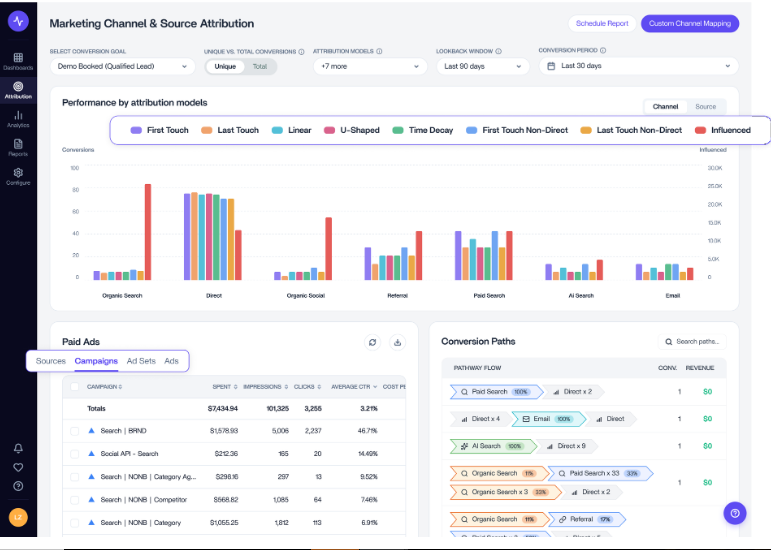
The useful part is being able to investigate the entire conversion journey in one place. Funnels show where users drop off, customer journeys reveal the paths they take, and multi-touch attribution shows which marketing interactions influenced the conversion.
Usermaven supports seven attribution models, so CRO teams can compare how credit changes across first touch, last touch, linear, U-shaped, time decay, and non-direct models. Content attribution also helps connect landing pages and other content with conversions and revenue rather than judging them only by traffic or engagement.
For SaaS teams, product analytics adds another layer: you can see what happens after signup and evaluate acquisition sources against product behavior, retention, LTV, and revenue.
Maven AI makes this data easier to investigate through natural-language questions and AI-generated analysis, while Usermaven’s MCP server lets teams work with their analytics through external AI tools such as ChatGPT and Claude.
The catch
Paid ads attribution and CRM revenue attribution require the Scale plan. Teams that only need basic traffic or landing-page conversion reporting may not need the additional attribution and product analytics depth.
Pricing: Growth starts at $84/month and Scale at $199/month. A 14-day free trial is available.
2. HockeyStack
Best for: B2B teams with long and complicated GTM journeys.
HockeyStack takes a broader view of attribution. Instead of looking only at marketing touches, it brings together marketing, sales, CRM, and other GTM data to understand how accounts move toward revenue.
Why CRO teams should care
A landing page conversion might be only one step in a six-month buying journey. HockeyStack helps connect those interactions with later pipeline and revenue, making it useful when CRO success cannot be measured by immediate conversions alone.
It also provides multi-touch attribution, buyer journey analysis, account-level reporting, lift analysis, and AI-powered GTM insights.
The catch
This is not really a lightweight CRO analytics tool. HockeyStack is designed for companies with more sophisticated B2B revenue operations, so smaller teams may find the scope excessive.
Pricing: Current pricing is sales-led.
3. Dreamdata
Best for: B2B companies where multiple people influence the same purchase.
Dreamdata is built around a problem traditional web analytics handles poorly: one company might have five people interacting with your marketing before an opportunity is created.
It combines those interactions into account-level customer journeys and connects them with CRM pipeline and revenue.
Why CRO teams should care
CRO teams can look beyond “this page generated 40 demos” and ask whether those demos influenced real opportunities. Dreamdata also provides multi-touch attribution, ROI and ROAS reporting, content analytics, and account-level journey analysis.
The catch
Its B2B focus is also its limitation. If your conversions happen quickly and involve individual consumers rather than accounts and buying committees, much of this complexity is unnecessary.
Pricing: A free foundational plan is available. Advanced attribution uses custom pricing.
4. Cometly
Best for: Performance marketing teams spending heavily on paid acquisition.
Cometly focuses on connecting advertising activity with downstream conversions and revenue. It pulls together ad platform data, website interactions, and CRM outcomes to give paid campaigns more context than the ad platform itself provides.
Why CRO teams should care
Suppose two landing pages generate the same conversion rate. If one brings in significantly more qualified opportunities, that changes which page and campaign you should actually scale.
Cometly helps follow paid traffic through later funnel stages, including leads, opportunities, and revenue.
The catch
Its strongest use case is paid acquisition. Teams that need deep product analytics, retention analysis, or broader behavioral analytics may need another platform alongside it.
Pricing: Pricing depends on the selected plan and requirements.
5. Ruler Analytics
Best for: Lead-generation businesses where conversions happen through forms and phone calls.
Ruler Analytics is particularly useful when the website conversion is not the sale. It tracks visitor journeys, captures lead-source information, and connects CRM revenue back to the marketing activity that generated it.
Why CRO teams should care
This matters for businesses where “Book a consultation” is the main conversion. Getting more bookings is useful, but knowing which pages and campaigns generated bookings that became customers is much better.
Ruler supports multi-touch attribution and tracks forms, calls, campaigns, keywords, and revenue.
The catch
It is primarily built around lead and revenue attribution rather than product behavior. SaaS teams trying to analyze what users do inside the product after signup may need additional analytics.
Pricing: Multi-touch attribution plans start from $400/month.
6. Triple Whale
Best for: Ecommerce CRO teams that need marketing and revenue data in one place.
Triple Whale is heavily focused on ecommerce. It combines advertising, store, customer, and attribution data to help brands understand how marketing spend relates to purchases.
Why CRO teams should care
For ecommerce CRO, the purchase happens much closer to the website experience than it does in B2B. Triple Whale can help teams compare campaign performance, customer acquisition costs, ROAS, and attribution while optimizing the storefront.
The catch
Its ecommerce specialization is significant. If you run a B2B SaaS company with CRM opportunities, demos, pipeline stages, and a long sales cycle, other tools on this list are better aligned.
Pricing: Depends on business revenue and selected products.
7. Northbeam
Best for: Ecommerce brands spending seriously across multiple paid channels.
Northbeam combines marketing attribution with media measurement and is designed to help ecommerce brands decide where to allocate advertising budgets.
Why CRO teams should care
CRO and acquisition are tightly linked. Improving conversion rates changes campaign economics, while sending low-quality traffic to an optimized page still wastes money.
Northbeam helps connect media spend, attribution, and revenue so teams can evaluate optimization decisions in the context of overall marketing performance.
The catch
Like Triple Whale, Northbeam is fundamentally ecommerce-focused. B2B SaaS teams will find more relevant customer journey and CRM functionality elsewhere.
Pricing: Plans vary based on business requirements.
8. Adobe Marketo Measure
Best for: Enterprise B2B teams already operating in the Adobe/Marketo ecosystem.
Marketo Measure, formerly Bizible, is one of the more established B2B attribution products. It tracks marketing touchpoints across the buyer journey and connects them with opportunities and revenue.
Why CRO teams should care
It supports multiple attribution approaches, including first-touch, lead-creation, U-shaped, W-shaped, full-path, and custom models. That makes it possible to evaluate conversions within the wider sales journey instead of treating every lead equally.
The catch
This is enterprise software. The implementation, ecosystem, and pricing are difficult to justify if you are a small CRO team that simply wants better attribution around landing pages and campaigns.
Pricing: Custom.
9. HubSpot
Best for: CRO teams already using HubSpot as their CRM.
HubSpot’s biggest advantage is fairly obvious: if your leads, lifecycle stages, deals, and revenue already live in HubSpot, attribution can use that data without building an entirely separate revenue reporting stack.
Why CRO teams should care
You can connect marketing interactions with contacts, deals, and revenue, making it easier to see whether conversions eventually become qualified pipeline.
For teams running landing pages, forms, email, CRM, and reporting inside HubSpot, having those pieces together can simplify analysis considerably.
The catch
Advanced attribution and reporting are tied to higher HubSpot tiers. Buying into HubSpot purely for attribution makes much less sense than using it when the CRM is already central to your stack.
Pricing: Varies considerably by Hub, tier, seats, and contact volume.
10. Google Analytics 4
Best for: Teams that need a free starting point for attribution.
GA4 is not the most sophisticated tool on this list, but leaving it out would be strange. It is free, widely installed, and provides attribution reports and conversion-path analysis without requiring another subscription.
Why CRO teams should care
GA4 can show how channels contribute to key events and lets teams explore paths users take before converting. If your main goal is understanding website acquisition and conversions, it may be enough.
The catch
The problems start when the journey continues outside GA4. Connecting marketing activity cleanly with CRM opportunities, offline sales, pipeline, and long-term customer value usually requires additional infrastructure or another attribution platform.
Pricing: Standard GA4 is free.
At-a-glance comparison
| Tool | Best for | CRO teams can connect | Pricing |
| Usermaven | B2B SaaS & agencies | Campaigns, journeys, conversions & revenue | From $84/mo |
| HockeyStack | B2B GTM teams | Buyer journeys & pipeline | Contact sales |
| Dreamdata | B2B account journeys | Accounts, touchpoints & revenue | Free + custom |
| Cometly | Paid acquisition | Ad spend & downstream revenue | Varies |
| Ruler Analytics | Lead generation | Forms, calls & sales revenue | From $400/mo |
| Triple Whale | Ecommerce | Marketing spend & purchases | Revenue-based |
| Northbeam | Ecommerce media teams | Media spend & revenue | Varies |
| Marketo Measure | Enterprise B2B | Touchpoints & opportunities | Custom |
| HubSpot | CRM-led teams | Marketing, deals & revenue | Varies |
| GA4 | General web analytics | Channels & conversions | Free |
Which marketing attribution tool should your CRO team choose?
Start with what happens after the conversion you are optimizing.
If a signup eventually turns into product usage, pipeline, and recurring revenue, Usermaven connects attribution with website and product behavior. For complex enterprise B2B journeys, HockeyStack, Dreamdata, and Marketo Measure go deeper into GTM and account-level attribution.
If most of your budget goes into advertising, Cometly is more focused on paid acquisition. Ruler Analytics makes sense when calls and form leads later convert offline.
For ecommerce, Triple Whale and Northbeam are much closer to how those businesses actually measure revenue. If everything already lives in HubSpot, using its attribution capabilities may save you from adding another platform.
And if you are just getting started? Use GA4 until you can clearly explain what attribution question it cannot answer. Buying a more expensive tool before that point usually just gives you a more expensive dashboard.
The point of attribution for CRO is not to add another report. It is to avoid optimizing a conversion that looks good on the page but contributes very little to the business.
FAQs
1. What is a marketing attribution tool?
A marketing attribution tool tracks the touchpoints customers interact with before converting and assigns credit to those interactions. It helps teams understand which channels, campaigns, ads, and content contribute to conversions, pipeline, and revenue.
2. Why is marketing attribution important for CRO?
CRO shows where conversion performance improves, while marketing attribution adds context about which traffic sources and touchpoints contributed to those conversions. Together, they help teams optimize for conversions that generate meaningful business outcomes rather than simply increasing conversion rates.
3. What is the best marketing attribution tool for CRO teams?
The best tool depends on the customer journey and business model. Usermaven combines attribution with website and product analytics, while HockeyStack and Dreamdata focus on B2B revenue journeys. Triple Whale and Northbeam are more closely aligned with ecommerce attribution.
4. What is the difference between marketing attribution and conversion tracking?
Conversion tracking records when an action such as a signup, purchase, or demo request occurs. Marketing attribution goes further by determining which marketing touchpoints contributed to that conversion and, when revenue data is connected, which interactions influenced pipeline and revenue.
5. What is multi-touch attribution?
Multi-touch attribution distributes conversion credit across multiple marketing interactions in the customer journey instead of assigning all credit to a single touchpoint. Common models include linear, U-shaped, time-decay, and other rules for distributing credit across interactions.
6. Can marketing attribution tools measure revenue from CRO experiments?
Marketing attribution tools can connect conversions with downstream pipeline and revenue when the necessary campaign, customer, and CRM or transaction data is available. CRO teams can use this context to evaluate whether higher conversion rates are also producing more valuable customers and revenue.