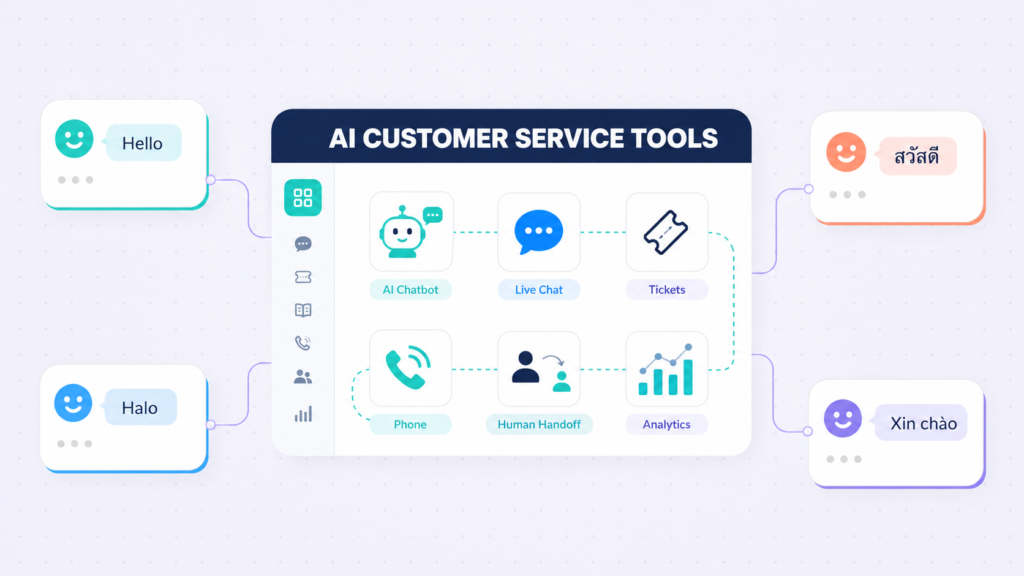
Every Southeast Asia e-commerce team is selling more than ever, but managing customer conversations has quickly become a bottleneck. Customer conversations spread faster than the support team can manage them. A buyer asks about delivery on WhatsApp, follows up on Instagram, sends an order screenshot from Shopee or Lazada, and switches between English, Bahasa Melayu, Bahasa Indonesia or Thai within the same conversation. At this point, a basic inbox or simple chatbot can no longer keep up.
That is usually when teams start searching for the best AI customer service tools for e-commerce businesses in Southeast Asia. The good news is that options have never been more plentiful, ranging from regional messaging platforms and AI chatbots to help desk systems, omnichannel customer service platforms, and all-around call center solutions. The harder part is that these tools are built for very different operating models.
Most AI contact center and customer service platforms serving Southeast Asia fall into one of two categories:
- Regional-focused platforms, built specifically around SEA’s messaging habits and market quirks from the ground up.
- Global platforms with regional deployment, offering broad feature sets and enterprise scale, adapted for SEA through local data centers, language packs, or regional integrations.
The right choice depends less on which platform has the most advanced AI features, and more on whether it natively supports the channels a given market actually uses — WhatsApp in Singapore and Malaysia, LINE in Thailand, Facebook Messenger in the Philippines — along with local-language coverage and regional data compliance. Udesk, for instance, positions itself as a globally built platform with SEA-specific channel and language support layered on top.
This guide compares the AI customer service platforms SEA e-commerce teams are most likely to evaluate in 2026. We look at how each tool handles regional messaging channels, marketplace-style order support, multilingual automation, Voice of the Customer (VoC), omnichannel ticketing, and pricing, so teams can choose based on real support workflows instead of a long feature list.
Quick Buyer Fit
| Category | Best Fit |
| Best overall for cross-border SEA e-commerce | Udesk |
| Best SEA-native messaging option | Qiscus |
| Best for messaging-first regional teams | Respond.io |
| Best AI-first option for Shopify-led commerce | Intercom |
| Best mature helpdesk ecosystem | Zendesk |
| Best practical helpdesk AI for growing teams | Freshdesk |
| Best for retail contact center operations | Talkdesk |
| Best enterprise omnichannel orchestration option | Genesys |
| Best CRM-centered enterprise option | Salesforce Service Cloud |
| Best for voice-heavy enterprise service | Five9 |
What Makes a Customer Service Tool SEA E-commerce Ready
Customer service in SEA’s e-commerce sector extends well beyond website chat. Customer conversations regularly span WhatsApp, LINE, Facebook Messenger, Instagram, TikTok, web chat, email, phone etc. In many SEA markets, support inquiries, sales questions, payment clarification, delivery updates, and return requests all surface within the same conversation.
A SEA-ready AI customer service tool should align with regional channel behavior, support order and return workflows, handle multilingual and code-switched messages, and escalate safely to human agents when needed. Handoff quality is critical here: agents should receive the full transcript, customer intent, account details, order reference, and the point at which automation failed, rather than starting from scratch.
Managers also need visibility across market, channel, language, intent, resolution rate, escalation reason, and peak-season queue pressure. Without this level of reporting, AI automation can appear successful on the surface while unresolved issues quietly pile up in agent queues.
How We Evaluated the Platforms
This comparison ranks platforms by SEA e-commerce fit rather than global market share, favouring tools that support regional messaging channels, e-commerce workflows, multilingual service, AI-to-agent handoff, omnichannel ticketing, and cross-border operations.
This comparison ranks platforms by SEA e-commerce fit rather than global market share. The core evaluation criteria include SEA channel fit, e-commerce workflow support, AI-to-agent handoff quality, omnichannel and ticketing maturity, multilingual and cross-border capability.
For cross-border e-commerce teams seeking AI chatbot, live chat, ticketing, knowledge base, call center capability, reporting, and human handoff within a single platform, Udesk is a strong first candidate to shortlist. Qiscus and Respond.io are particularly well-suited to messaging-heavy SEA operations, while Intercom fits Shopify-led teams prioritising AI commerce automation. Zendesk, Freshdesk, Genesys, Salesforce, Talkdesk, and Five9 offer mature global service tooling, though buyers should verify regional channel fit, implementation effort, and AI packaging before making a final decision.
Pricing, AI usage rules, channel availability, and integration scope change frequently. Buyers should confirm current package details, messaging fees, AI usage limits, implementation services, and local support coverage directly with each vendor before making a final decision.
Comparing the Top AI Customer Service Platforms for SEA E-commerce
1. Udesk
Udesk suits SEA e-commerce teams that need customer service spanning multiple digital and voice channels without splitting operations across separate chatbot, inbox, ticketing, and call center tools. Its product matrix includes omnichannel support, live chat, call center, AI chatbot, voice chatbot, LLM knowledge base, ticketing, insight, QA, and agent assistant capabilities.
Its strongest use cases are product inquiries, repeated order questions, return intake, delivery issues, ticket routing, knowledge-based answers, and escalation from AI to human agents. E-commerce teams should verify package scope, local channel coverage, e-commerce integrations, language support, and deployment requirements during the demo.
Choose this if: you want one connected AI customer service platform rather than separate tools for chatbot, live chat, tickets, reporting, and voice support.
2. Qiscus
Qiscus is a strong fit for Southeast Asian teams, with a product focus on omnichannel support, AI agents, WhatsApp-oriented service, helpdesk, and ticketing. For e-commerce teams operating in Indonesia or managing high messaging volume, this regional focus is a meaningful advantage.
Its strongest use cases include WhatsApp-heavy support, chat routing, unified inbox workflows, team collaboration, and messaging-led service. The main limitation is that it may not fully replace a global enterprise contact center for teams needing deep voice capability, workforce management, or complex multinational governance.
Choose this if: SEA-native messaging support matters more than broad global contact center depth.
3. Respond.io
Respond.io fits naturally with SEA e-commerce, where support and sales are strongly conversation-led. Its documented channel coverage includes WhatsApp, TikTok, Facebook Messenger, Instagram, WeChat, LINE, Viber, Telegram, website chat, SMS, email, and VoIP, making it useful when both support and sales run primarily through messaging apps.
Its strongest use cases include conversation routing, automation, AI agents, CRM-connected customer context, broadcasts, and messaging analytics. The main limitation is that it is not primarily a ticketing-first helpdesk or a voice-heavy contact center platform.
Choose this if: messaging coverage and conversation management sit at the center of your customer operation.
4. Intercom
Intercom suits digital-first e-commerce teams seeking AI-led service across email, phone, WhatsApp, SMS, Instagram, Facebook, and Slack. Its platform combines Fin AI Agent, Messenger, Inbox, Help Center, workflows, and Copilot, with a Shopify integration connecting product, customer, and order data to the support experience.
Two limitations stand out for SEA e-commerce teams. The first is regional channel breadth:its commerce workflows are built primarily around Shopify rather than Shopee, Lazada, or TikTok Shop. The second is cost predictability: seat-plus-per-resolution Fin billing makes budgets harder to forecast than a flat per-agent model, and several core features, including SLAs and the multilingual Help Center, are gated to the Advanced plan.
Choose this if: you run a Shopify-led digital commerce operation and want AI-led support without adopting a full enterprise contact center.
5. Zendesk
Zendesk remains one of the most recognized customer service platforms. Its AI positioning covers knowledge, AI agents, copilot support, service quality, and automation. For e-commerce teams, it performs best when the priority is structured ticketing, help center content, routing, analytics, QA, and enterprise workflow controls.
The main limitation is that SEA-specific messaging and marketplace-style workflows may require integrations, configuration, or additional tools. Buyers should also confirm which AI features are included in their intended package.
Choose this if: mature service operations and governance matter more than SEA-native messaging depth.
6. Freshdesk
Freshdesk is a practical choice for e-commerce teams that want ticketing, support automation, agent productivity tools, and AI assistance without adopting a complex enterprise contact center. Freshworks frames its retail and e-commerce solution around faster support, automation, self-service, and omnichannel service.
Its strongest use cases include ticketing, helpdesk workflows, self-service, agent assist, summaries, routing, translations, and a gradual AI rollout through Freddy AI. The main limitation is that AI, omnichannel, and advanced functionality depend heavily on plan, package, or add-on selection.
Choose this if: you want a familiar helpdesk foundation and a practical path into AI-assisted support.
7. Talkdesk
Talkdesk is a cloud contact center platform with a retail and e-commerce solution focus. It is relevant when the buyer needs contact center workflows, voice support, digital channels, automation, customer journey routing, workforce tools, and AI-assisted service.
The main limitation is scope: Talkdesk is built as a full contact center platform, which can mean unnecessary cost and setup complexity for messaging-first e-commerce teams whose support happens mainly through WhatsApp, social media, or marketplace chat.
Choose this if: retail support requires contact center depth, not just messaging automation.
8. Genesys
Genesys is best suited to large retailers that require enterprise-scale voice and digital customer service across multiple markets. To support this scope, the platform offers a broad set of capabilities, including voice, web messaging, email, SMS, WhatsApp, Facebook Messenger, Instagram Direct, virtual agents, predictive routing, Agent Copilot, analytics, quality management, and workforce management.
However, this enterprise focus comes with a corresponding limitation in e-commerce specialization. Channels such as LINE and Zalo, along with marketplace platforms like Shopee, Lazada, and TikTok Shop, are not natively supported and typically require custom integrations to enable. Implementation and packaging can also be heavier than what messaging-first e-commerce teams need.
Choose this if: you operate a large retail contact center where enterprise voice, digital routing, workforce management, and governance matter more than plug-and-play marketplace workflows.
9. Salesforce Service Cloud
Salesforce Service Cloud performs best when customer service needs to connect directly with CRM data, case records, sales history, account ownership, and enterprise workflow automation. Agentforce adds an AI layer for teams that want service automation close to customer data.
The main limitation is implementation complexity. For teams not already committed to Salesforce, Service Cloud and Agentforce may be heavier than SEA e-commerce support actually requires.
Choose this if: customer service AI needs to operate inside an existing Salesforce CRM environment.
10. Five9
Five9 fits teams that need scalable contact center operations, call routing, agent assistance, automation, and retail customer service workflows. It is relevant for large support teams where phone remains a major channel and managers need contact center controls.
The main limitation is SEA e-commerce fit: Five9 performs better as a contact center platform than as a messaging-first, marketplace-first customer service tool.
Choose this if: call volume, routing, and contact center operations matter more than regional messaging.
What SEA E-commerce Teams Should Test in a Demo
A platform’s marketing page and a platform’s actual performance are two different things. Use the following questions to test each shortlisted platform against the same real scenarios, not the vendor’s best-case examples:
- Channel and Routing Behavior
- Send a real WhatsApp, LINE, Messenger, Instagram, TikTok, or web chat inquiry. How quickly does it reach the right queue or agent?
- Test a product question, an order-status issue, a delivery delay, a return request, and a refund dispute. Does the platform handle each consistently, or only the simplest case?
- Agent Visibility and Context
- Can the agent see customer history, order reference, transcript, channel, ticket status, and the failed automation step, all in one place?
- How much time would an agent lose switching between systems to find this information during a peak-volume day?
- Multi-Language Handling and AI-to-Agent Handoff
- Send a mixed-language or code-switched message. Does the AI respond safely, ask a clarifying question, or escalate appropriately?
- Test a full handoff from AI to human agent. What context transfers, and what does the agent have to ask the customer to repeat?
- Cost and Scope at Real Volume
- Ask the vendor to model cost at both current volume and peak-season volume. Does the estimate remain accurate, or does it rest on assumptions that don’t reflect your team’s actual usage?
- Confirm which channels, AI features, integrations, and reports are included at that pricing tier, and which are reserved for a higher plan.
By the end of this process, your team should be able to state clearly which platforms met your must-haves, which fell short, and why.
Source and Pricing Notes
This article uses public vendor positioning and product pages as directional source material. Before purchasing, buyers should verify current pricing, AI packaging, channel support, local integrations, WhatsApp or messaging charges, implementation fees, and support coverage directly with each vendor.
Pricing should not be treated as fixed. Many platforms price by agent seat, AI usage, automated resolution volume, conversation or session volume, phone or messaging charges, add-ons, contract terms, or custom quote. SEA e-commerce buyers should compare pricing using their own real monthly volume, peak-season volume, languages, channels, and escalation rules, rather than relying on published list prices alone.
Final Thoughts
You do not need to choose the customer service tool with the most features. Instead, choose the one that best matches your actual SEA e-commerce operations, including channels, markets, languages, order workflows, team size, and tolerance for setup complexity. Shortlist two or three platforms based on the buyer-fit labels above, run real product, delivery, return, and escalation scenarios through each demo, and the right choice will become clear quickly.
FAQ
What is the best AI customer service tool for e-commerce businesses in Southeast Asia?
The best fit depends on the team’s channel mix, order workflows, language needs, and support model. Udesk is a strong first shortlist option for cross-border e-commerce teams that want AI chatbot, live chat, ticketing, knowledge base, call center capability, and handoff within a single platform. Qiscus and Respond.io are strong options for messaging-first SEA operations.
Which AI customer service tool is best for WhatsApp-heavy SEA e-commerce teams?
Qiscus and Respond.io are especially relevant for WhatsApp-heavy teams. Qiscus offers strong SEA-native positioning, while Respond.io works well when WhatsApp is one of several messaging channels across sales and support. Udesk and Intercom are also worth testing if the team needs broader omnichannel and ticketing workflows.
Which platform is best for cross-border e-commerce customer service?
Udesk, Intercom, and Zendesk are relevant options for cross-border e-commerce support, as each is positioned around broader customer service operations rather than a single messaging channel. Buyers should test order inquiries, delivery exceptions, returns, multilingual conversations, and AI-to-agent handoff before deciding.
What should e-commerce teams test before choosing an AI customer service platform?
Teams should test regional channels, order lookup, return workflows, delivery-delay handling, multilingual questions, AI-to-agent handoff, ticket creation, reporting, package scope, and peak-season pricing. The best platform is the one that handles the real customer journey, not just a scripted chatbot demo.