
ArtmeetAI.com – AI Can Start the Image in Seconds. Who Takes Responsibility for the Finish?

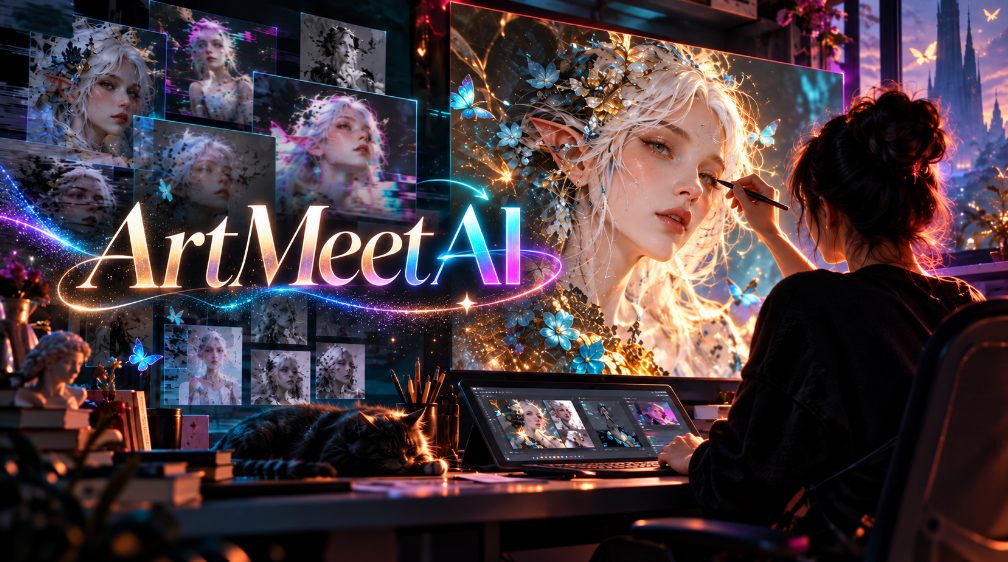
The next useful debate about AI art may be less about replacement and more about who makes the final decisions.
AI can produce a striking image before a human has finished describing what they wanted. That is its superpower and its problem. Speed can make a draft look like a conclusion. ARTmeetAI takes the opposite position: generation can begin the visual conversation, but a skilled human artist can still take responsibility for the choices that make the final image coherent, usable and deliberately made.
Polish can arrive before intention
A pencil sketch announces that it is unfinished. A generated image does not. It can arrive with cinematic light, detailed fabric and a beautiful face even when the underlying composition is still confused. That creates a new creative problem: the work looks expensive before anyone has decided whether all of its decisions belong together.
The viewer notices this as a vague unease. Every part is impressive, yet the whole thing feels unowned. The eye has nowhere obvious to rest. Materials behave differently from one region to the next. Details are abundant, but they do not form a hierarchy.
Someone still has to say no
Finishing is largely a process of refusal. No, that background element is unnecessary. No, the brightest light should not be behind the least important object. No, the hand does not need another ring. No, the generated hair should not merge into the shoulder just because the first version did.
A human artist can make those refusals without discarding the entire image. That is the distinction ARTmeetAI is trying to make practical. The machine can visualize possibilities quickly. The artist can select, redraw, simplify and reinterpret them.
This changes the role of AI from author to accelerator. It can provide the first visual answer, sometimes an excellent one. But the final responsibility moves to a person who can explain why the image was changed and why the remaining choices deserve to stay.
Why clients and creators should care
That responsibility matters whenever the image leaves the experiment stage. A client does not care that the model had trouble with perspective. A campaign does not get extra credibility because a costume changed in every generation. A game asset cannot have jewelry migrate around the character from scene to scene.
Production requires continuity. Human refinement can turn an attractive isolated generation into something that belongs to a larger visual system.
The artist is not there to erase the AI
The goal is not to disguise the origin of the draft. In many cases the most interesting parts of a generated image are exactly the accidents a human might never have sketched first. The useful artist is the one who can recognize those accidents, keep the good ones and remove the noise around them.
That can mean delicate correction or substantial artistic manipulation. A face may be rebuilt. Lighting can be redirected. Shapes can be simplified. Materials can be made consistent. The final image may remain close to the source or move far away from it.
ARTmeetAI already has the human side
This is not being framed as a distant marketplace concept. Skilled graphic artists are available to work on submitted material. That gives the site a concrete purpose today: creators who have reached the limit of prompting can move the image into a human refinement stage instead of waiting for the model to guess correctly.
The final file has to survive questions
Imagine the image reaches a client review. Why is the brightest object in the corner? Why does the left sleeve have a different material from the right? Why is the character looking past the subject they are supposed to notice? “The model did that” explains the origin, but it does not solve the picture.
A finished visual needs someone who can answer with a decision: the corner was darkened to restore focus, the sleeve was repainted for continuity, the gaze was redirected because the scene demanded it. That difference is small in wording and huge in production. It turns output into authorship.
This is where human manipulation becomes a feature, not an apology
ARTmeetAI is strongest when the artist is allowed to move beyond cleanup. A generated image can be treated like a collage, a rough painting or a blockout. The human can push it somewhere the original prompt never reached. That is more interesting than pretending the machine simply needed one more attempt.
REALITY CHECK
ARTmeetAI does not eliminate the judgement required to make art. It deliberately reintroduces it. The platform’s useful function is the handoff between rapid visualization and manual artistic work, with the scope determined by what the image actually needs.
FAST FACTS
- Generation can be the beginning of the workflow rather than the final delivery.
- Artists can correct, redraw, simplify or substantially reinterpret submitted visuals.
- The service is relevant when consistency, production readiness or artistic intent matters more than obtaining another random variation.
- The final value comes from decisions, not from hiding which tools were used earlier.
AI can make the first version astonishingly fast. ARTmeetAI exists for the moment when speed has stopped helping and somebody needs to own the finish. The final image should look intentional because, at some point, it actually became intentional.






Comment