Artificial intelligence is rapidly changing the way organisations think about information, productivity and decision making. Education is no exception.
For school management teams, however, the conversation around artificial intelligence needs to move beyond the question of which AI tool to purchase or how quickly a school can introduce generative AI into classrooms.
The more important question is how artificial intelligence can contribute to the functioning of the institution as a whole.
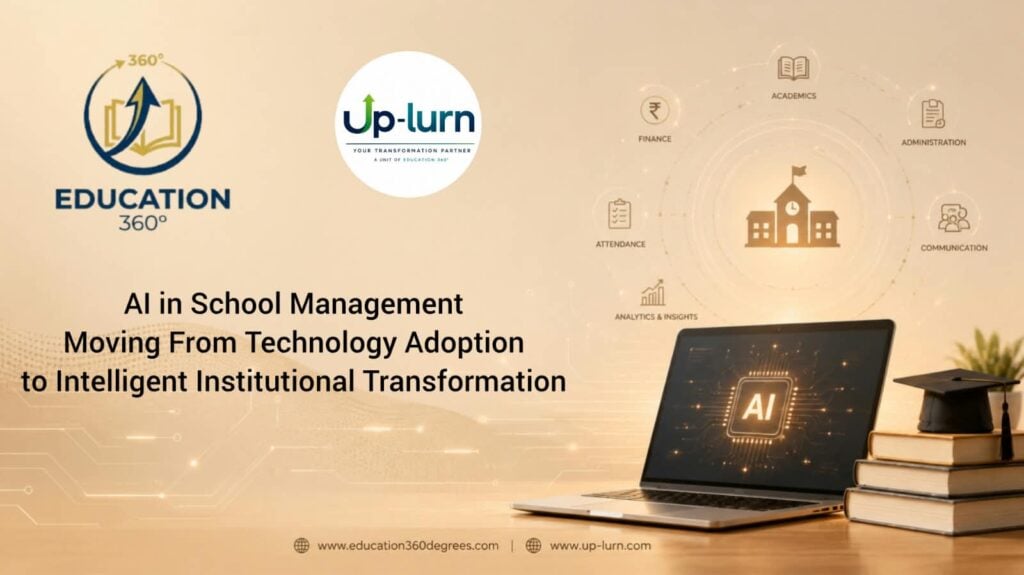
For school promoters, trustees, CEOs and senior leadership teams, AI has the potential to support academic processes, administration, communication, information management and management decision making. Yet meaningful adoption requires considerably more than technology procurement. It requires institutional strategy, appropriate systems, staff capability, responsible use and clear governance.
This is the context in which Education 360° and UP Lurn are developing a broader approach to technology and AI in education, placing digital transformation within the larger requirements of institutional development.
AI in School Management Is Bigger Than the Classroom
Much of the public discussion around artificial intelligence in education focuses on students and teachers.
That is only one part of the opportunity.
A school is a complex organisation generating information across admissions, academics, attendance, human resources, finance, operations, communication, compliance and governance.
Management teams need to interpret this information regularly.
AI can potentially assist institutions in organising information, identifying patterns, supporting routine workflows and strengthening decision support.
For example, AI enabled systems can contribute to administrative efficiency by assisting with repetitive documentation and communication. Within academics, appropriately governed AI applications can support teachers with lesson planning, content development, assessment design and differentiated learning.
At the management level, technology can help leadership teams move towards more structured interpretation of institutional information.
The value therefore lies not simply in introducing AI.
It lies in identifying where AI can solve a genuine institutional requirement.
Why Schools Need an AI Strategy
Technology adoption without institutional strategy can create complexity rather than efficiency.
Schools already operate multiple digital platforms, including ERP systems, learning management systems, communication applications and other technology enabled services.
Adding AI to this environment without considering the existing digital architecture can create fragmented systems and inconsistent practices.
An effective artificial intelligence strategy for school management therefore begins with institutional requirements.
What problems is the school trying to solve?
Which processes consume significant administrative time?
Where does management lack visibility?
Which academic activities could benefit from responsible AI support?
What information is being generated by existing systems?
How should data be protected?
What decisions should remain firmly under human supervision?
These questions establish a more meaningful starting point for AI transformation.
Education 360° approaches technology and AI through this institutional lens, recognising that digital systems need to align with an institution’s vision, operational goals and long term digital strategy.
Technology and AI With Purpose
The greatest value from artificial intelligence does not necessarily come from adopting the largest number of tools.
It comes from selecting appropriate solutions for specific institutional requirements.
Education 360° helps institutions evaluate and implement ERP platforms, digital systems and AI solutions according to their individual needs. Its approach seeks to integrate technology across academics, administration and governance while promoting responsible AI practices, effective data governance and alignment with applicable regulatory and data protection standards.
This is particularly relevant for school management.
Technology should support the institution rather than dictate how the institution operates.
A school should not restructure its educational philosophy simply because a particular technology is available.
Instead, technology should be evaluated against the school’s academic objectives, operational requirements and strategic direction.
AI and Academic Leadership
The introduction of artificial intelligence also changes the responsibilities of educational leaders.
Teachers may use AI for planning, content development and assessment support. Academic leaders may need to establish appropriate practices around its use. Principals and management teams may need to understand how AI is affecting teaching, learning and professional development.
This creates a requirement for institutional capability.
Professional development cannot focus only on demonstrating individual AI tools. Educators need to understand appropriate use, limitations, responsible practice and the relationship between technology and pedagogy.
The fundamental educational role of the teacher remains important.
AI can assist.
It does not replace professional judgement, relationships, mentorship or the human dimensions of education.
For school leadership, this distinction is essential.
AI for Administrative Efficiency
School administration involves numerous repetitive activities.
Documentation, communication, information organisation and routine workflows can consume significant time across departments.
AI can potentially assist with selected administrative functions when integrated appropriately with institutional systems.
The objective should not simply be to automate as much as possible.
The objective should be to allow people to spend more time on activities requiring judgement, interaction and professional expertise.
For management teams, this can create a different way of thinking about technology investment.
Instead of asking whether an AI platform is innovative, leadership can ask whether it improves efficiency, visibility, coordination or decision making.
That provides a more practical basis for evaluating digital transformation.
Data Governance Becomes More Important
The growing use of artificial intelligence also increases the importance of responsible data management.
Schools handle sensitive institutional information and information relating to students, families, employees and other stakeholders.
AI adoption therefore cannot be separated from data governance.
Management teams need clarity about what information is being used, how systems process it, who has access to it and what safeguards are required.
Education 360° specifically places emphasis on effective data governance, responsible AI practices and alignment with applicable regulatory and data protection standards.
This approach recognises that technological advancement and institutional responsibility must progress together.
The objective is not simply to make schools more digital.
It is to make them digitally capable and appropriately governed.
From Digital Tools to Management Intelligence
One of the most significant opportunities presented by AI is the possibility of improving management intelligence.
Schools generate large amounts of information, but information alone does not create insight.
Leadership teams need to understand what the information indicates and how it should influence decisions.
Integrated digital systems can potentially provide management with greater visibility across institutional functions.
AI and analytics may further support the interpretation of patterns and information.
This could help leadership teams ask better questions about enrolment, academic processes, operations, staffing and institutional performance.
The purpose, however, should remain clear.
More data should not result in more reporting for its own sake.
The objective is better information leading to better decisions.
Leadership Capability Is Central to AI Adoption
Technology transformation ultimately depends upon people.
A school may acquire sophisticated digital systems, but their effectiveness depends upon whether leadership and staff understand how to use them appropriately.
This makes leadership development an important component of AI adoption.
Principals, heads of department, coordinators and administrative leaders need sufficient digital awareness to evaluate technology, guide implementation and monitor its impact.
Education 360° places leadership development within its wider institutional consulting framework, alongside digital and AI transformation, academic excellence, governance and compliance, documentation and SOPs.
UP Lurn contributes to the broader education ecosystem around leadership, professional capabilities and education focused opportunities.
Together, the proposition reflects an important principle.
Technology adoption should strengthen institutional capability rather than create another layer of dependency.
AI Implementation Requires Institutional Ownership
A successful technology project should ultimately become part of the institution’s own operating capability.
This requires documented processes, trained teams, defined responsibilities and appropriate monitoring.
School management should understand why a system has been introduced and what outcomes it is expected to deliver.
Teachers should know how relevant tools fit into their professional responsibilities.
Administrative teams should understand new workflows.
Leadership should have sufficient visibility to evaluate performance.
Governance structures should provide appropriate oversight.
This institutional ownership approach aligns with the wider Education 360° philosophy of creating systems that educational institutions can understand, operate and sustain.
The Role of an Education Specific Technology Advisory Approach
Generic technology consulting can answer questions about software.
Education requires additional questions.
How will the technology interact with academic calendars?
How will teachers use it?
How will leadership monitor adoption?
What governance framework is required?
How will the technology interact with existing school systems?
What institutional capabilities need to be developed?
What should remain under human supervision?
These questions demonstrate why technology transformation in schools cannot be separated from educational understanding.
Education 360° approaches consulting specifically around educational institutions, incorporating academics, governance, leadership, operations, technology and institutional systems into a broader framework.
This creates a more connected approach to digital transformation.
Building the AI Ready School
The AI ready school will not necessarily be the institution with the greatest number of artificial intelligence applications.
It will be the institution that understands where technology creates genuine value.
Its leadership will have a clear digital strategy.
Its educators will possess appropriate capability.
Its systems will be integrated thoughtfully.
Its data will be governed responsibly.
Its technology will support academic and administrative objectives.
Its management will use information to make better decisions.
And its people will remain central to the educational process.
This is the broader direction in which Education 360° and UP Lurn are positioning their technology and AI proposition.
The objective is not technology for technology’s sake.
It is institutional advancement through purposeful technology.
For school promoters, trustees, CEOs and education leaders considering artificial intelligence in school management, the opportunity is therefore much larger than introducing another digital tool.
It is an opportunity to reconsider how the institution gathers information, supports its people, manages its processes and makes decisions.
Artificial intelligence may become one of the most important components of the next generation of educational institutions.
But its real value will depend on how intelligently institutions choose to use it.
Education 360° and UP Lurn
Institutional Transformation | Technology and AI | Academic Excellence | Leadership | Governance | Compliance | Digital Transformation | Capability Development
Connect with Education 360° and Up-Lurn
Official Websites:
Education 360°: Education 360°
UP-Lurn: UP-Lurn
Email: [email protected]
Email: [email protected]
WhatsApp: +91 95994 01443