
AI for Risk Prediction: How Businesses Spot Risk Before It Becomes a Loss

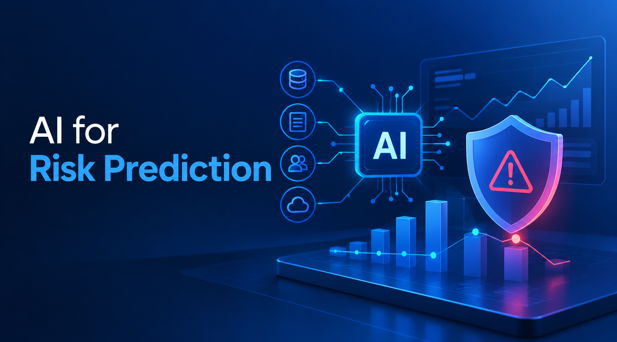
Most organizations still manage risk by looking backward. A loan defaults, a machine fails, a shipment stalls, or a patient deteriorates, and only then does the review begin. By that point, the cost has already landed. AI-powered risk prediction moves that moment earlier, turning historical and real-time data into early warnings that teams can act on.
For business leaders, the debate over adoption is largely settled. The questions that matter now are practical: which risks can AI predict reliably, what does it take to build models people trust, and where should human judgment still make the final call?
What AI Risk Prediction Actually Means
Traditional risk models rely on fixed rules and a handful of variables, reviewed on a quarterly or annual cycle. AI models learn patterns from far larger and more varied datasets, including transaction histories, sensor readings, clinical records, supplier data, and unstructured text such as emails or reports.
The output is usually a probability or a score: how likely a borrower is to default, a component is to fail, or a supplier is to miss a delivery. That score feeds into a workflow where it triggers an alert, a review, or an automated action.
How Risk Prediction Models Work
Most systems combine several techniques rather than relying on one:
- Classification models estimate the likelihood of a specific outcome, such as default or churn
- Time-series forecasting projects how a risk indicator will move over the coming days or weeks
- Anomaly detection flags behavior that departs from normal patterns, often before anyone knows what to look for
- Graph analytics maps relationships between entities to expose hidden exposure, such as linked accounts or shared suppliers
- NLP models pull risk signals from contracts, news, filings, and support tickets
The real strength comes from combining these signals, so a model sees a fuller picture than any single data source can provide.
Where Risk Prediction Delivers Value First
Financial services. Lenders use AI to assess creditworthiness with richer data, detect early signs of repayment stress in existing portfolios, and flag suspicious transactions as they happen.
Healthcare. Hospitals use predictive models to identify patients at risk of deterioration, readmission, or complications, giving care teams time to intervene sooner.
Manufacturing and operations. Predictive maintenance models read equipment sensor data to forecast failures, so repairs happen during planned downtime instead of in the middle of production.
Supply chain. AI tracks supplier performance, weather, logistics data, and geopolitical news to flag disruption risk before it reaches inventory.
Cybersecurity. Behavioral models spot unusual access patterns and lateral movement inside networks, surfacing threats that signature-based tools miss.
The common thread is that each use case involves high volumes of data, repeated decisions, and a clear cost when risk is caught late.
What Makes a Risk Model Trustworthy
An accurate model that nobody trusts rarely changes a decision. Four factors determine whether predictions get used.
Data quality. Incomplete, outdated, or siloed data produces confident but wrong predictions. Most of the work in a risk prediction project sits in building reliable data pipelines.
Explainability. A risk score needs a reason attached. Credit officers, clinicians, and auditors must see which factors drove a prediction. In regulated settings this is mandatory: the EU AI Act, for example, classifies AI used to evaluate the creditworthiness of individuals as high-risk.
Bias and fairness. Models trained on historical decisions can carry past inequities forward. Fairness testing needs to run continuously, not just at launch.
Drift monitoring. Risk patterns shift as markets, customer behavior, and threats evolve. A model that performed well last year can quietly degrade, so ongoing monitoring and retraining are essential.
Building all of this into one production system takes data engineering, machine learning, and integration with existing platforms. That is why many organizations work with a partner offering end-to-end AI development services to move risk models from proof of concept into reliable, governed production.
Where Human Judgment Still Matters
Risk prediction works best as decision support. People should stay in charge of:
- High-stakes decisions affecting individuals, such as loan rejections or treatment choices
- Novel situations the model has never seen in its training data
- Cases where a prediction conflicts with strong contextual knowledge
- Decisions with legal, ethical, or reputational consequences
The most effective setups route routine, low-risk cases through automation and send borderline or high-impact cases to experienced reviewers, supported by the model’s reasoning.
A Practical Starting Roadmap
- Pick one costly, recurring risk. Choose a problem with clear business impact and enough historical data to learn from.
- Audit your data first. Check availability, quality, and access before choosing a model.
- Build explainability in from day one. Every score should come with the factors behind it.
- Define the action for each prediction. A risk score without a workflow attached changes nothing.
- Monitor and retrain continuously. Treat the model as a living system rather than a one-time deliverable.
Closing the Skills Gap
Risk prediction sits at the intersection of data engineering, statistics, machine learning, and domain expertise. Few organizations have all of these skills in-house, and hiring specialists locally can take months.
A practical approach is to keep risk ownership and domain knowledge within the business and hire AI developers to fill specific technical gaps. Dedicated developers join existing teams and sprints, so knowledge stays inside the organization as capabilities grow.
Final Thoughts
AI risk prediction gives organizations something they have always wanted: time to act before a risk becomes a loss. The companies seeing results start with one well-defined problem, invest in data quality and explainability, and keep people in charge of the decisions that carry the most weight. Done that way, prediction becomes a lasting operational advantage.







Comment