Aesthetic and Sound Control: The Rise of Acoustical Clouds in Modern Interiors
What Are Acoustical Clouds and Panels?
Acoustical clouds and panels are overhead suspension systems designed to absorb sound waves and reduce reverberation times in open-plenum environments without requiring a wall-to-wall ceiling grid. These components function as high-performance sound absorbers that intercept noise before it reflects off hard structural surfaces.
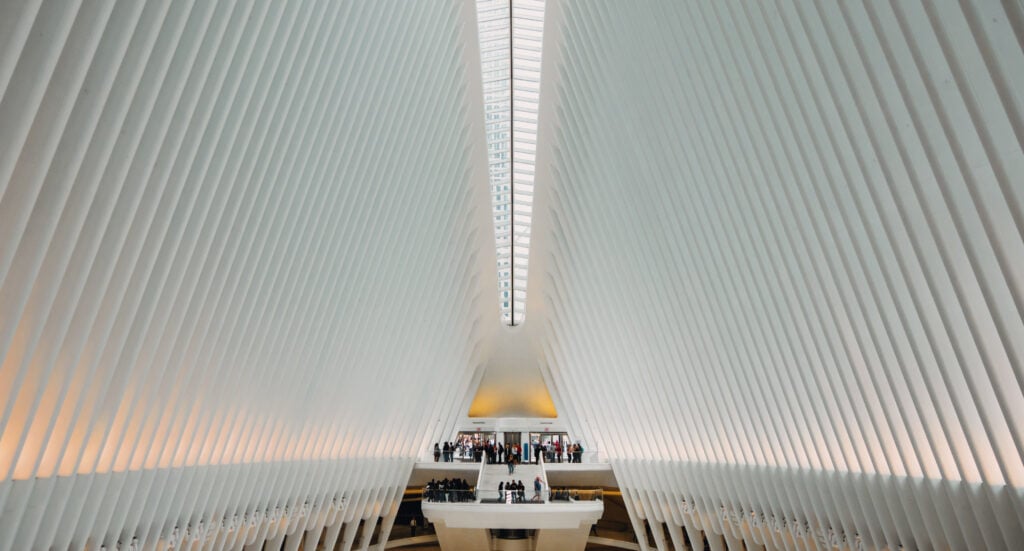
In modern commercial interiors, designers and contractors increasingly rely on acoustical clouds and panels to balance aesthetics and sound performance. In high-volume spaces like the Gastown tech lofts, the primary challenge is balancing the “industrial look” with speech intelligibility. When selecting acoustical clouds and panels, professionals focus on NRC ratings and material performance to achieve optimal sound absorption.
The Role of NRC and SAA in Sound Absorption
The Noise Reduction Coefficient (NRC) and Sound Absorption Average (SAA) are the primary metrics used to quantify how effectively an acoustical cloud or panel prevents sound energy from reflecting into a room. These values represent the arithmetic average of absorption coefficients at specific frequency ranges, typically from 250 Hz to 2500 Hz.
Engineering standards such as ASTM C423 dictate how we measure these values. In my experience, a cloud with a 1-inch fiberglass core provides significant high-frequency absorption, but for low-frequency “thrum” in mechanical rooms, I increase the thickness to 2 inches. This changes the flow resistivity of the material.
Seismic Requirements for Suspended Acoustical Elements
Seismic requirements for acoustical clouds involve the installation of lateral bracing, compression posts, and splay wires to prevent independent swinging and structural failure during a seismic event. Compliance with ASTM E580 and the BC Building Code ensures that suspended components do not collide with fire sprinklers or lighting.
During a recent project near the False Creek area, the seismic engineer required specific splay wire angles. We had to maintain a 45-degree angle for the four-way brace. If you ignore the “Zone 4” seismic requirements, the clouds become pendulums.
Seismic Installation Hardware Comparison
| Component | Standard Application | Seismic-Rated Application | Purpose |
| Suspension Wire | 12-gauge galvanized | 12-gauge with 3-tight wraps | Vertical load support |
| Lateral Bracing | None | Splay wires at 45° | Horizontal stability |
| Strut/Post | None | EMT or Compression Post | Prevents vertical uplift |
| Retainer Clips | Standard friction | Impact-rated locking clips | Secures the panel to the frame |
How to Install Seismic Bracing for Acoustical Clouds
Installing seismic bracing requires a 4-way splay wire configuration and a vertical compression post to lock the acoustical cloud into a rigid diaphragm. This assembly prevents both the lateral shifting and the upward “heave” caused by vertical seismic forces.
- Locate attachment points on the structural slab using heavy-duty anchors rated for cracked concrete.
- Attach 12-gauge splay wires at four points around the cloud, extending outward at a 45-degree angle.
- Install a compression post (often EMT conduit) in the center of the cloud to bridge the gap between the cloud frame and the deck.
- Secure the wires to the cloud frame with a minimum of three tight wraps within 1.5 inches.
- Check for 2-inch clearance around all non-structural elements like plumbing and HVAC ducts.
Performance Limitations and Installation Risks
Limitations of acoustical clouds include “sound flanking,” where noise travels over the top of the panels, and the risk of “shadowing,” which interferes with fire suppression coverage. Improper placement can lead to “dead spots” in a room or, conversely, areas where the cloud blocks the spray pattern of fire sprinklers.
Improper installation can lead to performance issues and code compliance risks in commercial projects. The NFPA 13 standards are rigid: if a cloud exceeds 4 feet in any dimension, it often requires integrated sprinkler heads or a specific percentage of “open area” in the material. Failing to account for this during the design phase leads to costly retrofitting.
People Also Ask (PAA)
- Do acoustical clouds work better than wall panels? Clouds are generally more effective per square foot because both the front and back surfaces are exposed to sound waves, increasing the total absorption area.
- What is the best material for acoustical clouds? High-density resin-hardened fiberglass is the industry standard for its high NRC rating and dimensional stability.
- How far apart should acoustical clouds be spaced? Spacing depends on the volume of the room, but a 20% to 30% coverage of the total ceiling area is usually the minimum for a noticeable reduction in decibel levels.
- Are acoustical clouds fire-rated? Most commercial clouds must carry a Class A fire rating according to ASTM E84 testing.
Final Technical Synthesis
Acoustical clouds represent a technical convergence of architectural aesthetics and rigorous physics, requiring precise NRC calculations and seismic engineering to ensure safety and performance. Successful implementation depends on following ASTM E580 standards and maintaining the mechanical integrity of the suspension system under lateral loads.