
What to Check Before Using Confidential Business Data in AI Research

Quick Answer
Before putting confidential business data into an AI research task, check five things: whether you are allowed to use it for this purpose, whether the task needs all of it, who will be able to see the inputs and outputs, how long both will be kept, and who reviews the result before it is shared. If you cannot answer one of these, reduce the data or pause the task.
AI research can draw on public information such as company websites, filings and news. It can also involve internal material. A team might paste in contract terms to compare suppliers, upload a pipeline export to research prospects, or attach board papers to prepare a briefing on a competitor.
That can make the research more useful. It also moves confidential data into new places, sometimes without the checks that would apply if the same documents were emailed to an outside adviser. This guide sets out five questions to answer before confidential business data enters an AI research task. It is practical guidance, not legal advice; your own policies and your legal or privacy colleagues should have the final word.
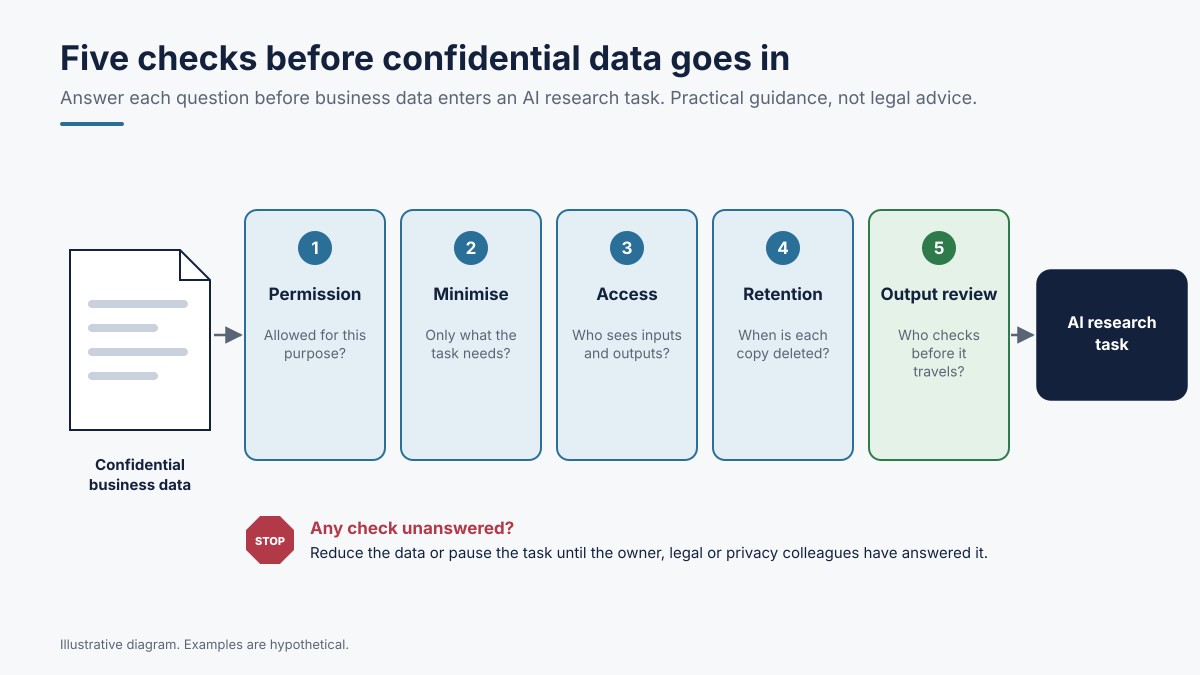
Five checks before confidential data enters an AI research task: permission to use it, minimum needed, who can see it, how long it is kept, and who reviews the output.
Why Does Confidential Data Need a Check First?
The risk is not only that a tool could be breached. Data can also end up somewhere it was never meant to go: a shared workspace, an output passed to a client, or a log kept longer than anyone expected.
The OWASP project's list of risks for large language model applications includes sensitive information disclosure, and names confidential business data among the information at risk alongside personal data and credentials. Its suggested mitigations include guiding users to avoid entering sensitive information and limiting access on a least-privilege basis. Both start with decisions made before any data is entered.
Check 1: Are You Allowed to Use It for This?
Start with permission, not technology. Ask whose data it is and what was agreed when you received it. Customer contracts, supplier agreements and non-disclosure agreements can limit how information is used or shared. Internal classification policies may also restrict certain documents to named people or approved systems.
If the data includes information about identifiable people, privacy or data protection laws may apply, depending on the jurisdiction and the circumstances. As one example, the UK regulator's guide to the data protection principles sets out principles such as purpose limitation, data minimisation and storage limitation. Check with your privacy team if you are unsure whether a planned use fits.
Check 2: Does the Task Need All of It?
Many research tasks need far less than the full document. Before uploading, ask what the question actually requires. Ways to reduce data include:
- Extracting only the relevant section instead of uploading a full contract
- Replacing names, prices or account details with placeholders
- Using ranges or totals instead of exact figures
- Removing personal details that are not relevant to the question
Reducing data lowers risk, but it does not automatically anonymise it. Removing names or adding placeholders can still leave people or companies identifiable through other details, such as a job title, a location, a deal size or a combination of facts. The material can also remain confidential. Treat reduced data as subject to the same permissions unless the data owner says otherwise.
For example, researching a supplier's public reputation does not require the price you pay them. The idea behind data minimisation, keeping data adequate, relevant and limited to what is necessary, is a sensible habit for confidential business information too.
Check 3: Who Can See the Inputs and the Outputs?
Look at access from both ends. On the input side, check who else can see the workspace, project or conversation where the data is entered. Shared folders and link sharing can widen access quietly.
On the output side, remember that results can inherit the sensitivity of their inputs. A summary of a confidential contract is confidential. Limit access to the people who need it, and review access when team members change roles.
Check 4: How Long Will It Be Kept, and Where Can It Go?
Data used in AI research can persist in several places: uploaded files, prompts, generated outputs, logs, exports and local copies on laptops. Each may have a different retention period, and some may have none set at all. Decide when each item should be deleted and who is responsible for deleting it.
Ask the provider of any tool, in writing and against its current terms:
- Can inputs or outputs be used for model training or service improvement?
- Which other services, integrations or connected apps can access the data?
- Are other companies involved in processing it?
- How are deletion requests handled, including copies and logs?
Check 5: Who Reviews the Output Before It Travels?
AI outputs can repeat details from their inputs in unexpected places. A research summary meant for a client could include a figure from an internal document, or a name that should have stayed private.
Name a reviewer for any output that leaves the team, and give them a short checklist: confidential figures, names, internal opinions and anything covered by an agreement. Label outputs that contain confidential material so they are handled accordingly.
A Pre-Flight Checklist
| Question | If the answer is no or unclear |
|---|---|
| Are we allowed to use this data for this purpose? | Stop and ask the data owner or legal team |
| Have we removed everything the task does not need? | Reduce the data before uploading |
| Do only the right people have access to inputs and outputs? | Fix permissions first |
| Do we know how long each copy is kept and where it can go? | Confirm terms in writing and set retention |
| Is a reviewer named for outputs that leave the team? | Assign one before sharing |
Making This a Team Habit
A checklist is easier to follow when it is short and built into routine. Map your data classes to the tools approved for each, provide templates with placeholders for common tasks, and name an approver for the most sensitive categories. OWASP also recommends training users on safe use, which can start with a short walkthrough of this checklist.
Reviewing the Output
Grep by Parcha Labs builds custom AI agents for high-stakes research whose findings link back to their sources. Linked sources can help the output review step, because a reviewer can see where each statement came from and spot anything that traces back to internal material. Whatever platform you consider, confirm its data-handling terms directly, and apply the five checks above.
Conclusion
Confidential data can make AI research more useful, but only if it is handled deliberately. Before anything is entered, confirm you are allowed to use it, cut it down to what the task needs, control who can see it, find out how long it is kept and where it can go, and name who reviews the output. Five questions now can help avoid a much harder conversation later.
Frequently Asked Questions
Can I put confidential documents into an AI research tool?
Only if your agreements and policies allow it, the tool is approved for that type of data, and you have removed what the task does not need.
What is data minimisation?
It is the principle of using only data that is adequate, relevant and limited to what is necessary for the purpose.
Does replacing names with placeholders anonymise data?
Not automatically. Other details can still identify people or companies, and the material may remain confidential, so the same permissions apply.
Who should approve the use of sensitive data?
The data owner, with input from legal, privacy or security colleagues for the most sensitive categories.
Are AI outputs confidential too?
Treat them as at least as sensitive as the inputs they were based on, and review them before they are shared.







Comment