
How Arborists Value a Tree: The Trunk Formula, Step by Step

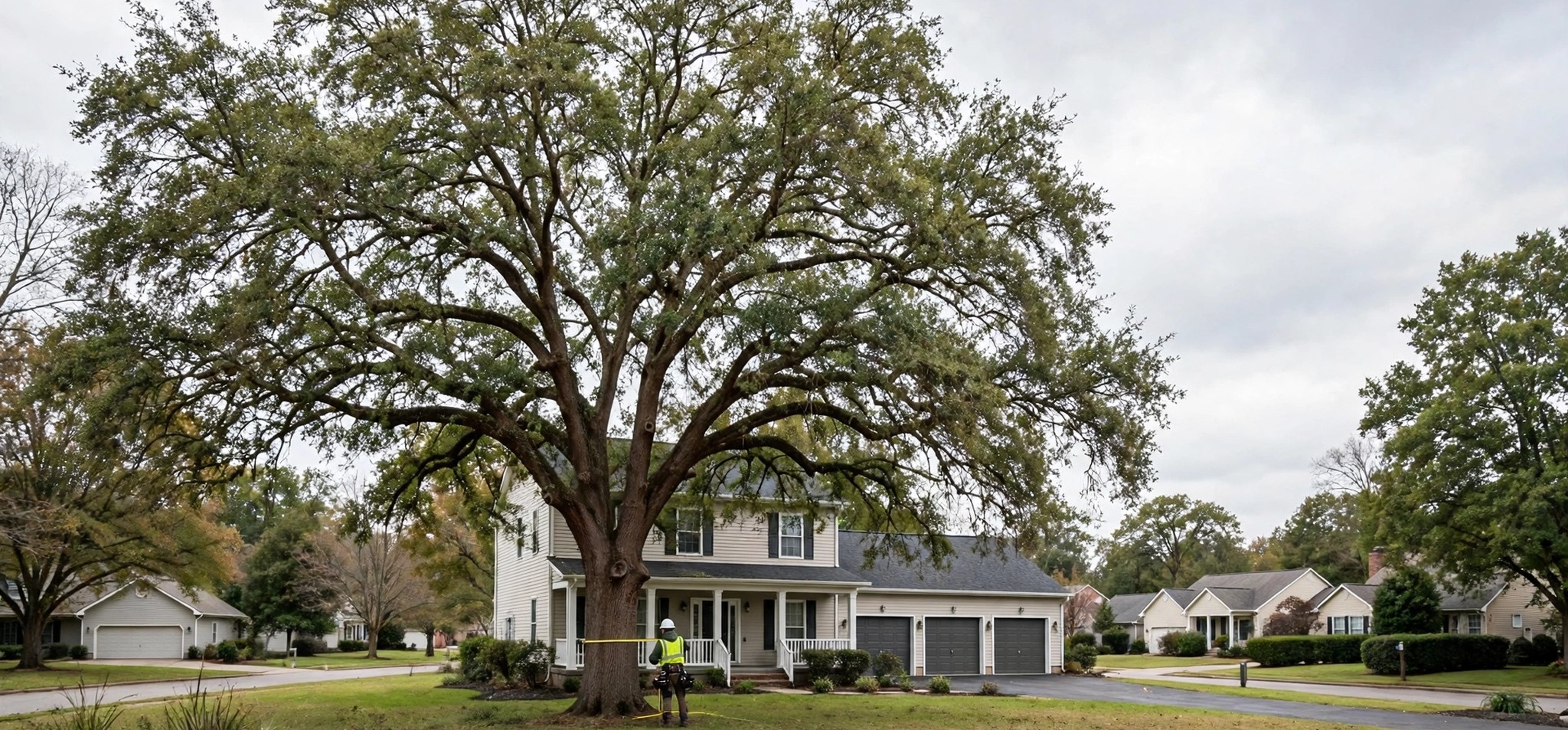
A storm drops a limb through your fence. A contractor damages the oak in your front yard. An insurance adjuster asks a simple question: What was the tree worth?
Trees aren't priced like furniture. Arborists use recognized appraisal methods from the Guide for Plant Appraisal. Small trees are usually valued at replacement cost. Larger trees are valued with the trunk formula, which turns trunk size into a baseline cost and then adjusts it for the tree's condition and its site. The final number depends on judgment calls, so a defensible report and early documentation matter as much as the math.
When does a tree need a formal valuation?
A formal appraisal puts a dollar figure on what a tree contributes to a property. One university extension guide to tree appraisal lists the common reasons: unexpected losses, tort claims, insurance claims, tax deductions, real estate assessments, and planning, especially when construction may affect trees on the site.
Scott Seargeant, an ISA Certified Arborist and member of the American Society of Consulting Arborists, works as a consulting arborist at Seargeant Landscape & Arboriculture, a firm in Visalia, California, that prepares tree assessments and valuation reports for insurance, real estate, and legal disputes. He says a valuation is only useful if it survives a challenge.
A tree appraisal is only worth the paper it's printed on if it holds up when someone pushes back. That means measuring the trunk properly, documenting the condition with photos and notes, and being able to explain every rating. Adjusters and attorneys pick at the same things: how the trunk was measured and why the condition isn't rated higher or lower. I write every report assuming it will be read by someone who wants a smaller number. And the best time to document a tree is before anything happens to it, not after.
How do arborists value a tree?
The Guide for Plant Appraisal, now in its 10th edition, describes three approaches: the cost approach, the income approach, and the sales comparison approach. For most landscape trees, arborists work within the cost approach.
How they do it depends on the size of the tree:
- Small trees: under about 4 caliper inches, or an 8-foot conifer, are valued at retail cost, meaning what it would cost to buy and plant a comparable tree.
- Larger trees: a tree too big to buy at a nursery is valued with the Trunk Formula Technique. It starts with the cost of the largest commonly available nursery tree and scales that cost up in proportion to the trunk size of the tree being appraised.
How does the trunk formula work, step by step?
The steps below follow the method that the guide describes:
- Measure the trunk. Use a diameter tape around the trunk at 4.5 feet above the ground. That's the diameter at breast height, or DBH.
- Find the cross-sectional area. Divide the diameter by 2 to get the radius, then multiply the radius by itself and by 3.14.
- Multiply by the unit tree cost. The unit cost comes from the local wholesale market or a regional plant appraisal committee. The result is the basic reproduction cost.
- Apply the three ratings. Multiply the basic cost by ratings for condition, functional limitations, and external limitations.
- Add any extra costs. If a tree has been lost, cleanup, installation, and post-planting care can be added.
- Round the result. The figure is rounded to a defensible number.
Here's the extension guide's worked example. A 14-inch tree has a cross-sectional area of 154 square inches. At a unit tree cost of $37.67, the basic cost is $5,801. The tree is in good condition (1.0), has a minor functional limitation (0.80), and no external limitation (1.0). Multiplying gives $4,640, which rounds to a $5,000 appraisal.
That unit cost came from a regional survey, and unit costs change by place and over time, so don't reuse the number. It's an illustration of the method, not a price list.
What do the three ratings measure?
The ratings are where the appraiser's judgment shows up:
- Condition covers the tree's health, structure, and form. The extension guide's table runs from excellent (1.0 to 0.90) and good (0.90 to 0.75) down through fair, poor, and very poor, with dead trees at 0.10 or less. Roots, trunk defects, branch attachments, crown density, and pest problems all feed in.
- Functional limitations come from the tree or its site. Overhead utility lines that force heavy pruning are one example. So are species traits such as weak branch structure or susceptibility to pests.
- External limitations are outside the owner's control. The guide cites water availability, pest threats, utility vegetation management, and local ordinances, easements, or rights-of-way that may affect how long a tree can stay.
Why do two appraisals of the same tree differ?
Because several inputs involve judgment. Two appraisers can reasonably differ on how they measure a trunk, especially a multi-stem one, how they rate condition, which unit cost they use, and which method fits the purpose of the report.
The result also has to be reasonable. The extension guide points out that studies estimate trees may account for up to 15 percent of a residential property's value, and that a formula can produce a number that makes no sense in context. Its example: a $15,000 value for a tree growing beside a $35,000 house is unrealistic, and no professional would stand behind it.
What makes a valuation defensible?
A report that holds up usually has these things in common:
- A qualified consulting arborist who can explain and defend the method.
- Documented measurements with photos, dates, and notes.
- A stated method and the sources for the unit cost and the ratings.
- Evidence of the tree's condition before any damage, such as earlier assessments, site records, photos, and witnesses.
- A written report that walks through each step so a reader can follow the math.
- Professional liability insurance. The extension guide says appraisers should carry it because valuations are sometimes disputed in court.
What can you do before anything happens to your trees?
The extension guide says the best time to conduct an appraisal is before any incident, though most happen afterward. You can make a later appraisal easier now:
- Take dated photos of your significant trees from several angles.
- Measure the trunk diameter at 4.5 feet and write it down.
- Keep records of pruning, treatments, and any professional assessments.
- Consider a baseline assessment for high-value trees, especially before nearby construction.
If a tree is lost without that paperwork, an appraiser can still work backward using site records, previous assessments, witnesses, and comparison samples to estimate its condition before the damage.
How do you choose an appraiser?
Look for credentials you can verify. ISA lets you find and verify credentialed arborists through its public directory. Then look at how the professional shows up online. Editorial HQ, a link-building agency that works with local home services companies, suggests checking whether credentials can be verified in a public directory and whether the website shows real examples of past work.
Then ask these questions:
- Which appraisal method will you use, and why?
- Where will the unit cost and the ratings come from?
- How will you measure the trunk, especially if it has several stems?
- Have you prepared appraisals for insurance claims or legal disputes?
- Will the report include photos, calculations, and your reasoning?
Frequently asked questions
How much is a tree worth?
It depends on trunk size, condition, site, and the local unit cost. In the extension guide's example, a healthy 14-inch tree with a minor limitation comes out around $5,000. Larger, higher-quality trees can be worth more, and unhealthy ones much less.
Can I calculate my tree's value myself?
You can estimate a basic cost, but that isn't the same as the tree's value. The extension guide notes that the ratings require professional judgment, and recommends a qualified consulting arborist for an accurate figure.
What if the tree is already gone?
An appraiser can still estimate its value before the loss. Previous site records, assessments, photos, witnesses, and comparison samples all help establish what condition it was in.
Does a mature tree add to my property's value?
Often, yes. Studies estimate that trees may account for up to 15 percent of a residential property's value, though the real figure depends on the tree's condition, species, and where it stands.
Final Thoughts
A tree's value isn't a guess, and it isn't a single formula either. It's a method applied with judgment: measure the trunk, price the replacement, and adjust for condition and site.
The strongest valuations are the ones documented before there's a dispute. Take photos, record the measurements, and when a number really matters, bring in a consulting arborist who can show their work.







Comment