
Managing Human, Machine and AI Agent Identities With Modern PAM

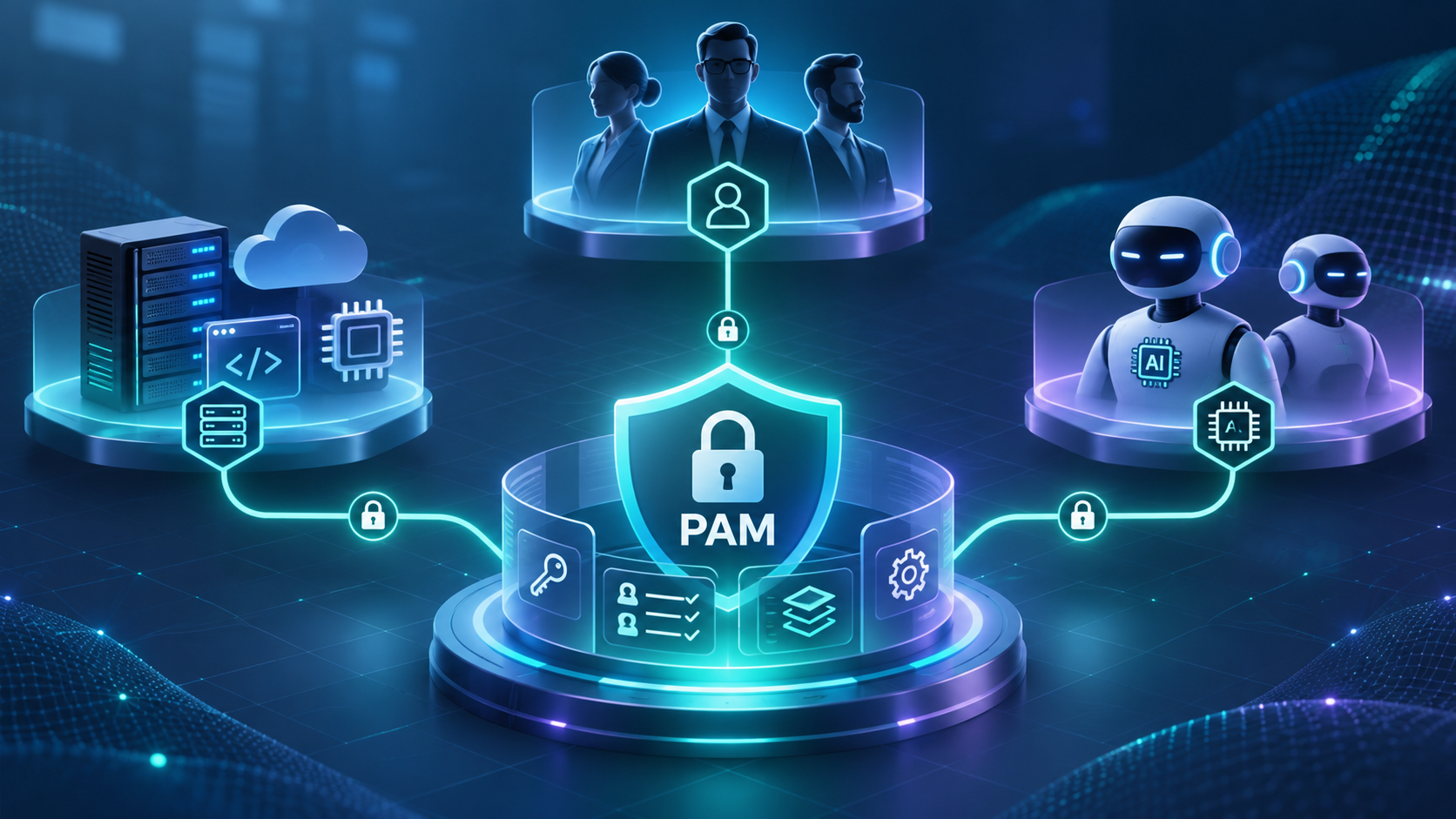
PAM, or privileged access management, is how organizations control and monitor the identities that can do the most damage: the ones that can change system settings, reach sensitive data, or create and delete other users.
For most of PAM’s history, that meant a small group of human administrators holding the keys to critical systems. Today, machine identities like service accounts and CI/CD pipelines now far outnumber human admins, and AI agents are joining them, often with broad permissions and little oversight.
Securing privileged access across human, machine, and agentic identities is now one of the core challenges for security teams, and modern PAM is built for this problem. It applies one principle to every privileged identity. Whether human, machine, or AI agent, each is granted only the access it needs, and only when that access is needed.
Managing Privileged Access for Human Identities
IT administrators, developers, contractors, all need elevated privileges to do their jobs. Granting that access is easy, but managing it over time is tedious work, especially in large environments.
Roles change all the time, new projects keep adding access to the same accounts, and nothing ever takes it away. A temporary access change set for a contractor can live on for months after the project ends, quietly widening the attack surface. In cybersecurity terms, that’s called standing privilege. It can lead to scenarios where a seemingly meaningless account, like an old contractor login, gives an attacker a direct path to critical systems.
Modern PAM addresses this through just-in-time (JIT) privilege elevation. Instead of holding standing admin rights, users request elevated access for specific tasks. The platform grants access to the specific resources involved and nothing else. When the task ends or the authorized access period expires, the permissions are removed automatically. No one has to remember to revoke them.
Contextual, policy-driven rules can be set to decide how each request is handled. Routine, low-risk requests can be authorized automatically, so engineers are not left waiting for days. More sensitive operations trigger additional human review before granting access.
Securing Machine Identities in Automated Environments
Nowadays, non-human identities (NHIs) such as service accounts, pipelines, scripts, and cloud workloads need privileged access too. They use it to interact with other systems and run automated tasks.
These identities can be a challenge to manage simply because there are so many of them. Cloud-native applications, containers, and automated deployment pipelines create new identities constantly. Most of them operate without direct human involvement.
That creates real security risk. Long-lived API keys can stay valid for years. Credentials get hardcoded into scripts and repositories. Service accounts collect more permissions than their job requires. Secrets end up scattered across environments, which makes them difficult to inventory and rotate. Any one of these can give an attacker a way in.
Modern PAM changes how machine access works. It continuously discovers machine identities so teams can see what exists. It then applies centralized access policies instead of leaving each team to decide on its own. It provides privileges automatically, with short-lived credentials that expire on their own. Permanent permissions become a thing of the past.
Two additional techniques are worth mentioning. FIrst, workload identity federation lets a workload prove who it is through a trusted identity provider, so it does not need a stored secret. Secretless authentication keeps static credentials out of the workload entirely. Paired with policy-driven, just-in-time access, a workload gets only the permissions a specific operation requires, and only for as long as that operation runs.
Controlling Privileged Access for Autonomous AI Agents
The newest and fastest growing identity type is the autonomous AI agent. According to KPMG’s Q3 2026 AI Pulse Survey, 62% of large U.S. organizations are now building, deploying, or developing AI agents. That is a significant leap from 53% the previous quarter. The share working on multi-agent systems jumped to 25%, up from 6% in each of the two quarters before.
When it comes to PAM, AI agents differ from traditional machine identities in one important way. They can select their own tools, plan multi-step workflows, and take action without any human involvement. That autonomy is what makes them risky. Yes, the productivity benefits are great, but security guardrails, especially around access, must exist.
A few things can go wrong without them. If the agent’s credentials are stolen or misused, an attacker will get the same access the agent has. And because agents act on what they read, prompt injection or manipulated external information can steer them into dangerous actions, including leaking sensitive data.
Modern PAM addresses these challenges by treating agents as governed identities. Every agent is assigned its own identity and an accountable human owner. Privileges are tied to the agent’s authorized task and expire quickly, so stolen credentials don’t hold much value.
Runtime checks verify each action against policy before it runs, which limits what a manipulated agent can actually do. High-risk operations, like data deletion or configuration changes, can require human approval first. The agent still moves fast on routine work, but it is blocked from acting beyond its authorized scope.
Conclusion
Privileged access used to be about people. Now it is about workloads and AI agents too. Modern PAM handles all three the same way. It grants access when it is needed, keeps it tied to the task, and takes it away when the work is done.







Comment